TABLE OF CONTENTS
How to Make a Grindstone in Minecraft: Recipe & Uses
You're probably here because you're drowning in enchanted junk gear and don't want to waste experience levels on an anvil that keeps getting more expensive. The grindstone solves that problem — it strips enchantments, repairs tools, and resets your anvil penalty, all without costing a single XP level to craft. Understanding exactly how it works (and where players go wrong) will save you resources and frustration across your entire playthrough.
Crafting the Grindstone in Minecraft
Three simple ingredients, but one of them trips up almost every new player.
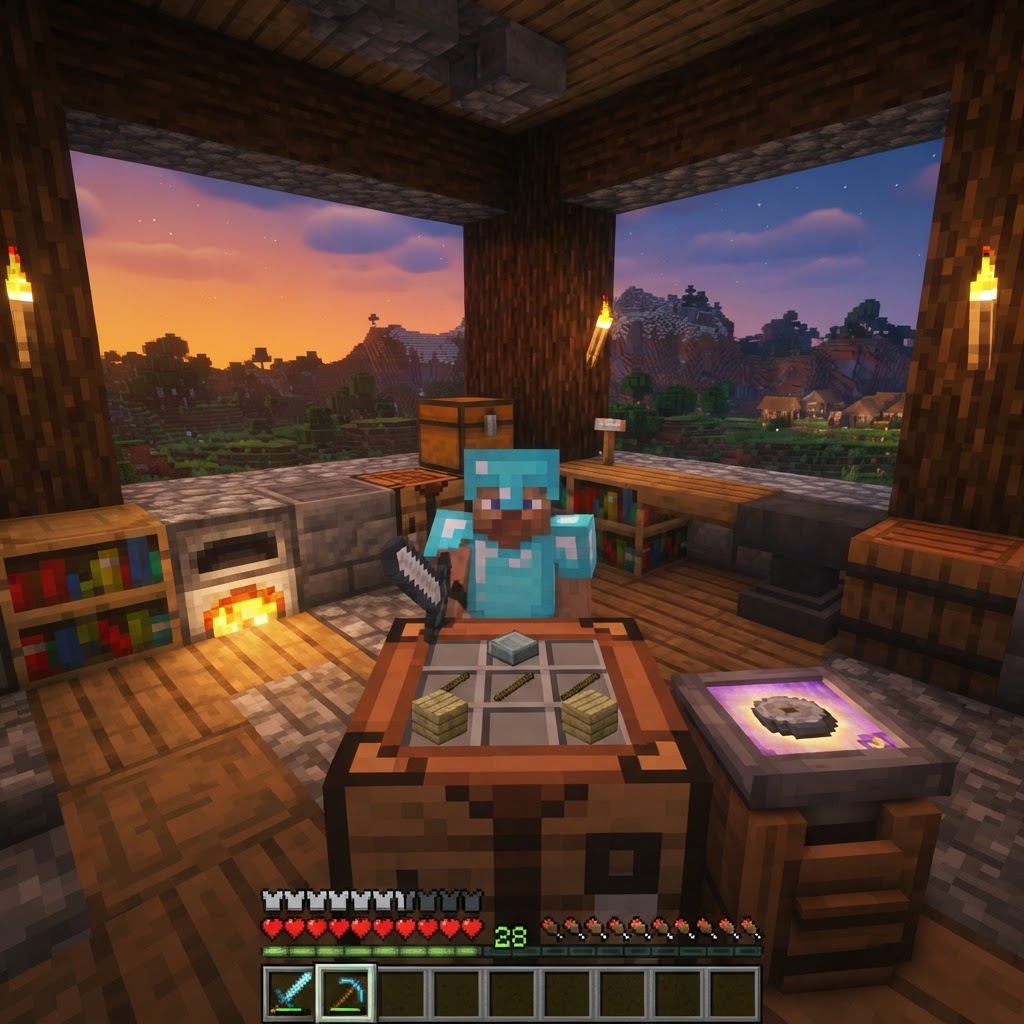
The grindstone recipe requires exactly three material types placed in a specific pattern on a crafting table. Here's the full breakdown:
Required Materials:
- 2 Sticks
- 2 Wood Planks (any type — oak, spruce, birch, jungle, acacia, dark oak, mangrove, bamboo, cherry)
- 1 Stone Slab (NOT cobblestone slab — regular stone)
Crafting Grid Layout (3x3):
- Place a Stick in the top-left slot
- Place the Stone Slab in the top-center slot
- Place a Stick in the top-right slot
- Place a Wood Plank in the middle-left slot
- Leave the middle-center slot empty
- Place a Wood Plank in the middle-right slot
- Leave the entire bottom row empty
- Mine cobblestone
- Smelt cobblestone in a furnace to get smooth stone — wait, actually smelt it to get stone
- Place 3 stone blocks in a row on a crafting table to produce 6 stone slabs
- Alternatively, use a stonecutter with stone blocks for a 1:2 ratio
- It does not rename items (use an anvil for that)
- It does not combine enchantments from two items
- It does not repair items using materials (anvil only)
- It does not reset item names applied via anvil
To get your Stone Slab correctly:
The wood plank type does not affect the grindstone's function at all — use whatever you have on hand.
What the Grindstone Actually Does
It's not just a repair tool — it's an XP generator and enchantment recycler.
Most players treat the grindstone as a basic repair block, but it has three distinct functions that make it genuinely powerful:
Function 1: Disenchanting Items
Place any enchanted item in either input slot and the grindstone will strip all enchantments from it, returning some experience points to you. The XP returned scales with the enchantment's level and value — high-level enchantments give back more XP than low-level ones.
Function 2: Repairing Two Items
Place the same type of damaged tool or weapon in both input slots and the grindstone combines their durability. The output item gains the combined durability of both inputs, plus a small 5% bonus durability on top.
Function 3: Combined Repair + Disenchant
If you put two enchanted items of the same type into both slots, it repairs them AND strips all enchantments simultaneously, returning XP for the removed enchantments.
What the Grindstone Does NOT Do:
Finding a Grindstone Without Crafting
Villages generate grindstones naturally — know where to look.
If you're in early survival and short on stone, you can find a naturally generated grindstone in any Village Weaponsmith building. The weaponsmith's workspace always includes a grindstone as part of the structure. Simply locate a village, find the building with the grindstone (it looks like a weapon shop with an anvil and weapon racks nearby), and either use it in place or break it with any pickaxe to collect it.
Villages spawn in most biomes including plains, savannas, deserts, snowy plains, and taiga. If you're playing on a seed with a nearby village spawn, this is often faster than crafting, especially before you have a furnace set up.
Grindstone vs Anvil vs Enchanting Table
Choosing the wrong tool for the job costs you levels, materials, and time.
These three blocks overlap in purpose but serve very different roles. Here's exactly when to use each:
| Situation | Best Tool | Why |
|---|---|---|
| Strip bad enchantments from gear | Grindstone | Free, returns XP |
| Combine two enchanted items | Anvil | Only option for merging enchants |
| Repair using raw materials | Anvil | Grindstone can't use materials |
| Apply enchanted books | Anvil | Grindstone doesn't accept books for application |
| Repair two identical tools | Grindstone | No XP cost, gives bonus durability |
| Rename an item | Anvil | Grindstone has no rename function |
|---|---|---|
| Get new enchantments | Enchanting Table | Neither grindstone nor anvil generates enchants |
| Reset prior work penalty | Grindstone | Removes the anvil cost escalation |
The Prior Work Penalty Explained:
Every time you use an anvil on an item, its "prior work" penalty increases, doubling the XP cost each time. After enough uses, the anvil will display "Too Expensive" and refuse to work on the item entirely. The grindstone resets this by stripping the item back to base — but this also removes all enchantments, so plan before you strip valuable gear.
| Tool | XP Cost to Use | Removes Curse of Vanishing | Combines Enchants | Repairs with Materials |
|---|---|---|---|---|
| Grindstone | None | No | No | No |
| Anvil | Yes (scales up) | No | Yes | Yes |
| Enchanting Table | Yes (fixed) | No | No | No (adds only) |
Common Mistakes Players Make With the Grindstone
These errors waste experience, destroy valuable gear, and confuse new players constantly.
Mistake 1: Stripping a "God Sword" to repair durability
A grindstone will happily wipe every enchantment off your Sharpness V, Looting III, Unbreaking III sword just to patch up its durability. Always use an anvil with the matching material (diamonds, netherite, etc.) to repair valuable enchanted gear — never the grindstone.
Mistake 2: Expecting it to work without a pickaxe
Dozens of players break village grindstones by punching them. Nothing drops. The block is gone. Use a pickaxe.
Mistake 3: Using cobblestone slabs in the recipe
Covered above, but worth repeating: cobblestone slabs do not work. The recipe requires regular stone slabs. Smelt your cobblestone first.
Mistake 4: Thinking it removes all penalties
The grindstone removes the prior work penalty AND the enchantments. It does not repair the item's durability unless you put two of the same item in both slots. A single enchanted item placed in one slot gets disenchanted and returned at the same durability it went in with.
Mistake 5: Overlooking the XP returns
Players often use the grindstone purely for repair and ignore that stripping cheap enchantments off junk gear found in dungeons is an efficient way to bank XP before a big enchanting session. Sweep your storage for unwanted enchanted loot and run it through the grindstone regularly.
Pro Strategies for Advanced Players
Once you understand the basics, the grindstone becomes part of a larger efficiency system.
Strategy 1: The Enchant-Grind XP Farm
Set up an enchanting table with a full 15-bookshelf setup. Enchant cheap items (wooden swords, stone pickaxes) with your XP, then immediately grind them to recover partial XP. While this isn't a 1:1 return, it lets you "bank" XP into portable disenchantable items if you're about to do something risky in the Nether or near lava.
Strategy 2: Targeting Specific Enchants from Books
When you find an enchanted book with a curse attached (Curse of Binding is common on armor pieces found as treasure), remember that you can't remove the curse. Instead of wasting the item, make peace with discarding cursed armor early — the grindstone won't save you here.
Strategy 3: Weaponsmith Villager Interaction
The grindstone is the job site block for the Weaponsmith villager profession. If you want to create or reactivate a weaponsmith in your village trading hall, place a grindstone nearby an unemployed villager. Weaponsmiths sell enchanted swords and axes at later trade levels, making them one of the most valuable villager types for combat gear.
Strategy 4: Efficient Dungeon Loot Processing
When clearing dungeons, strongholds, or bastion remnants, you'll accumulate enormous amounts of enchanted armor with random, often useless enchantments. Don't hoard it — process it through your grindstone back at base. You'll reclaim significant XP over the course of a full dungeon run, which compounds into meaningful levels for your actual gear progression.
Strategy 5: Pre-Nether Gear Check
Before entering the Nether, use an anvil (not a grindstone) to repair your best gear using materials. Never grind your combat set right before a dangerous run — you'll lose the enchantments. Repair with materials to preserve every enchantment you've worked for.
Conclusion
The grindstone is one of Minecraft's most underutilized efficiency tools — now you know exactly how to use it.
To recap what matters: craft it with 2 sticks, 2 wood planks, and 1 stone slab (not cobblestone). Use it to strip bad enchantments and recover XP, repair identical tools without spending experience, and reset prior work penalties before they make your anvil useless. Never use it on gear you want to keep enchanted, always break it with a pickaxe, and leverage it as a weaponsmith job site block for your trading hall.
The grindstone isn't glamorous — but players who ignore it end up spending twice as many XP levels at the anvil and throwing away dungeon loot that could have been experience. Build one early, keep it near your enchanting setup, and let it do the unglamorous work that keeps your enchanting economy running efficiently.
RELATED ARTICLES
How to Make a Brewing Stand in Minecraft: Recipe & Uses
If you've hit a wall in Minecraft — mobs are one-shotting you, your armor feels useless, and the End seems impossible — a brewing stand is the tool that changes everything. Potions transform your surv...
How to Make Glass in Minecraft: A Complete Smelting Guide
Glass is one of those crafting staples that looks simple on the surface but hides a surprising number of ways to go wrong — and a lot of creative potential most players never tap. Whether you're build...
How to Get Blaze Rods in Minecraft: Find and Farm Blazes
Blaze rods are one of the most critical bottlenecks in Minecraft progression — without them, you can't brew potions, reach the End, or craft Eyes of Ender. Most players die repeatedly trying to get th...
STAY UPDATED
New blog posts, guides, and community tips delivered to your inbox.
No spam. Unsubscribe anytime.
Comments (0)
No comments yet. Be the first to share your thoughts!

