TABLE OF CONTENTS
How to Make Glass in Minecraft: A Complete Smelting Guide
Glass is one of those crafting staples that looks simple on the surface but hides a surprising number of ways to go wrong — and a lot of creative potential most players never tap. Whether you're building windows, brewing stands, beacons, or decorative structures, understanding the full glass-making pipeline will save you time, resources, and frustration.
How to Get Sand for Glass Smelting
The resource you need is everywhere — but not all of it works the same way.
Sand is the core ingredient for standard glass, and it's one of Minecraft's most abundant materials. You'll find it in:
- Beach biomes — Large flat deposits at water's edge, easy to mass-collect
- Desert biomes — The fastest source for bulk quantities
- Riverbanks — Scattered deposits along most river systems
- Ocean floors — Accessible with a boat or diving
Red Sand also smelt into glass, but it produces standard glass — not red-tinted glass. Many players assume red sand makes red stained glass. It does not. Both sand types yield the same clear glass output.
Efficient Sand Farming:
- Equip a shovel with Efficiency IV or V
- Locate a desert biome for maximum yield
- Use a Fortune-enchanted shovel — it does NOT increase sand drops (sand is a full block, not a drop), so skip Fortune here
- Bring multiple stacks of chests or a shulker box to manage inventory
The Smelting Process: Furnace vs. Blast Furnace
Choosing the right furnace cuts your production time in half.
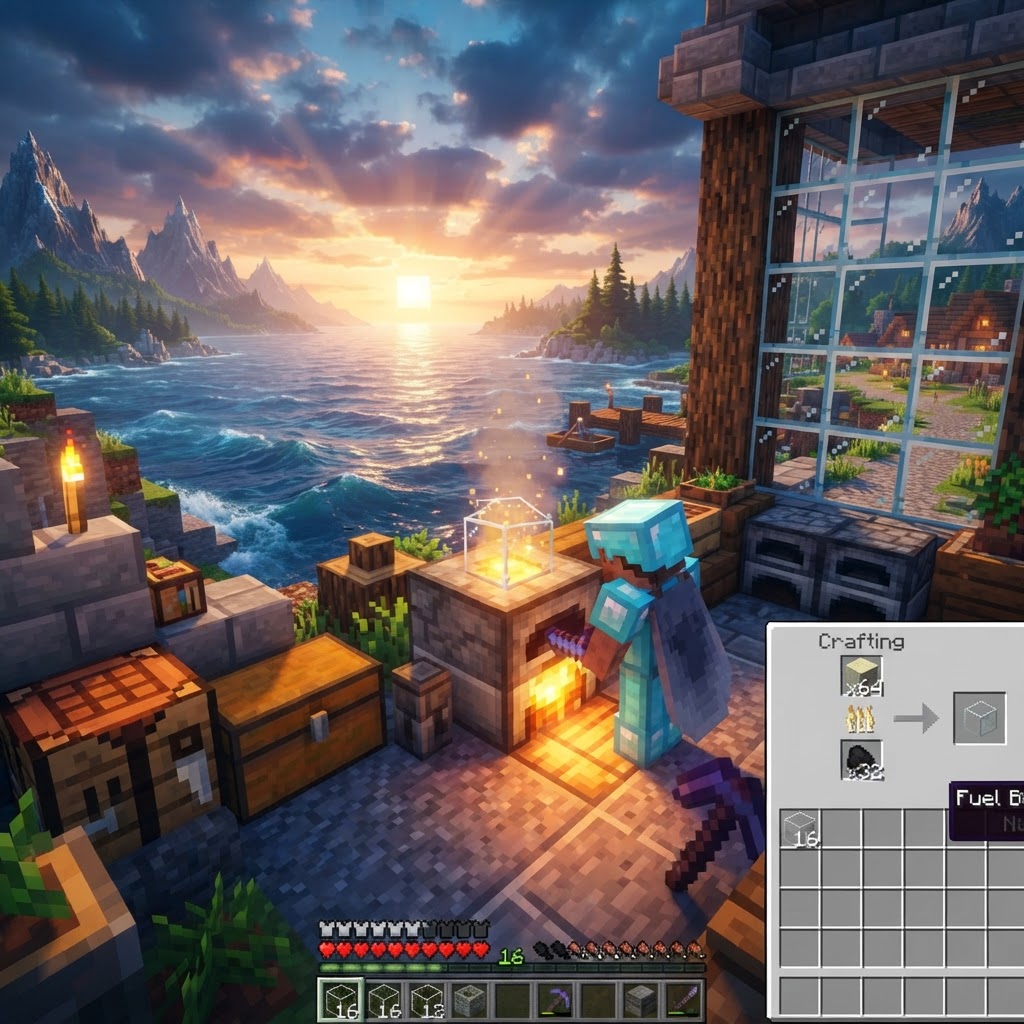
Smelting sand into glass requires any furnace-type block, but your choice of furnace significantly impacts speed.
| Furnace Type | Smelt Speed | Fuel Efficiency | Best For |
|---|---|---|---|
| Regular Furnace | 1 item / 10 sec | Standard | Small batches, early game |
| Blast Furnace | 1 item / 5 sec | Same fuel cost | Bulk glass production |
| Smoker | Cannot smelt sand | — | Food only |
| Campfire | Cannot smelt sand | — | Food only |
The Blast Furnace is your best friend for mass glass production. It smelts ore and sand-type materials at double speed for the same fuel cost, meaning you get twice the glass in the same time window. Craft one early if you're planning any large build.
Step-by-Step Smelting:
- Open your furnace or blast furnace
- Place sand (or red sand) in the top input slot
- Place fuel in the bottom fuel slot
- Wait for the progress arrow to complete — each sand block yields exactly one glass block
- Collect glass from the output slot
Fuel Efficiency Comparison:
| Fuel Type | Items Smelted Per Unit | Notes |
|---|---|---|
| Wood Log | 1.5 | Inefficient — avoid for bulk |
| Coal / Charcoal | 8 | Standard reliable fuel |
| Coal Block | 80 | Best for large sessions |
| Lava Bucket | 100 | Best single-use fuel item |
| Bamboo | 0.25 | Extremely poor — avoid |
| Dried Kelp Block | 20 | Excellent renewable option |
|---|
Glass Variants: Stained Glass, Panes, and Beyond
Clear glass is just the beginning — here's every variant and how to craft each one.
Once you have glass blocks, the crafting options expand significantly.
Stained Glass:
Combine 8 glass blocks around any dye in a crafting table. This yields 8 stained glass blocks. Every dye color works, giving you 16 color options. Stained glass transmits colored light in Java Edition but does NOT in Bedrock Edition — a key difference for redstone and aesthetic builds.
Glass Panes:
Place 6 glass blocks in a 3x2 crafting grid (two rows of three). This yields 16 glass panes. Panes are more material-efficient for windows — 6 blocks become 16 panes, covering far more surface area than 6 individual blocks would.
Stained Glass Panes:
Same recipe as regular panes, but use stained glass blocks instead. You cannot dye panes directly — you must dye the blocks first, then craft into panes.
Tinted Glass (1.17+):
Craft 4 amethyst shards around 1 glass block to produce 2 tinted glass blocks. Tinted glass blocks light entirely while remaining visually transparent — this is unique and extremely useful for mob farms where you want to see inside without spawning conditions being met.
Common Mistakes Players Make with Glass
These errors waste resources, break builds, and frustrate players at every level.
1. Breaking Glass Without Silk Touch
Glass blocks and panes do NOT drop themselves when broken with a regular tool or by hand. They shatter and are lost entirely. Always use a Silk Touch-enchanted tool when mining placed glass you want to recover. This is the single most expensive mistake in glass-heavy builds.
2. Assuming Red Sand Makes Red Glass
As mentioned earlier, red sand produces the same clear glass as regular sand. If you want colored glass, you must craft stained glass using dye.
3. Using a Regular Furnace for Bulk Production
Running 500 sand through a regular furnace instead of a blast furnace wastes roughly 40+ minutes of real time. The blast furnace recipe is easy (3 iron ingots, 1 furnace, 3 smooth stone) and pays for itself immediately.
4. Crafting Glass Blocks When You Need Panes
Six glass blocks craft into 16 panes. If you place 6 individual blocks as a window instead of converting to panes, you've used 10 more glass than necessary. For large window builds, this adds up to hundreds of wasted blocks.
5. Forgetting Stained Glass Pane Conversion Order
You cannot dye panes. Players frequently craft panes first, then try to dye them and wonder why it doesn't work. Always: sand → glass → stained glass (with dye) → panes.
6. Ignoring Tinted Glass for Mob Farms
Many players build elaborate mob farm lighting systems when tinted glass solves the visibility-vs-darkness problem elegantly. If you're on 1.17+, tinted glass is a game-changer for farm design.
Pro Strategies for Efficient Glass Production
If you're building at scale, these techniques separate efficient players from everyone else.
Automate Your Smelting with Hoppers
A basic auto-smelter uses three hoppers: one feeding sand into the furnace top, one feeding fuel into the furnace bottom, and one pulling finished glass out into a chest. This setup runs continuously without manual intervention. Scale up with multiple furnaces in parallel for industrial output.
Run Multiple Blast Furnaces in Parallel
A single blast furnace processing a double chest of sand takes about 27 minutes. Run four blast furnaces simultaneously and cut that to under 7 minutes. The setup cost (12 iron ingots, 4 furnaces, 12 smooth stone) is trivial by mid-game.
Charcoal Over Coal for Renewable Builds
If you're running a tree farm, charcoal is a completely renewable fuel source that matches coal's efficiency exactly (8 items per unit). Combine a wood farm with an auto-smelter and you have a self-sustaining glass factory.
Use Glass Strategically in Beacon Structures
Beacons require an unobstructed sky view, but glass blocks do NOT block the beam — you can encase a beacon in glass for aesthetic and protective purposes without breaking beacon functionality.
Silk Touch Pickaxe is Non-Negotiable at Scale
Once you're placing glass in significant quantities, keep a Silk Touch pickaxe in your hotbar at all times. Misclicks happen. The cost of re-smelting 20 glass blocks because you broke them accidentally is frustrating and avoidable.
Pre-Plan Color Quantities
Before starting a stained glass build, calculate exactly how many blocks of each color you need. Dye can be expensive depending on your biome access (blue requires lapis, brown requires cocoa beans, etc.). Run your numbers before smelting a hundred glass blocks you then dye the wrong color.
Java vs. Bedrock: Key Glass Differences
The platform you play on changes how glass actually behaves.
| Feature | Java Edition | Bedrock Edition |
|---|---|---|
| Colored light transmission | ✅ Yes | ❌ No |
| Glass pane connectivity | Connects to most blocks | Slightly different hitbox behavior |
| Tinted glass availability | 1.17+ | 1.17+ |
| Glass in recipes | Same | Same |
The colored light difference is significant for decorative and atmospheric builds. Java players can create colored light shafts through stained glass; Bedrock players cannot. If you're building a cathedral or mood-lit room on Bedrock, you'll need alternative lighting strategies.
Conclusion
Glass production in Minecraft rewards players who understand the full system. The core loop is straightforward — smelt sand, craft variants, place strategically — but the difference between a player who knows these details and one who doesn't is hundreds of wasted blocks, broken panes, and missed efficiency gains.
Key takeaways:
- Use a blast furnace for all bulk glass production
- Silk Touch is essential before you place glass in any serious build
- Convert blocks to panes whenever you're filling window space
- Dye before crafting panes, never after
- Tinted glass solves mob farm visibility problems cleanly
- Know your platform differences if colored light matters to your build
Glass is cheap to produce and powerful in application. Get the process right once, and you'll never think twice about it again.
RELATED ARTICLES
How to Make a Brewing Stand in Minecraft: Recipe & Uses
If you've hit a wall in Minecraft — mobs are one-shotting you, your armor feels useless, and the End seems impossible — a brewing stand is the tool that changes everything. Potions transform your surv...
How to Get Blaze Rods in Minecraft: Find and Farm Blazes
Blaze rods are one of the most critical bottlenecks in Minecraft progression — without them, you can't brew potions, reach the End, or craft Eyes of Ender. Most players die repeatedly trying to get th...
How to Make a Saddle in Minecraft: All Ways to Get One
If you've tamed a horse, found a pig you want to ride, or finally spotted a strider in the Nether, you've hit the same wall every Minecraft player hits: you need a saddle and you have no idea where to...
STAY UPDATED
New blog posts, guides, and community tips delivered to your inbox.
No spam. Unsubscribe anytime.
Comments (0)
No comments yet. Be the first to share your thoughts!

