TABLE OF CONTENTS
How to Make a Barrel in Minecraft: Recipe & Uses
If you've been drowning in chests that need clear space above them to open, or you're tired of your storage room eating up half your base, the barrel solves both problems at once. Barrels are functionally identical to chests in capacity but work in ways that suit tight builds, vertical stacking, and villager trading mechanics that most players completely overlook. This guide gives you everything — the exact recipe, material sourcing, smart placement, and advanced uses that make barrels genuinely superior to chests in specific situations.
Crafting the Barrel: Exact Recipe and Steps
Get this right the first time — the recipe trips up more players than it should.
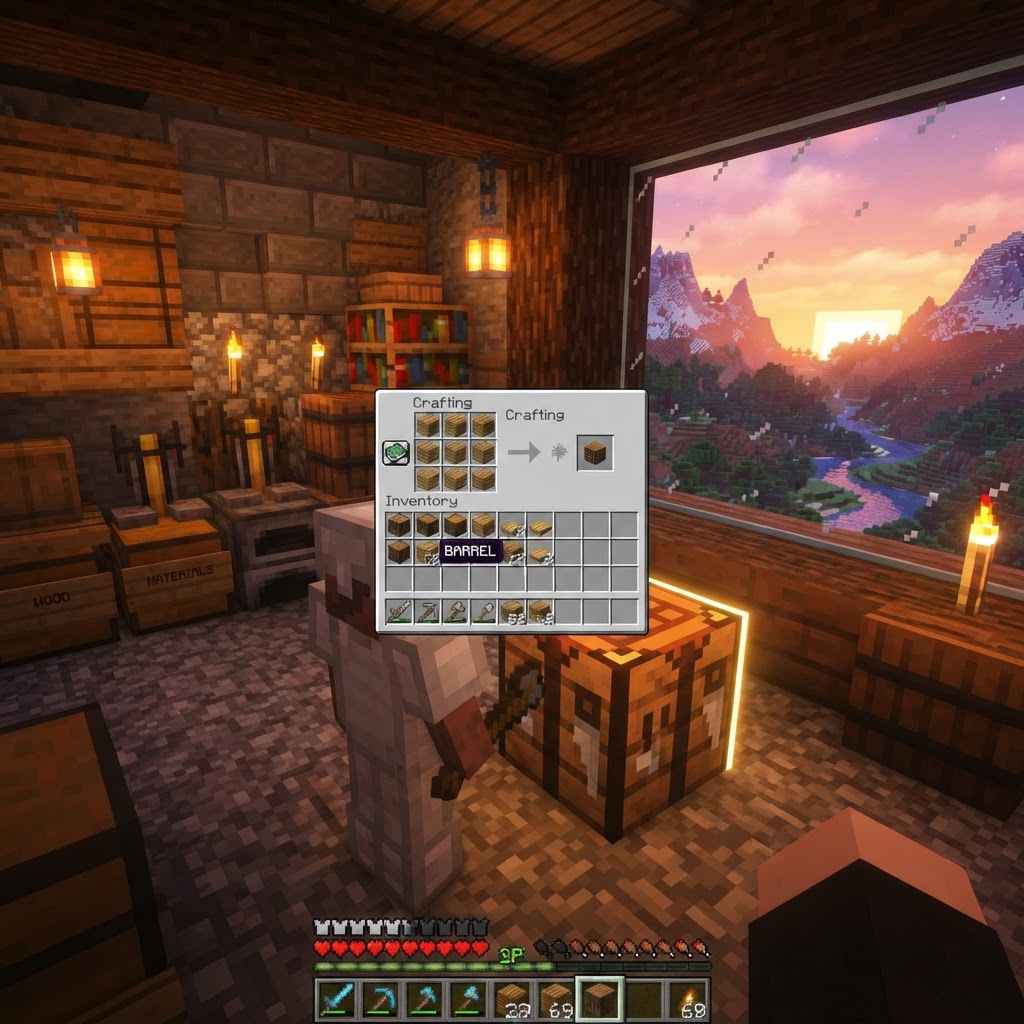
The barrel recipe is straightforward once you see it, but it's not intuitive from memory. You need a 3x3 crafting grid and specific placement.
What you need:
- 6 Oak Planks (or any wood planks — mixed types work fine)
- 2 Oak Slabs (or any wood slabs — again, mixed works)
Step-by-step crafting:
- Open your crafting table (3x3 grid)
- Place planks in the left column (all 3 rows)
- Place planks in the right column (all 3 rows)
- Place one slab in the top center slot
- Place one slab in the bottom center slot
- Leave the middle center slot empty
- Drag the barrel to your inventory
The middle column is the key — slabs on top and bottom, nothing in the middle. That empty center slot confuses players who try to fill the entire grid.
Sourcing Your Materials Fast
Don't waste time hunting wood when smarter options exist.
Barrels are cheap — 6 planks and 2 slabs means you only need 4 logs total to craft one barrel (each log gives 4 planks; slabs cost 3 planks for 6 slabs, so 2 slabs = 1 plank worth). In practice, gather 4-5 logs and you're set.
Material sourcing by situation:
| Situation | Best Wood Source | Notes |
|---|---|---|
| Early game survival | Nearest tree biome | Any wood type works |
| Building themed storage | Match your base wood | Purely aesthetic |
| Mass crafting barrels | Birch or oak forest | Fast chopping, dense spawns |
| No trees nearby | Village houses | Break planks/slabs carefully |
| Nether playthrough | Crimson/Warped Stems | Both work as valid plank sources |
The slab shortcut: When crafting slabs, 3 planks produce 6 slabs. You only need 2 slabs per barrel, so 3 planks gives you enough slabs for 3 barrels. Plan your crafting order — make slabs first from a small batch of planks, then use the remaining planks for the side columns.
Barrel vs Chest: Which Should You Actually Use?
Knowing when barrels beat chests (and when they don't) changes how you build storage.
Most players treat barrels as a backup option when they're out of chests. That's backwards thinking. Barrels have genuine advantages that make them the better choice in specific scenarios.
| Feature | Barrel | Single Chest | Double Chest |
|---|---|---|---|
| Storage slots | 27 | 27 | 54 |
| Needs clear space above | ❌ No | ✅ Yes | ✅ Yes |
| Can be opened when buried | ✅ Yes | ❌ No | ❌ No |
| Stackable vertically | ✅ Yes | ⚠️ Limited | ❌ No |
| Connects to adjacent unit | ❌ No | ✅ Pairs with chest | ✅ Yes |
| Villager job block | ✅ Fisherman | ❌ No | ❌ No |
|---|---|---|---|
| Redstone interaction | Basic | Basic | Basic |
| Flammable | ✅ Yes | ✅ Yes | ✅ Yes |
When barrels win:
- Underground storage rooms with low ceilings
- Stacked wall storage (floor to ceiling, no gap needed)
- Anywhere you want a fisherman villager
- Boats and compact mobile bases
- Hiding storage inside walls or floors (opens regardless of obstruction)
When chests win:
- You need 54 slots in one block footprint (double chest)
- You're using item sorters that depend on double-chest hopper mechanics
- You want cheaper crafting (chest = 8 planks, no slabs needed)
- Floor placement: Opens upward, classic look, acts like a ground-level chest
- Wall placement: Opens outward from wall, great for compact corridor storage
- Ceiling placement: Opens downward — unusual but functional for overhead access in tight builds
- Stacked columns: Stack 5-6 barrels vertically against a wall, every one accessible without gaps
- Place a barrel near an unemployed villager
- The villager claims it as their workstation and becomes a Fisherman
- Fisherman villagers trade fish, fishing rods, boats, and eventually enchanted fishing rods and emeralds for fish
- Fishermen buy raw cod and raw salmon for emeralds — fish is trivially easy to farm with an AFK fish farm or even basic fishing
- Enchanted fishing rods from Fishermen can have Mending — meaning you can get Mending books through trading without raiding libraries
- Emeralds from fish trading fuel your entire villager trading economy
Placement, Opening Mechanics, and Build Integration
Where and how you place barrels changes what's possible in your builds.
Barrels are directional blocks — the opening face points toward you when placed. This means you can mount them on walls, ceilings, or floors and they'll still open correctly from the side you're facing when placing.
Placement directions and uses:
Integration with hoppers and automation:
Barrels interact with hoppers identically to chests. Hoppers can feed items into any face of a barrel and extract from the bottom. Droppers and comparators also read barrel fullness the same way as chests — useful for automated sorting systems.
Villager Trading: The Barrel's Hidden Value
This mechanic alone makes barrels worth crafting even if you never store a single item in them.
The barrel is the job site block for Fisherman villagers. This is one of the most underused mechanics tied to a storage block in the entire game.
How it works:
Why this matters for progression:
Setup tip: Build a small fisherman trading hall using barrels as job blocks. You can reroll trades by breaking and replacing the barrel until the villager offers what you want (do this before trading with them to lock in trades).
Common Mistakes
These are the errors that waste your materials and time.
1. Filling the center column in the recipe
The most common crafting mistake. Players see a storage block and assume the grid should be mostly filled. The center middle slot must stay empty — slab top, slab bottom, empty middle.
2. Assuming barrels have more storage than chests
Barrels hold exactly 27 slots — same as a single chest, not a double. Players sometimes switch to all-barrels expecting more space and end up with the same capacity in more blocks.
3. Placing barrels where they can't be accessed
While barrels don't need clearance above them, they still need you to be able to click the opening face. A barrel buried completely inside a wall with no exposed face can't be opened. The no-clearance rule applies to the top face specifically.
4. Not using barrels as villager job blocks
Spending resources on lecterns, blast furnaces, or smokers for villager jobs when a simple barrel gives you one of the best trading villagers in the game — the Fisherman — is a significant missed opportunity.
5. Using barrels in double-chest item sorters
If your sorting system relies on the two-chest connection for overflow or hopper-locking mechanics, swapping to barrels breaks the system. Know your automation before substituting.
Pro Strategies
For players who want to use barrels at a level most guides never mention.
Stack trading halls vertically
Build a 1-wide trading hall using barrels as job blocks. Because barrels need no overhead clearance, you can fit villager cells with 2-block ceilings instead of 3, cutting your hall's vertical footprint by a third.
Barrel walls for organized mass storage
A 5-wide, 5-tall wall of barrels gives you 25 barrels × 27 slots = 675 item slots in a flat wall footprint. Label with item frames on the side — barrel faces open outward so item frames fit naturally on adjacent wall blocks. This beats a chest room for accessibility in tight base designs.
Underground stash rooms with zero tell
Barrels placed under flooring with their opening face pointing up can be opened by breaking the floor block, or better — leave a 1-block gap and cover with a trapdoor. The barrel opens through the trapdoor. No chest lid animation visible from above.
Fish farm + Fisherman combo
An AFK fish farm generating raw cod feeds directly into a Fisherman villager trading loop. Raw cod sells for emeralds, emeralds buy Mending books. This is one of the most resource-efficient emerald loops in survival Minecraft and it all hinges on the barrel as the job block.
Comparator barrel meters
Use a comparator reading off a barrel to create a simple fill-level indicator for your storage. When the barrel hits a certain fullness, the comparator signal triggers a lamp or alarm. Useful for farms with overflow protection needs.
Conclusion
The barrel is one of those blocks that looks minor until you understand its full toolkit. The crafting recipe — 6 planks flanking 2 slabs with an empty center — takes under a minute to execute with resources you always have on hand. But the real value is in what barrels enable: no-clearance storage that stacks to the ceiling, seamless hopper integration in tight builds, and the Fisherman villager job that quietly funds your entire enchanting economy through fish.
Use barrels where chest lids would cause problems, stack them where double chests can't connect cleanly, and always keep a few near your villager hall. Once you start using them intentionally instead of as a chest substitute, you'll find yourself building around them on purpose.
RELATED ARTICLES
How to Make a Brewing Stand in Minecraft: Recipe & Uses
If you've hit a wall in Minecraft — mobs are one-shotting you, your armor feels useless, and the End seems impossible — a brewing stand is the tool that changes everything. Potions transform your surv...
How to Make Glass in Minecraft: A Complete Smelting Guide
Glass is one of those crafting staples that looks simple on the surface but hides a surprising number of ways to go wrong — and a lot of creative potential most players never tap. Whether you're build...
How to Get Blaze Rods in Minecraft: Find and Farm Blazes
Blaze rods are one of the most critical bottlenecks in Minecraft progression — without them, you can't brew potions, reach the End, or craft Eyes of Ender. Most players die repeatedly trying to get th...
STAY UPDATED
New blog posts, guides, and community tips delivered to your inbox.
No spam. Unsubscribe anytime.
Comments (0)
No comments yet. Be the first to share your thoughts!

