TABLE OF CONTENTS
How to Make a Stonecutter in Minecraft: Easy Crafting Guide
If you've ever wasted a stack of stone trying to carve out the perfect stair count or lost materials to bad crafting ratios, the stonecutter solves that problem permanently. This block gives you precise, material-efficient cuts that the crafting table simply can't match — and once you understand how to make one and use it properly, your building workflow changes completely. This guide goes deeper than the basics: we cover crafting, sourcing, version differences, and the strategies that separate efficient builders from wasteful ones.
What a Stonecutter Actually Does (And Why You Need One)
Before you build it, understand exactly what problem it solves.
The stonecutter is a job-site block that lets you convert stone-type blocks into slabs, stairs, walls, and other variants with a 1:1 or better material ratio. That last part is critical. At a crafting table, making 4 stone stairs costs 6 stone blocks — that's a terrible conversion rate if you're building anything large. The stonecutter gives you 1 stair per 1 stone block, no waste.
Beyond efficiency, the stonecutter unlocks cuts you flat-out cannot perform at the crafting table. Chiseled variants, for example, or converting polished granite directly into polished granite stairs without intermediate steps. For builders who care about precision and material economy, this block is not optional — it's essential.
What the stonecutter processes:
- Stone, cobblestone, smooth stone
- Granite, diorite, andesite (and their polished forms)
- Sandstone and red sandstone
- Prismarine variants
- Blackstone and deepslate variants
- Bricks, nether bricks, end stone bricks
- Mossy cobblestone and mossy stone bricks
- Mine at least 3 stone blocks (or 3 cobblestone to smelt)
- Mine iron ore — just 1 piece needed
- Smelt cobblestone → stone (fuel: wood, planks, anything)
- Smelt raw iron → iron ingot
- Craft the stonecutter
- I = Iron Ingot (center of middle row)
- S = Stone (all three bottom row slots)
- Top row = empty
Materials Required to Make a Stonecutter
You only need two ingredients, but sourcing them efficiently matters.
The recipe is deliberately simple — Mojang designed this as an early-to-mid game unlock. Here's exactly what you need:
| Material | Quantity | Where to Get It |
|---|---|---|
| Iron Ingot | 1 | Smelt iron ore / raw iron in a furnace |
| Stone | 3 | Smelt cobblestone in a furnace |
| Crafting Table | 1 | Already have one (used to craft it) |
The stone (not cobblestone) requirement catches beginners off guard. When you mine stone with a non-Silk Touch pickaxe, you get cobblestone, not stone. You have to smelt that cobblestone back into stone. It's an extra step that most new players miss on their first attempt.
Fastest material path from scratch:
How to Craft a Stonecutter: Step-by-Step
The exact grid placement — because one wrong square wastes your materials.
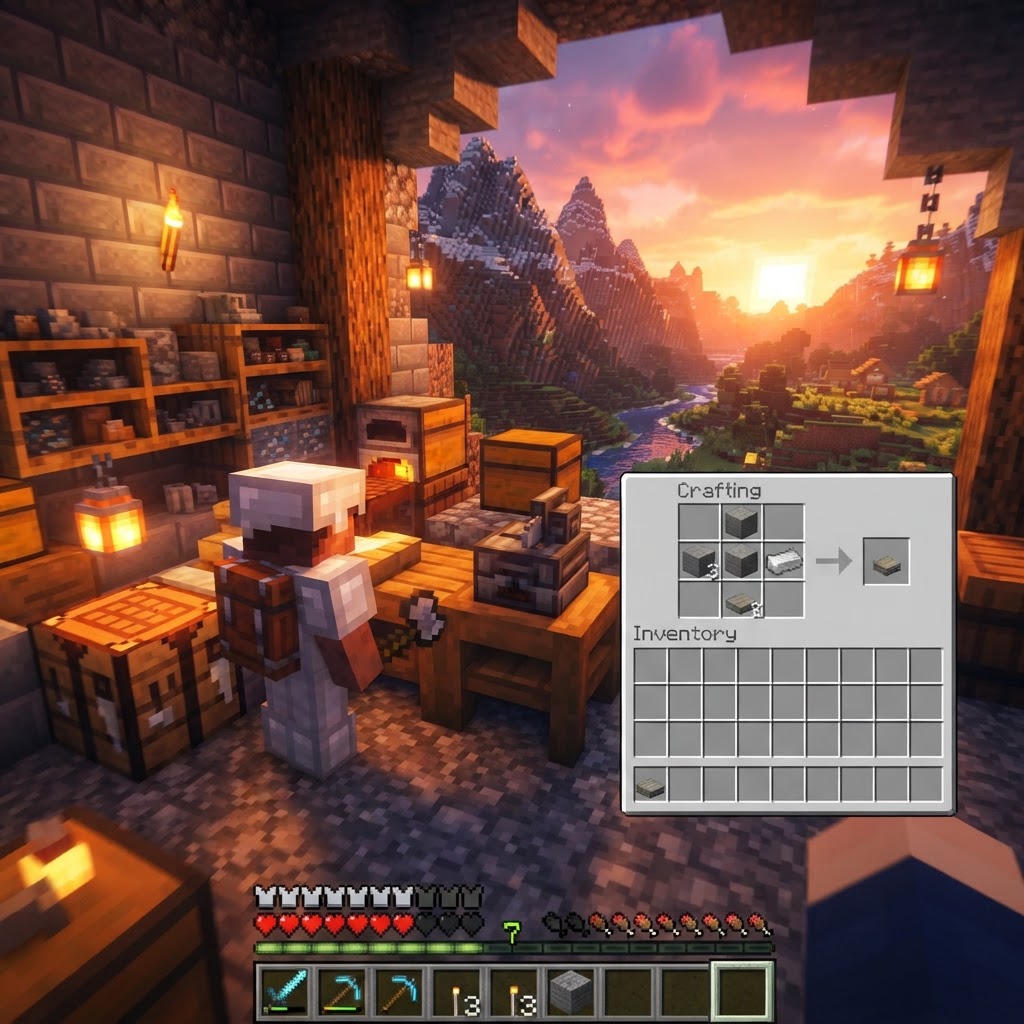
Open your crafting table (3x3 grid) and place the materials in this exact pattern:
Stonecutter Crafting Recipe:
```
```
That's it. The iron ingot goes dead center in the middle row, and the three stone blocks fill the entire bottom row. No other configuration works. You'll get 1 stonecutter per craft.
Placing it: Once crafted, place the stonecutter anywhere in your world. Right-click to open its interface. You'll see an input slot on the left and a grid of output options on the right — select what you want, and it produces it instantly. No fuel required.
Where to Find a Stonecutter Without Crafting
Sometimes the fastest build is no build at all.
Stonecutters generate naturally in stone mason houses in villages. If your world spawned you near a village — particularly plains, savanna, taiga, or snowy tundra biomes — check the buildings for one. The stone mason's house (identifiable by its stone/cobblestone construction) almost always contains a stonecutter inside or near the entrance.
| Method | Speed | Resource Cost | Reliability |
|---|---|---|---|
| Craft from scratch | Medium | 1 iron ingot + 3 stone | Always works |
| Loot from village | Fast (if nearby) | None | Depends on world seed |
| Trade with Mason villager | Slow | Emeralds | Requires leveling villager |
If you find a village stonecutter early game, you can mine it with any pickaxe and it drops as an item — no Silk Touch required. This is actually the fastest early-game path if you luck into a village near spawn.
Common Mistakes Players Make With Stonecutters
These errors waste time, materials, and opportunities.
1. Using cobblestone in the recipe
Already covered above, but worth repeating — this is mistake #1 by a wide margin. Smelt your cobblestone first.
2. Still using the crafting table for stone stairs and slabs
Old habits die hard. Players who learn the crafting table recipes first keep using them even after getting a stonecutter. At scale, this is a massive material drain. 6 stone → 4 stairs at a crafting table vs. 4 stone → 4 stairs at a stonecutter. On a 100-stair build, that's 50 extra stone blocks wasted.
3. Not knowing what the stonecutter can chain-convert
You can put polished granite directly into the stonecutter and get polished granite stairs or slabs — you don't need to make the polished version at a crafting table first. Many players do unnecessary intermediate crafting steps.
4. Ignoring stonecutter for deepslate builds
Deepslate variants are expensive to farm. Players who hand-craft deepslate stairs at the crafting table are hemorrhaging materials. The stonecutter's 1:1 ratio is especially valuable here.
5. Forgetting it's a villager job block
If you're building a villager trading hall and need Masons, stonecutters are your unlock. Players often wonder why villagers won't become Masons — it's because there's no unclaimed stonecutter nearby.
Pro Strategies: Getting More From Your Stonecutter
For builders who want efficiency, not just functionality.
Bulk conversion workflow
When starting a large build, calculate your total stair and slab count first. Convert all your stone in one sitting rather than running back to the stonecutter repeatedly. This keeps your build rhythm clean.
Stone supply chain optimization
Set up a dedicated smelting array for stonecutter prep: multiple furnaces (or better, blast furnaces — wait, blast furnaces don't smelt stone. Use regular furnaces) running cobblestone → stone continuously. Pair this with an automatic cobblestone generator if you're in a technical Minecraft mindset.
Stonecutter as a design tool, not just a utility
The stonecutter lets you mix variants fluidly. Need a wall that transitions from regular stone bricks to chiseled stone bricks? The stonecutter handles both. Advanced builders use it to access cut stone variants that create visual texture impossible with standard crafting recipes.
Comparison: Stonecutter vs. Crafting Table for stone processing
| Output | Crafting Table (stone input) | Stonecutter (stone input) | Winner |
|---|---|---|---|
| Stone Stairs (x4) | 6 stone | 4 stone | Stonecutter |
| Stone Slabs (x6) | 3 stone | 1 stone per slab | Stonecutter |
| Chiseled Stone Bricks | Requires intermediate step | Direct | Stonecutter |
| Stone Bricks | 4 stone → 4 bricks | 1 stone → 1 brick | Tie |
| Polished Granite Stairs | Not possible directly | Direct | Stonecutter only |
Use the stonecutter as your primary stone processing station. The crafting table should be a fallback for recipes the stonecutter doesn't support, not your default.
Early game placement
Don't tuck your stonecutter in a corner. Place it near your furnace array and chest storage — the three blocks you'll use most in any building session. Workflow matters. A good workstation layout cuts your building time by reducing movement.
Conclusion: Make It, Use It, Don't Build Without It
The stonecutter is a two-ingredient recipe that pays dividends across every building project you'll ever do in Minecraft. Three stone blocks, one iron ingot, and you permanently unlock material-efficient stone processing that the crafting table can't replicate. The key takeaways: always use stone, not cobblestone in the recipe, understand that the stonecutter's 1:1 conversion ratio saves significant materials at scale, and don't overlook it as a villager job block for Mason trading setups.
If you're doing any stone-heavy build — and most Minecraft builds eventually are — the stonecutter isn't a luxury. It's infrastructure. Build it early, place it smart, and let it do the heavy lifting on every staircase, slab, and wall your world demands.
RELATED ARTICLES

Best Minecraft Seeds for the Latest Version (2026)
Finding the best Minecraft seeds in 2026 means knowing which world generations deliver the most value — whether you're speedrunning, building, or just exploring. This guide covers the top seeds for Ja...
How to Make a Brewing Stand in Minecraft: Recipe & Uses
If you've hit a wall in Minecraft — mobs are one-shotting you, your armor feels useless, and the End seems impossible — a brewing stand is the tool that changes everything. Potions transform your surv...
How to Make Glass in Minecraft: A Complete Smelting Guide
Glass is one of those crafting staples that looks simple on the surface but hides a surprising number of ways to go wrong — and a lot of creative potential most players never tap. Whether you're build...
STAY UPDATED
New blog posts, guides, and community tips delivered to your inbox.
No spam. Unsubscribe anytime.
Comments (0)
No comments yet. Be the first to share your thoughts!

