TABLE OF CONTENTS
How to Make a Composter in Minecraft: Easy Guide
If you've been throwing away crops, seeds, and plant scraps without a second thought, you're leaving free bone meal on the table — one of the most useful farming accelerants in the game. The composter exists to solve a real problem: converting your excess organic waste into a renewable fertilizer source that scales with your farm. This guide goes beyond the basic recipe to help you understand exactly how composters work, what fills them fastest, and how to automate the whole system.
Crafting the Composter in Minecraft
You only need seven wood slabs — but which wood you choose matters less than you think.
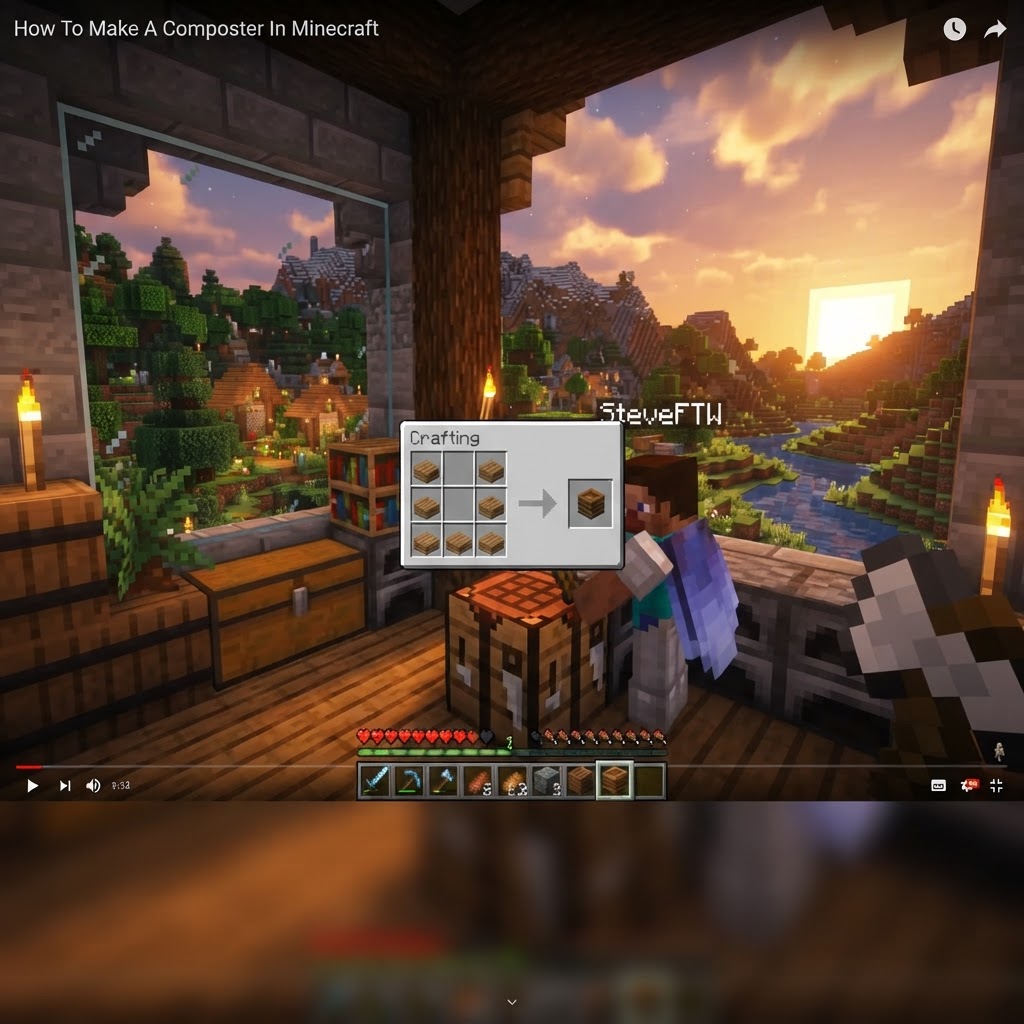
The composter recipe is one of the most forgiving in Minecraft because it accepts any wood type, mixed or matched. Here's exactly how to craft it:
- Open your crafting table (3x3 grid).
- Place wooden slabs in a U-shape: fill the bottom row (3 slabs), place one slab on the far left of the middle row, and one slab on the far right of the middle row. Leave the top row and center empty.
- The result is one composter. Drag it into your inventory.
That's it — 7 wooden slabs, no sticks, no other materials. You can use oak, spruce, birch, jungle, acacia, dark oak, mangrove, cherry, bamboo, or crimson/warped slabs interchangeably.
Alternative: Find One Instead of Crafting
Composters generate naturally in village farms. If you're near a village early game, just grab the composter sitting in the garden — it's a free shortcut before you have a crafting table set up.
How Composters Actually Work
Understanding the fill mechanic stops you from wasting hundreds of items on the wrong materials.
A composter has 7 fill levels, visualized as layers of compost rising inside the block. Each time you add a valid organic item, there's a percentage chance that the fill level increases by one. Once it hits level 7, it produces a single bone meal — which you collect by right-clicking the composter.
This is where most players get confused: adding an item does NOT guarantee a level increase. Each item has a fixed probability, ranging from 30% to 100%.
| Fill Chance | Example Items |
|---|---|
| 30% | Melon seeds, pumpkin seeds, dried kelp, beetroot seeds, grass, fern |
| 50% | Melon slices, apples, beetroot, carrots, potatoes, cactus |
| 65% | Bread, baked potato, cookies, hay bale (per use) |
| 85% | Pumpkin, melon (whole block), nether wart, sweet berries |
| 100% | Cake, pumpkin pie, mushroom stew (bowl returned) |
Because you need 7 level increases per bone meal, and each increase requires at least one successful compost, you'll typically use 10–25 items per bone meal depending on what you're feeding it.
Best Items to Compost for Maximum Efficiency
Not all organic items are equal — knowing the right inputs cuts your material cost in half.
The smart play is matching high-probability items to your existing farm outputs. Here's a practical breakdown by farm type:
If you run a cactus farm: Cactus has 50% chance. It's renewable and fully automatable with zero replanting. One mid-size cactus farm can feed a composter indefinitely.
If you run a wheat farm: Use the wheat itself (65%) rather than seeds (30%). Seeds are tempting because they're abundant, but wheat is twice as efficient per item slot.
If you run a bamboo farm: Bamboo has 30% chance, but bamboo farms produce insane quantities passively. The sheer volume compensates for the low per-item probability.
High-efficiency picks for manual composting:
- Pumpkin pie (65%) — crafted from pumpkin + sugar + egg, all renewable
- Bread (65%) — from wheat farms
- Cookies (85%) — cocoa beans + wheat, extremely cheap per batch
- Cake (100%) — expensive to craft but guaranteed level increase every time
- Place your composter on the ground.
- Place a hopper underneath the composter — this catches bone meal output automatically.
- Connect that hopper to a chest to store the bone meal.
- Place a hopper on top of the composter (or feed from the side via a dropper chain) to push compostable items in.
- Feed your farm's output (via hopper minecart or linked hopper chain) into the top hopper.
Automating Your Composter with Hoppers
A manual composter is a time sink — automation turns it into a passive bone meal factory.
The composter works seamlessly with hoppers on both ends, making full automation straightforward:
Basic Automated Setup:
Hopper Direction Check: When placing the bottom hopper, crouch and click the side of the composter block — this ensures the hopper pulls FROM the composter rather than an adjacent block.
| Setup Type | Automation Level | Best For |
|---|---|---|
| Manual composter only | None | Early game, occasional use |
| Composter + bottom hopper + chest | Output only | Semi-auto, manual feeding |
| Full hopper chain (top + bottom) | Fully automatic | Large farms, AFK setups |
| Composter + hopper minecart | High-speed | Multi-farm collection systems |
The Composter as a Villager Job Block
Most players ignore this mechanic entirely — it unlocks a free bone meal trade.
The composter is the job site block for the Farmer villager. If you place an unclaimed composter near an unemployed villager, they'll claim it and become a Farmer. This matters for two reasons:
1. Trading Bone Meal: Farmer villagers at certain levels will trade bone meal directly. Combined with a composter farm, you can create a self-reinforcing economy where crop surplus converts to bone meal, which accelerates more crops.
2. Villager Restocking: Farmers restock their trades by working at the composter block. If you're running a villager trading hall, make sure each Farmer has unobstructed access to their composter or their trades won't refresh.
If you break the composter a Farmer is assigned to, they lose their profession and revert to unemployed — useful if you want to reset bad trade rolls, since unemployed villagers can be reassigned to a new job block.
Common Mistakes Players Make with Composters
These errors waste materials and slow down your bone meal production significantly.
Mistake 1: Using seeds as the primary input.
Seeds have only 30% compost chance. Players dump stacks of wheat seeds because they seem "free," but you'll use 3x as many items compared to composting the wheat itself. Always prioritize higher-tier outputs.
Mistake 2: Ignoring the bottom hopper.
Manually clicking the composter every time it fills is tedious and scales terribly. Even a basic hopper-to-chest setup below the composter costs just 5 iron and saves constant micromanagement.
Mistake 3: Thinking more composters = proportionally more output.
Multiple composters running in parallel do increase throughput, but they need proportionally more input. Don't build a bank of composters before your farm can actually feed them all.
Mistake 4: Composting items that have better uses.
Pumpkins are 85% compost chance, but they're also extremely valuable as helmet armor for golems, for trading, and as a beacon base material. Don't feed high-value items to a composter when lower-value farm surplus does the same job.
Mistake 5: Placing the hopper wrong.
A hopper placed next to a composter (not underneath) won't collect bone meal. The output only comes from the bottom face of the composter block.
Pro Strategies for Maximizing Bone Meal Output
These techniques separate efficient farmers from players who never have enough fertilizer.
Strategy 1: The Kelp-to-Dried-Kelp Pipeline
Raw kelp farms produce massive quantities. Smelt raw kelp into dried kelp (30% compost chance, but volume is enormous), or craft dried kelp blocks. Use the kelp farm as a passive compost feeder running 24/7 in the background while your main farms handle food production.
Strategy 2: Bamboo as a Dedicated Composter Fuel
Bamboo grows faster than almost any other plant and requires no replanting. A 10x10 bamboo farm feeding directly into composters via hopper minecart creates a near-zero-maintenance bone meal source. The 30% chance per stalk is offset by the sheer production rate — bamboo generates multiple stalks per minute per column.
Strategy 3: Cookie Composting for Targeted Efficiency
If you have cocoa bean access (jungle biome), cookies have an 85% compost chance and are cheap to craft in bulk (2 wheat + 1 cocoa bean = 8 cookies). This is the best crafted-item-to-compost-value ratio in the game for players who want to actively batch-process bone meal quickly.
Strategy 4: Chain Composters for Bone Meal on Demand
Line up 4–6 composters each fed by a hopper from a shared chest. All output drops into a single collecting chest via hoppers. This multiplies throughput proportionally — useful when you need large quantities of bone meal fast for a massive planting session.
Strategy 5: Use Bone Meal to Grow, Then Compost the Surplus
Apply bone meal to crops → harvest surplus → compost the surplus → make more bone meal. This loop is self-sustaining once your farm is large enough. Wheat and carrot farms are ideal for this cycle.
The Bottom Line
The composter is deceptively simple but has layers of efficiency that most players never tap. Craft it with 7 wooden slabs, understand that item quality matters for fill rates, automate the output with a bottom hopper immediately, and build your input pipeline around high-percentage items like bread, cookies, or pumpkins. If you're in a village, check for a free one first. If you're mid-to-late game, a bamboo or cactus farm running into a hopper-fed composter bank gives you passive bone meal that scales with zero ongoing effort. Stop wasting organic drops — put them to work.
RELATED ARTICLES
How to Make a Brewing Stand in Minecraft: Recipe & Uses
If you've hit a wall in Minecraft — mobs are one-shotting you, your armor feels useless, and the End seems impossible — a brewing stand is the tool that changes everything. Potions transform your surv...
How to Make Glass in Minecraft: A Complete Smelting Guide
Glass is one of those crafting staples that looks simple on the surface but hides a surprising number of ways to go wrong — and a lot of creative potential most players never tap. Whether you're build...
How to Get Blaze Rods in Minecraft: Find and Farm Blazes
Blaze rods are one of the most critical bottlenecks in Minecraft progression — without them, you can't brew potions, reach the End, or craft Eyes of Ender. Most players die repeatedly trying to get th...
STAY UPDATED
New blog posts, guides, and community tips delivered to your inbox.
No spam. Unsubscribe anytime.
Comments (0)
No comments yet. Be the first to share your thoughts!

