TABLE OF CONTENTS
How to Get Honeycomb in Minecraft: Easy Guide & Tips
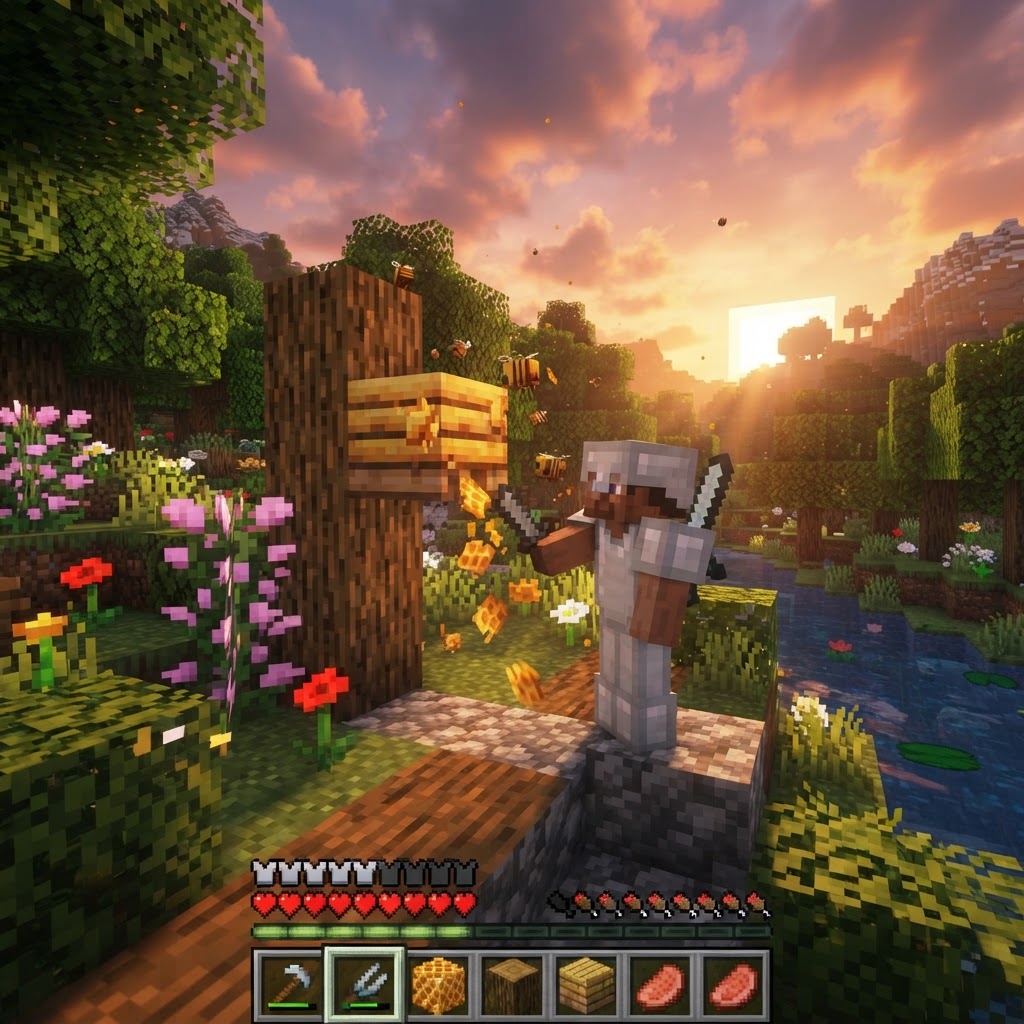
Honeycomb is one of those resources that blocks your progress in Minecraft the moment you decide to craft wax, make candles, or build a copper build that actually looks good over time. The problem most players run into isn't finding bees — it's harvesting honeycomb without triggering a swarm that kills them or destroys their progress. This guide covers every method, every mistake, and every efficiency trick so you get what you need without the chaos.
What Honeycomb Is Actually Used For
Before you farm it, know exactly why you need it — and how much.
Players often search for honeycomb without a clear picture of how much they'll actually need. That changes your farming strategy significantly. Here's the full breakdown of honeycomb crafting uses:
Honeycomb crafts into:
- Honeycomb Block — 4 honeycombs = 1 decorative block (purely aesthetic)
- Candles — 1 honeycomb + 1 string = 1 candle (lighting and decoration)
- Waxed Copper variants — 1 honeycomb + any copper block = waxed version (stops oxidation permanently)
- Beehive — 3 honeycombs + 6 planks = 1 craftable beehive (lets you relocate bees)
Waxing copper is by far the biggest demand driver. A single copper roof or large copper build can require dozens of honeycombs. If that's your goal, plan for a proper farm rather than a one-time harvest.
Finding Bee Nests in the Wild
Knowing where bees spawn saves you hours of wandering.
Bee nests generate naturally attached to trees in specific biomes. They do not spawn randomly — there are fixed rules governing where they appear.
Biomes where bee nests spawn on trees:
| Biome | Spawn Chance on Trees | Notes |
|---|---|---|
| Meadow | Very High (~100% of oak/birch trees) | Best biome for wild nests |
| Plains | ~5% of oak trees | Common biome, decent odds |
| Sunflower Plains | ~5% of oak trees | Same as Plains |
| Forest | ~2% of oak/birch trees | Lower chance, more trees overall |
| Birch Forest | ~2% of birch trees | Dense trees offset low chance |
| Flower Forest | ~2% of trees | Reliable with exploration |
|---|---|---|
| Cherry Grove | Present on cherry trees | Introduced in 1.20 |
The Meadow biome is your fastest route to honeycomb in early game. Meadows generate frequently near mountains in Java and Bedrock, and nearly every tree has a nest attached.
Each nest holds up to 3 bees and has a honey level from 0 to 5. You can only harvest at honey level 5, which you'll recognize by the dripping honey particles and the nest texture changing to show honeycomb visible through the slats.
Harvesting Honeycomb Without Getting Attacked
The difference between a smooth harvest and a full bee swarm comes down to two things.
This is where most players fail. Bees attack when you harvest without proper precautions, and a full swarm applies poison that can kill you quickly on higher difficulties.
The two safe harvesting methods:
Method 1: Campfire Beneath the Nest
- Place a campfire directly under the bee nest (or within 5 blocks below it).
- The smoke calms all bees associated with that nest permanently while the campfire burns.
- Wait for honey level 5 (dripping particles).
- Use shears on the nest — you'll receive 3 honeycombs.
- The nest resets to honey level 0 and bees resume normal behavior.
- Craft or enchant a tool with Silk Touch.
- Place a campfire nearby first (bees still aggro during breaking without it).
- Break the nest — it drops as a collectible block with its bees still linked to it.
- Place it at your base for a permanent bee farm.
- Place your beehive or relocated nest at least 2 blocks from any door or workstation (bees pathfind to flowers, not your build).
- Plant flowers within 22 blocks of the hive — this is the bee's foraging range. More flowers = faster honey production.
- Place a campfire 1-5 blocks below the hive. Use a carpet on top of the campfire to block smoke damage to bees while still producing calming smoke.
- Connect a dispenser loaded with shears facing the hive front, wired to a clock circuit or observer — this automates harvesting completely.
- Tool needed: Shears (right-click on level 5 nest)
- Safety requirement: Campfire within 5 blocks below nest
- Harvest yield: 3 honeycombs per harvest
- Nest reset: Returns to level 0, refills over time with bee activity
- Best wild biome: Meadow
- Key crafting uses: Candles, waxed copper, beehives, honeycomb blocks
- Do NOT confuse with: Honey Bottle (glass bottle, not shears)
Method 2: Silk Touch Collection
If you want to relocate a nest rather than harvest from it repeatedly in place:
Method Comparison:
| Approach | What You Need | Output | Best For |
|---|---|---|---|
| Campfire + Shears (wild nest) | Shears, campfire | 3 honeycomb per harvest | Quick early-game collection |
| Silk Touch relocation | Silk Touch tool, campfire | Full nest moved to base | Long-term farming |
| No campfire (risky) | Just shears | 3 honeycomb + probable attack | Avoid entirely |
| Crafted Beehive at base | 3 honeycomb + planks | Controlled farm | Mid/late game scaling |
Building a Honeycomb Farm at Your Base
One relocated nest beats a dozen wild harvests over a single play session.
Once you have a Silk Touch tool or have crafted a beehive using your first honeycomb batch, setting up a base farm pays off fast.
Basic farm setup:
Automated vs Manual Farm:
| Setup | Complexity | Honeycomb/Hour (est.) | Required Materials |
|---|---|---|---|
| Manual (campfire + shears) | Very Low | ~15-30 | Campfire, shears |
| Semi-auto (dispenser + button) | Low | ~30-60 | Dispenser, shears, redstone button |
| Full auto (observer + clock) | Medium | ~60-120 | Observer, redstone, comparator, dispenser |
| Multi-hive auto farm | High | 200+ | Multiple hives, full redstone layout |
Common Mistakes Players Make
These errors cost you nests, honeycombs, and sometimes your life.
1. Breaking the nest without Silk Touch
The single most common mistake. You see a level 5 nest, get excited, swing your axe — and it's gone. Always use shears for honeycomb or Silk Touch for the nest itself.
2. Forgetting the campfire before harvesting
Even one harvest without smoke control triggers all three bees. On Normal or Hard difficulty, that's a real threat. The campfire costs almost nothing to craft — there's no reason to skip it.
3. Planting no flowers near a farmed hive
Bees need to visit flowers to produce honey. A hive placed in a sterile room fills agonizingly slowly. Plant at least 5-10 flowers within the 22-block foraging range.
4. Using a water bucket to escape bees
Water doesn't stop bee aggro in most situations — bees pursue you above water. Running indoors and closing a door is your best escape if you trigger a swarm without campfire setup.
5. Harvesting honey bottle instead of honeycomb
Right-clicking with a glass bottle gives honey. Right-clicking with shears gives honeycomb. Know which tool is in your hand before you approach the hive.
6. Placing the campfire too far away
The campfire must be within 5 blocks directly below the nest to work. Placing it off to the side at ground level often doesn't count. Verify it's directly beneath.
Pro Strategies for Efficient Honeycomb Collection
What veteran players do that beginners never think to try.
Stack multiple beehives in one farm
Each hive holds 3 bees. Build a wall of 5-10 beehives with a single campfire below each column and one shared dispenser row. This scales output without proportionally scaling effort.
Breed bees to fill hives faster
New beehives start empty. Lure bees from a wild nest using flowers held in your hand, then breed them with more flowers to populate your farm. Each hive needs 3 bees to operate at full capacity.
Use name tags on bees you relocate
Named bees don't despawn. Unnamed bees in unloaded chunks can disappear over time. This is especially important if you've relocated rare bees from a Meadow far from your base.
Wax your copper in stages, not all at once
Copper oxidizes in four stages. Many players wax too early (fresh copper) or too late (fully oxidized green). Decide which oxidation stage you want your build frozen at, then wax at that exact moment. You need one honeycomb per copper block — plan your inventory before you start.
Trade with Wandering Traders as backup
Wandering Traders occasionally sell leads and rare items, but in some modpack environments or custom servers, emerald trades for honeycomb exist. Check your server's economy or trade plugin if foraging is restricted.
Quick Reference: Honeycomb at a Glance
Getting honeycomb in Minecraft is simple once you stop skipping the campfire step and know which biomes to target. For one-time needs — a handful of candles or waxing a small copper accent — find a Meadow, drop a campfire, and harvest. For anything bigger, relocate a nest with Silk Touch, set up flowers, automate with a dispenser and observer, and let it run passively while you build. The players who struggle with honeycomb are almost always the ones harvesting without smoke or breaking nests by hand. Fix those two habits and the resource becomes trivially easy to stockpile.
RELATED ARTICLES
How to Make a Brewing Stand in Minecraft: Recipe & Uses
If you've hit a wall in Minecraft — mobs are one-shotting you, your armor feels useless, and the End seems impossible — a brewing stand is the tool that changes everything. Potions transform your surv...
How to Make Glass in Minecraft: A Complete Smelting Guide
Glass is one of those crafting staples that looks simple on the surface but hides a surprising number of ways to go wrong — and a lot of creative potential most players never tap. Whether you're build...
How to Get Blaze Rods in Minecraft: Find and Farm Blazes
Blaze rods are one of the most critical bottlenecks in Minecraft progression — without them, you can't brew potions, reach the End, or craft Eyes of Ender. Most players die repeatedly trying to get th...
STAY UPDATED
New blog posts, guides, and community tips delivered to your inbox.
No spam. Unsubscribe anytime.
Comments (0)
No comments yet. Be the first to share your thoughts!

