TABLE OF CONTENTS
Make a Grindstone in Minecraft: Crafting, Uses & Tips
You've finally got a pile of enchanted gear you don't want, or you're staring at two damaged swords wondering if there's a smarter way to repair them than burning through an anvil. The Grindstone solves both problems — it removes enchantments for XP and repairs items for cheaper than an anvil — but most players either don't know how to craft it or don't realize how much utility they're leaving on the table. This guide covers everything: crafting, placement, real use cases, and the mistakes that cost players XP and materials.
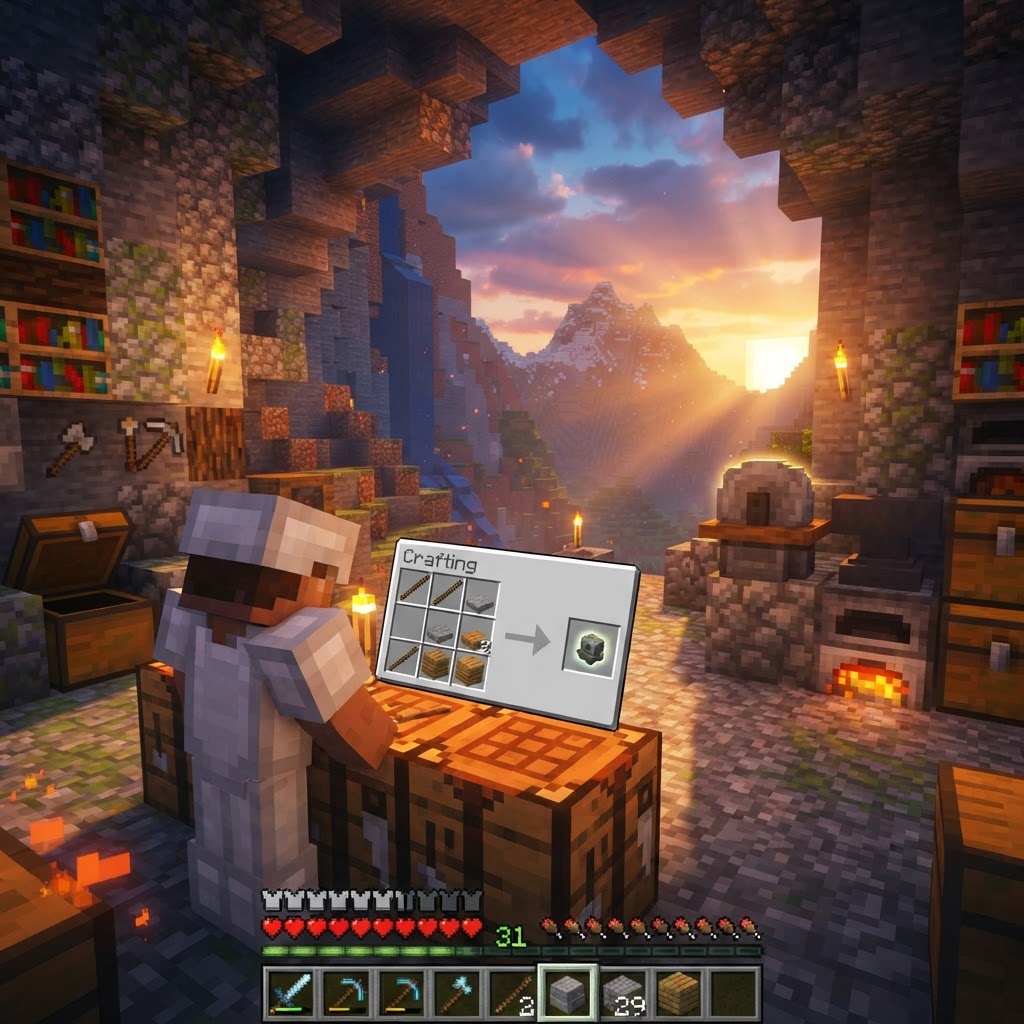
Crafting the Grindstone
Three ingredients, one of which trips up almost every new player.
The Grindstone recipe is straightforward once you know it, but the "stone slab" component causes confusion — players often use the wrong slab type and wonder why it won't work.
Ingredients:
- 2 Sticks
- 2 Wood Planks (any type — oak, spruce, birch, jungle, acacia, dark oak, mangrove, bamboo, etc.)
- 1 Stone Slab (not a cobblestone slab, not a smooth stone slab — a regular stone slab crafted from stone blocks)
Step-by-Step Crafting:
- Smelt cobblestone in a furnace to get stone blocks
- Place 3 stone blocks in a row in your crafting table to craft stone slabs
- Open your crafting table (3x3 grid)
- Place sticks in the top-left and top-right corners
- Place the stone slab in the top-center slot
- Fill the middle-left and middle-right slots with wood planks
- Leave the bottom row empty
- Collect your Grindstone from the output slot
Crafting Grid Layout:
| Left | Center | Right |
|---|---|---|
| Stick | Stone Slab | Stick |
| Plank | (empty) | Plank |
| (empty) | (empty) | (empty) |
What the Grindstone Actually Does
It's not just an enchantment remover — it's a cost-efficient repair station with a hidden XP mechanic.
Players who think the Grindstone only strips enchantments are missing half its value. It performs two distinct functions, and understanding both changes how you manage your gear economy.
Function 1 — Repairing Items
Place two damaged items of the same type in both input slots. The Grindstone combines their durability, adds a small bonus (roughly 5% of the item's total durability on top), and outputs a single repaired item. No experience cost required.
Function 2 — Removing Enchantments
Place an enchanted item in either input slot. The Grindstone strips all non-curse enchantments and returns a portion of the XP used to enchant the item. The more powerful the enchantment, the more XP you recover.
What the Grindstone CANNOT do:
- Remove curse enchantments (Curse of Binding, Curse of Vanishing — these are permanent)
- Repair items using materials (that's the anvil's job)
- Preserve enchantments during repair — if an enchanted item is in either slot, enchantments are stripped
- Grindstone: Cheap item combine repairs, recycling XP from unwanted gear, refreshing an item's "prior work" penalty before re-enchanting
- Anvil: Repairing with materials, combining enchanted books onto gear, preserving enchantments
- Enchanting Table: First-time enchanting, generating enchanted books via librarians
- Village Weaponsmith buildings — Grindstones appear as the job site block for the Weaponsmith villager profession
- Found in plains, savanna, taiga, snowy tundra, and desert village variants
- Simply right-click (Java) or tap (Bedrock) to interact — no ownership required
- You can mine it with any pickaxe and carry it home; it drops as a complete item
- A Grindstone without Silk Touch still drops as a Grindstone (no special tool required)
XP Recovery Breakdown:
| Enchantment Level | Approximate XP Returned |
|---|---|
| Enchantment Level I | ~2–4 XP orbs |
| Enchantment Level II | ~5–9 XP orbs |
| Enchantment Level III | ~10–18 XP orbs |
| Enchantment Level IV | ~19–30 XP orbs |
| Enchantment Level V | ~31–50 XP orbs |
(Values are approximate and depend on the specific enchantment and game version)
Grindstone vs. Anvil vs. Enchanting Table
Knowing which tool to use in each situation is what separates efficient players from gear-wasters.
This is the decision players get wrong constantly. Each block has a distinct role, and using the wrong one costs XP, materials, or both.
| Feature | Grindstone | Anvil | Enchanting Table |
|---|---|---|---|
| Repair with materials | ❌ | ✅ | ❌ |
| Repair by combining items | ✅ (free) | ✅ (costs XP) | ❌ |
| Add enchantments | ❌ | ✅ (books) | ✅ |
| Remove enchantments | ✅ | ❌ | ❌ |
| XP cost | ❌ None | ✅ Yes | ✅ Yes |
| Preserves enchantments on repair | ❌ | ✅ | N/A |
|---|---|---|---|
| Removes curses | ❌ | ❌ | ❌ |
| Prior work penalty | ❌ Never | ✅ Accumulates | ❌ |
When to use each:
Where to Find a Grindstone Without Crafting
Already spawned in villages — you may not need to craft one at all.
If you're early-game and short on materials, you might already be standing near one. Grindstones generate naturally as part of village structures.
Natural Spawn Location:
How to use a found Grindstone:
Common Mistakes
The errors that waste materials, XP, and time — and how to avoid every one of them.
Mistake 1: Using the Wrong Slab
Players use cobblestone slabs because they have cobblestone readily available. The recipe requires a stone slab (smelted stone → slabs). Keep a stack of stone slabs in your crafting supplies.
Mistake 2: Grinding Enchanted Items You Meant to Keep
The interface doesn't warn you that placing an enchanted item alongside another item will strip enchantments. Always double-check what's in both input slots before confirming.
Mistake 3: Expecting Curses to Be Removed
Curse of Binding and Curse of Vanishing cannot be removed by anything in survival mode. Don't waste time grinding cursed gear hoping to get a clean item back.
Mistake 4: Using the Grindstone to Repair High-Value Gear
If your diamond sword has Sharpness V, Looting III, and Fire Aspect II — do NOT grind-repair it with another sword. You'll lose all those enchantments. Use the anvil with diamond ingots instead.
Mistake 5: Forgetting the XP Bonus
Many players disenchant gear and walk away without absorbing the XP orbs. The orbs drop on the ground and despawn after 5 minutes. Stand close and collect them — especially when batch-processing old gear.
Mistake 6: Treating the Grindstone as a Last Resort
Players reach for it only when desperate. It should be part of your regular gear cycle — use it proactively to recycle failed enchants, cheap-repair backup tools, and prep items for re-enchanting.
Pro Strategies
Advanced techniques that turn the Grindstone from a utility block into a core part of your XP and gear economy.
Strategy 1: The Enchant-Strip Loop
Enchanting tables sometimes give you an enchantment you don't want (Bane of Arthropods on a sword, for example). Rather than keeping it or wasting the item, grind it off, recover partial XP, and re-enchant. This keeps your enchanting level topped up and avoids gear waste.
Strategy 2: Batch Processing Mob Farm Loot
If you run a mob farm, you accumulate stacks of enchanted bows, swords, and armor from drops. Run them all through the Grindstone in bulk. The XP adds up fast — a stack of enchanted bows can return significant levels that you then invest into your good gear.
Strategy 3: Prior Work Penalty Reset for Endgame Gear
Anvil repairs accumulate a "prior work" penalty. Once it hits "Too Expensive," you're locked out of further repairs. Solution: strip the enchantments with the Grindstone, use your XP to re-enchant from scratch with books. The penalty resets completely. This extends the life of your best items indefinitely.
Strategy 4: Weaponsmith Trading Prep
Weaponsmith villagers trade enchanted weapons. After buying them, if the enchantment isn't useful, grind it off for XP and use the clean, repaired item as a base for your own enchanting. You're essentially buying XP cheaply through villager trading.
Strategy 5: Paired Grindstone + Anvil Workstation
Set up your crafting area with both a Grindstone and an Anvil side by side. Use the Grindstone to combine-repair base items cheaply first, then take the result to the Anvil to add enchantment books. This reduces the total XP cost of your final enchanted item because you're not paying anvil repair costs on top of enchanting costs.
Conclusion
The Grindstone earns its place in every serious Minecraft player's base — not because it does everything, but because it does specific things no other block can match: free item repairs, XP recovery from unwanted enchantments, and prior work penalty resets that extend the life of your best gear. Craft it right (stone slab, not cobblestone slab), use it strategically alongside your anvil and enchanting table, and it becomes the backbone of a smart gear economy rather than an afterthought you remember when something goes wrong. The biggest takeaway: use it regularly as part of your workflow, not just when you're desperate.
RELATED ARTICLES
How to Make a Book in Minecraft: Easy Recipe & Uses
You're probably here because you just hit a wall — enchanting, writing, or crafting something advanced — and realized you need books but aren't sure how to get them efficiently. Books are one of Minec...
How to Make a Blast Furnace in Minecraft: Recipe & Uses
If you've been manually smelting ores one by one in a regular furnace, you're wasting serious time — the Minecraft blast furnace doubles your smelting speed for metals and ores, making it one of the m...
How to Make a Smoker in Minecraft: Recipe & Uses
If you're tired of waiting forever for your food to cook in a standard furnace, the smoker is the upgrade you didn't know you needed. It cooks food items at exactly twice the speed of a regular furnac...
STAY UPDATED
New blog posts, guides, and community tips delivered to your inbox.
No spam. Unsubscribe anytime.
Comments (0)
No comments yet. Be the first to share your thoughts!

