TABLE OF CONTENTS
Glass in Minecraft: Complete Guide to Make, Use & Save Sand
Glass in Minecraft is one of those materials players underestimate until they're deep into a build and suddenly realize they need hundreds of panes for windows, skylights, or greenhouse walls — and they're out of sand. Whether you're racing to finish a base before nightfall or planning a massive architectural project, understanding the full glass production pipeline saves you time, resources, and frustration.
How to Craft Glass in Minecraft
The basics done right — because the furnace step trips up more players than you'd expect.
Making glass is a two-step process: gather sand, then smelt it. Simple in theory, but there are specific decisions at each step that affect your efficiency dramatically.
Step-by-step process:
- Locate a desert, beach, or riverbank biome and collect Sand (regular sand or red sand both work).
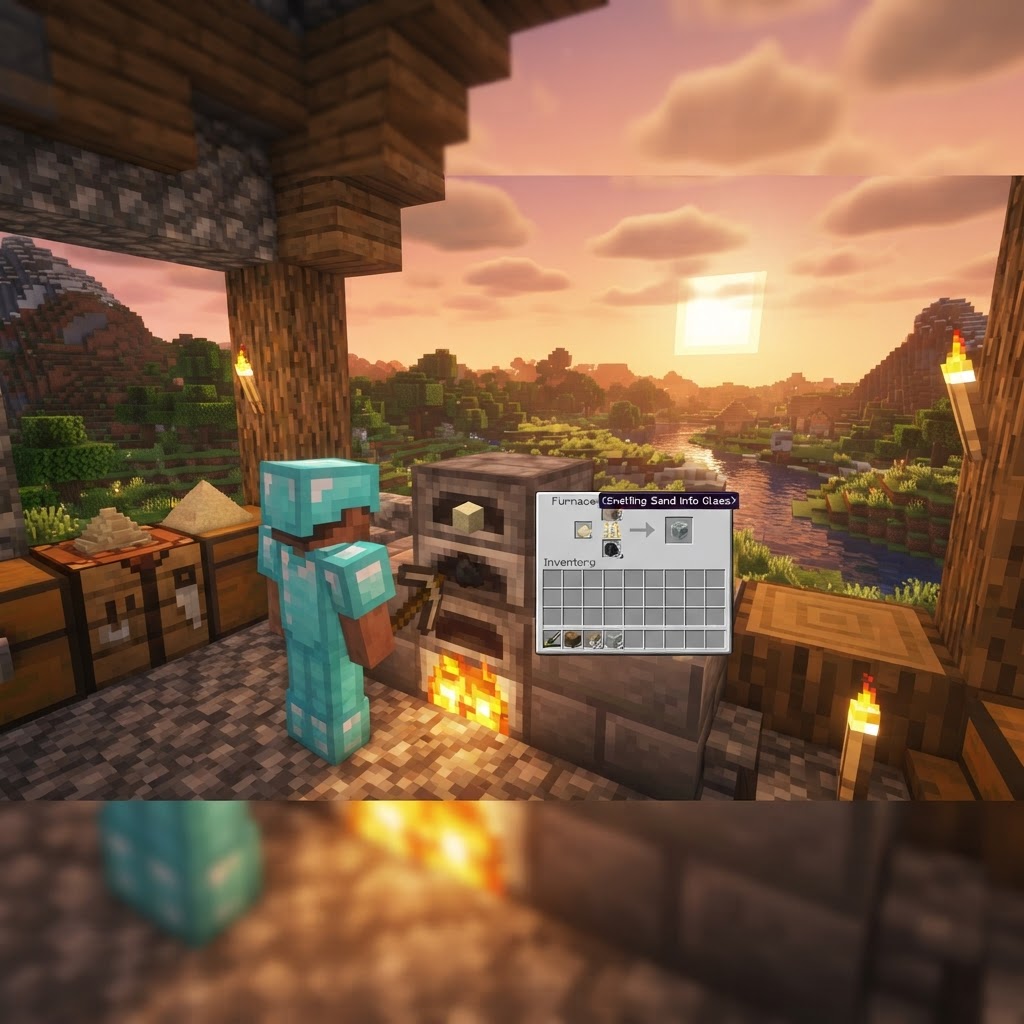
- Open your Furnace, Blast Furnace (faster), or Smoker (does NOT work — smokers only process food).
- Place sand in the top input slot.
- Add any fuel source to the bottom slot (wood, coal, lava bucket, etc.).
- Wait for the arrow to fill — each sand block produces one glass block.
- Collect your glass from the output slot.
- 🟡 Yellow — Dandelions or sunflowers, extremely common
- ⬜ White — Bone meal from skeletons, very common
- 🟠 Orange — Craft from red + yellow dye, easy
- 🔴 Red — Roses, poppies, or beetroot
- 🟢 Green — Smelt cactus in a furnace
- 🔵 Blue — Lapis lazuli from mining (Y-level 0 peak)
- 🟣 Purple — Craft from red + blue dye
- ⚫ Black — Ink sacs from squid or wither roses
- 🩷 Pink — Pink tulips or craft red + white
- 🟤 Brown — Cocoa beans (jungle biomes only, rarest dye to farm)
- Silk Touch is non-negotiable for any builder working with glass — one wrong break without it and your materials disappear.
- Blast Furnaces cut your smelting time in half and should be your default glass production tool.
- Panes cover more area than blocks per sand invested — when in doubt, go panes for windows.
Fuel efficiency at a glance:
| Fuel Source | Items Smelted | Best For |
|---|---|---|
| Wood Log | 1.5 | Small batches only |
| Coal / Charcoal | 8 | Mid-size production |
| Coal Block | 80 | Large dedicated runs |
| Lava Bucket | 100 | Maximum efficiency |
| Blaze Rod | 12 | If you have excess |
Red sand smelts into standard clear glass — not red glass. Many players assume otherwise. If you want colored glass, you'll need dye at the crafting table, not a different sand variant.
Glass Blocks vs. Glass Panes: Which Do You Actually Need?
Choosing the wrong form wastes materials and ruins the look of your build.
This is where most players waste significant resources. Glass blocks and glass panes serve different architectural purposes, and converting between them is costly if you've already crafted the wrong one.
| Feature | Glass Block | Glass Pane |
|---|---|---|
| Crafting Output | 1 block per smelt | 16 panes from 6 blocks |
| Coverage | 1×1 area | More area per glass used |
| Aesthetic | Solid, chunky walls | Thin, realistic window look |
| Connects to walls | No | Yes — adapts shape |
| Best use case | Floors, aquariums, roofs | Windows, dividers, greenhouses |
| Recipe location | Furnace only | Crafting table (3×2 grid) |
|---|
To craft glass panes: Arrange 6 glass blocks in the bottom two rows of a 3×3 crafting grid (3 blocks on the middle row, 3 on the bottom). This yields 16 panes.
The math matters here: 6 glass blocks → 16 panes. That's roughly 2.67 panes per original sand block. For window-heavy builds, panes are always more efficient than blocks in terms of sand-to-coverage ratio.
Stained Glass: Every Color and How to Get It
Dyes are the variable — knowing which dyes are easy to farm changes everything.
Stained glass opens up enormous creative possibilities, but the bottleneck is always the dye, not the glass itself. Here's how to make any color:
Recipe: 8 glass blocks surrounding 1 dye in a crafting grid → 8 stained glass blocks (same color as dye used).
Stained glass panes: Same logic — 6 stained glass blocks in a pane pattern → 16 stained glass panes of matching color.
Dye acquisition difficulty (fastest to hardest):
Sand Farming: Never Run Out of Glass Materials Again
The real bottleneck isn't the furnace — it's always the sand supply.
Running out of sand mid-project is one of the most common frustration points for builders. Sand is a falling block, finite in most biomes, and can't be grown like wood. Here's how to build a sustainable supply:
Source 1: Desert Biomes
The most obvious but also the most finite. Strip-mine desert floors carefully — dig down one layer at a time to avoid sand collapse.
Source 2: Beach and Riverbank Collection
Less sand per chunk but more accessible early-game. Rivers respawn surrounding terrain slowly but sand itself doesn't regenerate.
Source 3: Ocean Floor Excavation
Underwater sand farming with a shovel enchanted with Aqua Affinity and Respiration III is extremely efficient. Ocean floors contain massive sand deposits that most players ignore.
Source 4: Wandering Trader / Bartering
Not reliable for bulk, but in a pinch, some trades offer sand.
Source 5: Infinite Sand Farm (Java Edition)
Using a combination of sand duplication glitches (patched in some versions) or suspicious sand mechanics. Check your version before attempting.
Source 6: Concrete Powder → Concrete Method
Not glass production per se, but players who need building material and are running low on sand sometimes substitute stained concrete for stained glass in non-transparent portions of builds.
Most efficient smelting setup for glass production:
Run multiple furnaces in parallel rather than one at a time. A bank of 5 furnaces with hoppers feeding sand in and collecting output can process glass 5x faster and lets you go do other things while it runs.
Common Mistakes Players Make with Glass
These are the errors that waste your sand, your time, and your temper.
Mistake 1: Using a Smoker to Smelt Sand
Smokers only process food. Sand goes in, nothing happens, you've wasted time wondering if the game is broken.
Mistake 2: Smelting Sand Into Glass Before Knowing Final Quantity
Players smelt 200 glass blocks when they needed panes — then realize they've over-committed to blocks and can't easily cover the build area efficiently.
Mistake 3: Building with Glass Blocks When Panes Were Intended
Glass blocks have a different texture and visual weight. Using blocks where panes were needed gives your build a chunky, unintentional look.
Mistake 4: Forgetting That Silk Touch Preserves Glass
Breaking glass without Silk Touch destroys it completely — you get nothing. Always use a Silk Touch tool if you need to relocate glass in your build.
Mistake 5: Mass-Crafting Stained Glass Before Confirming Dye Stock
If you craft 64 white glass blocks and run out of bone meal halfway through a dye job, you'll have mismatched colors that can't be undone.
Mistake 6: Ignoring the Blast Furnace
A Blast Furnace smelts sand at 2x the speed of a regular furnace. Players who don't own one for glass production are wasting real time on large projects.
Pro Strategies for Efficient Glass Production
These techniques separate casual builders from players who finish massive projects without resource panic.
Strategy 1: The Blast Furnace Bank
Build 5–10 Blast Furnaces in a row with hoppers feeding in from a chest above and collecting into a chest below. Fill the top chest with sand and walk away. You'll return to hundreds of glass blocks produced at twice normal speed.
Strategy 2: Smelt First, Dye Second
Always smelt all your sand into clear glass before dyeing. This way you can adapt your color plan if your dye supply changes mid-project.
Strategy 3: Batch Staining by the Stack
The stained glass recipe uses 8 glass blocks per craft (yielding 8 stained blocks). Prep your dye in bulk — a full inventory row of a single dye = many crafting cycles without interruption.
Strategy 4: Use Panes for Interior Dividers
Panes automatically connect to adjacent blocks and create thin window profiles. For any interior wall that needs transparency, panes are always visually superior to blocks and use fewer materials.
Strategy 5: Pre-Plan Your Glass Budget
Before starting a build, count your window/glass surface area in the game's block grid. A 10×5 window requires 50 glass blocks OR (if using panes) you need only 50/2.67 ≈ 19 glass blocks to make enough panes. Pre-calculating prevents under- or over-production.
Strategy 6: Tinted Glass for One-Way Visibility
Tinted glass (crafted from 4 amethyst shards + 1 glass block, yielding 2 tinted glass) blocks light and provides a darkened look that players can see through from inside but appears opaque from certain angles. Perfect for observatory rooms, dark-room mob farms with windows, or aesthetic builds.
Final Takeaways: Glass Done Right
Glass in Minecraft is easy to make but easy to get wrong at scale. The core loop — sand → furnace → glass — is just the starting point. The players who build efficiently know to smelt in bulk using Blast Furnaces, plan their pane vs. block split before crafting, carry Silk Touch tools during construction, and farm sand from ocean floors rather than exhausting desert biomes.
The three things to remember above everything else:
Whether you're building a greenhouse, a skyscraper facade, or a simple cabin with real windows, glass in Minecraft rewards players who think ahead. Plan your quantities, source your sand sustainably, and never craft stained glass until your dye supply is secured.
RELATED ARTICLES
How to Make a Book in Minecraft: Easy Recipe & Uses
You're probably here because you just hit a wall — enchanting, writing, or crafting something advanced — and realized you need books but aren't sure how to get them efficiently. Books are one of Minec...
How to Make a Blast Furnace in Minecraft: Recipe & Uses
If you've been manually smelting ores one by one in a regular furnace, you're wasting serious time — the Minecraft blast furnace doubles your smelting speed for metals and ores, making it one of the m...
How to Make a Smoker in Minecraft: Recipe & Uses
If you're tired of waiting forever for your food to cook in a standard furnace, the smoker is the upgrade you didn't know you needed. It cooks food items at exactly twice the speed of a regular furnac...
STAY UPDATED
New blog posts, guides, and community tips delivered to your inbox.
No spam. Unsubscribe anytime.
Comments (0)
No comments yet. Be the first to share your thoughts!

