TABLE OF CONTENTS
How to Make a Saddle in Minecraft: Easy Guide & Best Methods
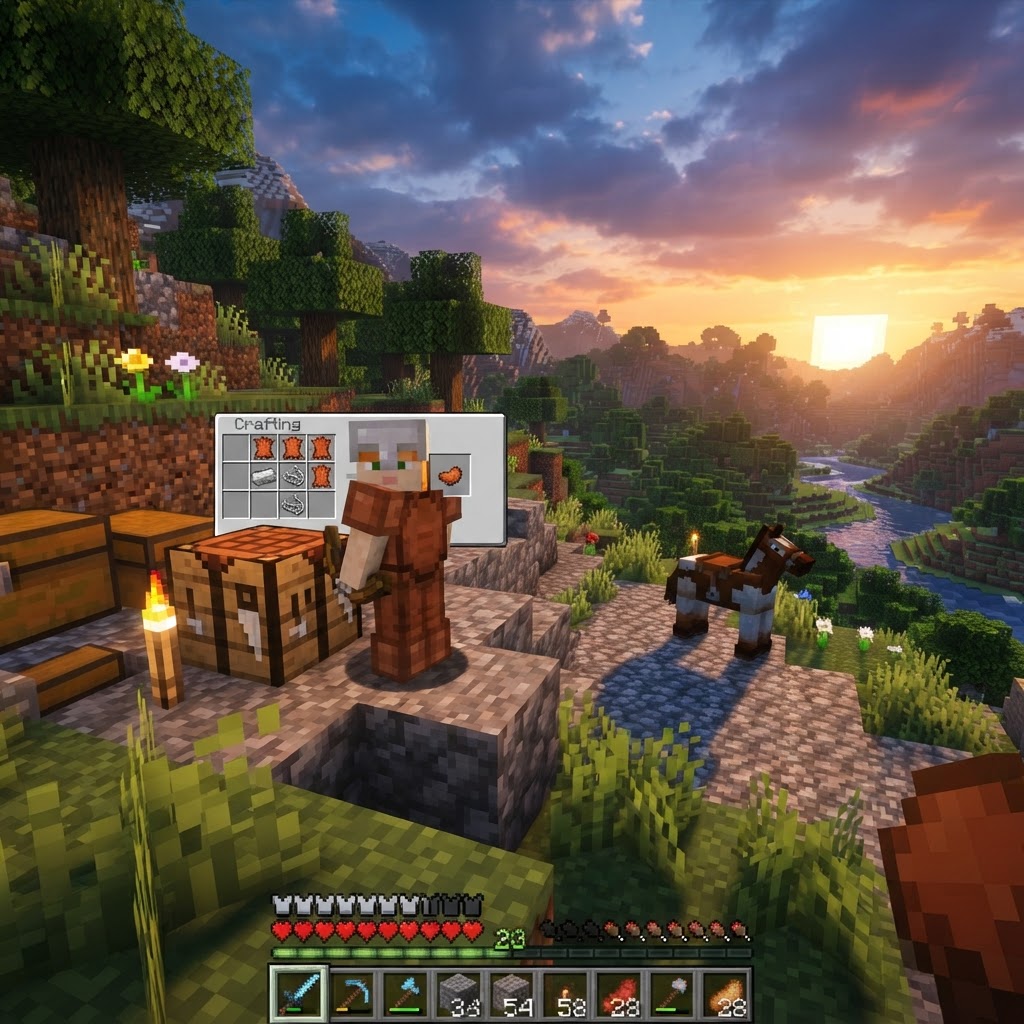
If you've tamed a horse, found a pig you want to ride, or finally spotted a strider in the Nether, you already know the frustration: without a saddle, none of it works. The maddening truth that stops most players cold is that you cannot craft a saddle in Minecraft — there's no crafting recipe, no workbench setup, no shortcut through a crafting table. Instead, you need to know exactly where to find one, and that's what this guide is built around.
Why You Can't Craft a Saddle in Minecraft
Understanding the design decision that trips up every new player.
This is the single biggest source of confusion surrounding saddles, and it's worth addressing head-on before you waste an hour arranging leather and iron on a crafting grid. Mojang intentionally made the saddle a non-craftable item. It has been this way since the early days of Minecraft, and despite years of community requests, it remains unchanged as of Java 1.21 and Bedrock 1.21.
The design philosophy behind this is actually meaningful: saddles are meant to feel like a discovery, not a manufactured tool. They reward exploration, trading, and fishing — the same activities that define the early-to-mid game loop. This forces players to engage with the world rather than sit at a crafting table.
> [NOTE: There are no mods or vanilla tricks that let you craft a saddle in the base game. If a guide tells you there's a crafting recipe, it's either outdated, referencing a mod, or flat-out wrong.]
What this means practically: your time is better spent learning the fastest acquisition routes than searching for a recipe that doesn't exist. The good news is that saddles are actually one of the more accessible rare items once you know where to look.
The Five Best Ways to Get a Saddle in Minecraft
A ranked breakdown of every reliable method, so you can pick the one that fits your current game stage.
Not all saddle sources are created equal. Some require a fully explored world, others work in the first 10 minutes of a new save. Here's a comparison of every primary method:
| Method | Difficulty | Speed | Requires | Best For |
|---|---|---|---|---|
| Chest Loot (Dungeons/Temples) | Low–Medium | Fast | Exploration | Early-game players |
| Fishing | Low | Medium | Fishing rod | Any stage |
| Villager Trading | Medium | Slow | Emeralds + Leatherworker | Mid-game |
| Nether Fortress Chests | Medium | Fast | Nether access | Mid-game |
| Ravager Drop | High | Varies | Raid participation | Late-game |
Each of these deserves its own breakdown.
Finding Saddles in Chests: The Fastest Early-Game Method
Knowing exactly which structures to target saves you hours of aimless searching.
Chest loot is statistically the most common way new players stumble onto their first saddle — but most players don't know which structures have the highest spawn rates, so they waste time raiding the wrong places.
Structure-by-Structure Saddle Chances:
| Structure | Saddle Spawn Chance | Notes |
|---|---|---|
| Nether Fortress | ~35.3% | Multiple chests per fortress |
| Desert Temple | ~23.5% | 4 chests per structure |
| Dungeon (Mob Spawner Room) | ~27.9% | Common underground |
| Village Weaponsmith | ~16.2% | Easy early access |
| Savanna/Plains Village | ~17.3% | Ground-level, safe |
| Jungle Temple | ~12.9% | Requires puzzle solving |
|---|---|---|
| Stronghold Altar | ~2.5% | Not worth targeting for saddles |
> [TIP: Dungeons are your best early-game bet because they spawn underground at almost any biome and don't require you to travel to dangerous terrain. Listen for mob sounds beneath you — that's usually a dungeon. Dig down carefully and raid the chest before engaging the spawner.]
Step-by-step dungeon approach:
- Listen for zombie, skeleton, or spider sounds coming from underground.
- Dig straight down at a 45-degree staircase (never straight down) toward the sound.
- Locate the mossy cobblestone or cobblestone room — that's the dungeon.
- Open both chests before activating the spawner (torches on the spawner stop spawning).
- Check inventory — if no saddle, continue exploring for a second dungeon nearby.
Nether Fortresses deserve a special mention. Once you reach the Nether, fortress chests are your single best source of saddles, with a 35% chance per chest and multiple chests per structure. Always bring fire resistance potions and a good sword before entering.
Fishing for Saddles: The Underrated AFK Method
Most players ignore fishing as a saddle source — that's a mistake when you know how to optimize it.
Fishing is genuinely one of the most efficient saddle-farming methods in the game, especially for players who want to go AFK while gathering resources. The catch: saddles are classified as "treasure" loot in Minecraft's fishing system, meaning you need the right setup to reliably catch them.
> [WARNING: Without the Luck of the Sea enchantment on your fishing rod, your chance of catching a saddle is only about 0.8% per cast. With Luck of the Sea III, this jumps to roughly 1.9%. It's still low per cast, but over hundreds of AFK casts it adds up significantly.]
Optimizing your fishing setup:
- Craft an enchanted fishing rod with Luck of the Sea III (primary) and Lure III (secondary).
- Lure III reduces wait time between catches — faster casts = more saddle chances per hour.
- Build a covered fishing spot (blocks overhead at the right distance) so rain doesn't interrupt.
- Use an AFK fish farm design (check current 1.21-compatible designs — older barrel/trapdoor designs were patched).
Why this method works well: It requires zero exploration risk, no combat, and can run passively while you do other things. Over a 2–3 hour session with Luck of the Sea III, most players will land at least 1–2 saddles alongside other useful treasure like enchanted books and name tags.
Trading with Leatherworker Villagers: The Most Reliable Late-Game Method
Once you have a villager trading hall, saddles become infinitely renewable.
This method requires more setup but offers the most consistent long-term supply. Master-level Leatherworker villagers will trade a saddle for 6 emeralds — a very fair price once your emerald income is established.
How to unlock the saddle trade:
- Find or breed a villager and place a Leather Worker's workstation (cauldron) nearby to assign the profession.
- Trade with the villager repeatedly to level them up: Novice → Apprentice → Journeyman → Expert → Master.
- At Master level, the saddle trade unlocks for 6 emeralds.
- Lock in the trade and refresh it repeatedly — each villager can trade saddles indefinitely once unlocked.
> [TIP: Cure a zombie villager (using a splash Potion of Weakness + golden apple) to permanently reduce their trade prices by up to 66%. That Master-level Leatherworker's saddle can drop to just 1–2 emeralds each time.]
The investment to set up a cured villager trading hall pays off massively if you're playing long-term survival — you'll never need to search for a saddle again.
How to Actually Use Your Saddle (and What You Can Ride)
Getting the saddle is only half the job — equipping it correctly for each mob is different.
A surprisingly common moment of confusion happens right after players get their saddle: they don't know how to equip it, or they try to ride a mob that requires extra steps.
Rideable mobs and saddle requirements:
| Mob | Saddle Required? | Extra Steps | Where Found |
|---|---|---|---|
| Horse | Yes | Must tame first (right-click until hearts) | Plains, Savannas |
| Donkey | Yes | Must tame first | Plains, Savannas |
| Mule | Yes | Must tame first | Bred from horse + donkey |
| Pig | Yes | No taming needed | Overworld (common) |
| Strider | Yes | No taming needed | Nether (lava lakes) |
Equipping a saddle — step by step:
- Horses/Donkeys/Mules: Open the horse's inventory by pressing E while riding (after taming) or sneaking and right-clicking. Drag the saddle into the saddle slot (top-left icon).
- Pigs: Simply right-click the pig with the saddle in hand. It equips instantly — but you'll need a carrot on a stick to actually steer it.
- Striders: Right-click the strider with the saddle. Use a warped fungus on a stick to steer. Saddle equips on contact — no taming required.
> [NOTE: Saddles cannot be removed from pigs or striders once equipped in survival mode — they're permanent until the mob dies. Horses, donkeys, and mules allow saddle removal by opening their inventory. Plan accordingly before you saddle a pig you don't intend to keep.]
Common Mistakes Players Make When Getting a Saddle
These are the time-wasters and misconceptions that send players in circles.
1. Searching for a crafting recipe. There isn't one. Every minute spent looking is a minute not spent exploring a dungeon.
2. Targeting Strongholds first. Strongholds have extremely low saddle spawn rates. Go to dungeons or Nether Fortresses instead.
3. Fishing without Luck of the Sea. The base catch rate for saddles via fishing is under 1%. Unenchanted rods are nearly useless for saddle farming.
4. Saddling a pig before having a carrot on a stick. You can mount the pig, but you can't steer it. Craft your carrot on a stick (fishing rod + carrot) before you saddle up.
5. Ignoring villages entirely. Savanna and plains village chests have decent saddle spawn rates and are often some of the first structures players encounter. Always raid village chests early.
6. Not curing villagers before trading. Paying 6 emeralds per saddle is fine. Paying 1–2 emeralds per saddle after curing a villager is dramatically better — the setup cost is worth it.
Pro Strategies: Getting Saddles Faster Than Most Players Ever Will
For players who want to optimize beyond the basics.
Run Nether Fortress chest routes. A single large Nether Fortress can contain 4–6 chests. Map the fortress, loot every chest, then leave and return after the chunks reload if you're desperate. In a fresh world speedrun, experienced players can have a saddle within the first 20–30 minutes by beelining to the Nether.
Set up a saddle-specific trading hall with multiple cured Leatherworkers. If you cure 3–4 Leatherworkers and level them all to Master, you can buy 3–4 saddles per trading session with minimal emerald cost. This is the endgame saddle farm setup.
Use chunk-based exploration efficiency. When exploring for dungeons, use F3 (Java) to watch your Y-level. Dungeons generate between Y=0 and Y=63. Carving horizontal tunnels at Y=20–30 while listening for mob sounds dramatically increases dungeon encounter rates compared to random digging.
Combine fishing with other goals. Run an AFK fish farm overnight. You're getting XP, enchanted books, and saddles simultaneously. The opportunity cost is zero — it's pure passive gain.
Trade route planning for emeralds: Before you can trade for saddles, you need emeralds. The fastest emerald sources are paper trading (sugar cane farm → librarian villagers) or wheat trading (farmer villagers). Set up one of these first, then pivot to the Leatherworker for saddle access.
Conclusion: Stop Looking for a Recipe and Start Exploring
Every method you need, ranked by your current game stage.
The saddle in Minecraft rewards the player who understands the game's systems rather than looking for a shortcut at the crafting table. If you're in the early game, target dungeons and village chests. If you're mid-game, hit the Nether Fortress and set up an enchanted fishing rod for AFK sessions. If you're late-game and playing long-term survival, a cured Leatherworker trading hall makes saddles effectively infinite.
The key takeaways:
- No crafting recipe exists — stop looking, start exploring.
- Nether Fortresses and dungeons offer the fastest discovery rates.
- Enchanted fishing rods with Luck of the Sea III make passive farming viable.
- Cured Leatherworker villagers are the best long-term saddle source.
- Know your mob — horses need taming, pigs need a carrot on a stick, striders need warped fungus on a stick.
Get out there, raid a dungeon, and get riding.
RELATED ARTICLES

How to Make a Book in Minecraft: Easy Recipe & Uses
You're probably here because you just hit a wall — enchanting, writing, or crafting something advanced — and realized you need books but aren't sure how to get them efficiently. Books are one of Minec...

Minecraft Update News: What’s New in Java and Bedrock?
The latest Minecraft update news covers significant changes across both Java and Bedrock editions, and keeping track of what dropped where isn't always straightforward. This guide breaks down the most...
How to Make a Blast Furnace in Minecraft: Recipe & Uses
If you've been manually smelting ores one by one in a regular furnace, you're wasting serious time — the Minecraft blast furnace doubles your smelting speed for metals and ores, making it one of the m...
STAY UPDATED
New blog posts, guides, and community tips delivered to your inbox.
No spam. Unsubscribe anytime.
Comments (0)
No comments yet. Be the first to share your thoughts!

