TABLE OF CONTENTS
Breeding Horses in Minecraft: Ultimate Guide & Pro Tips
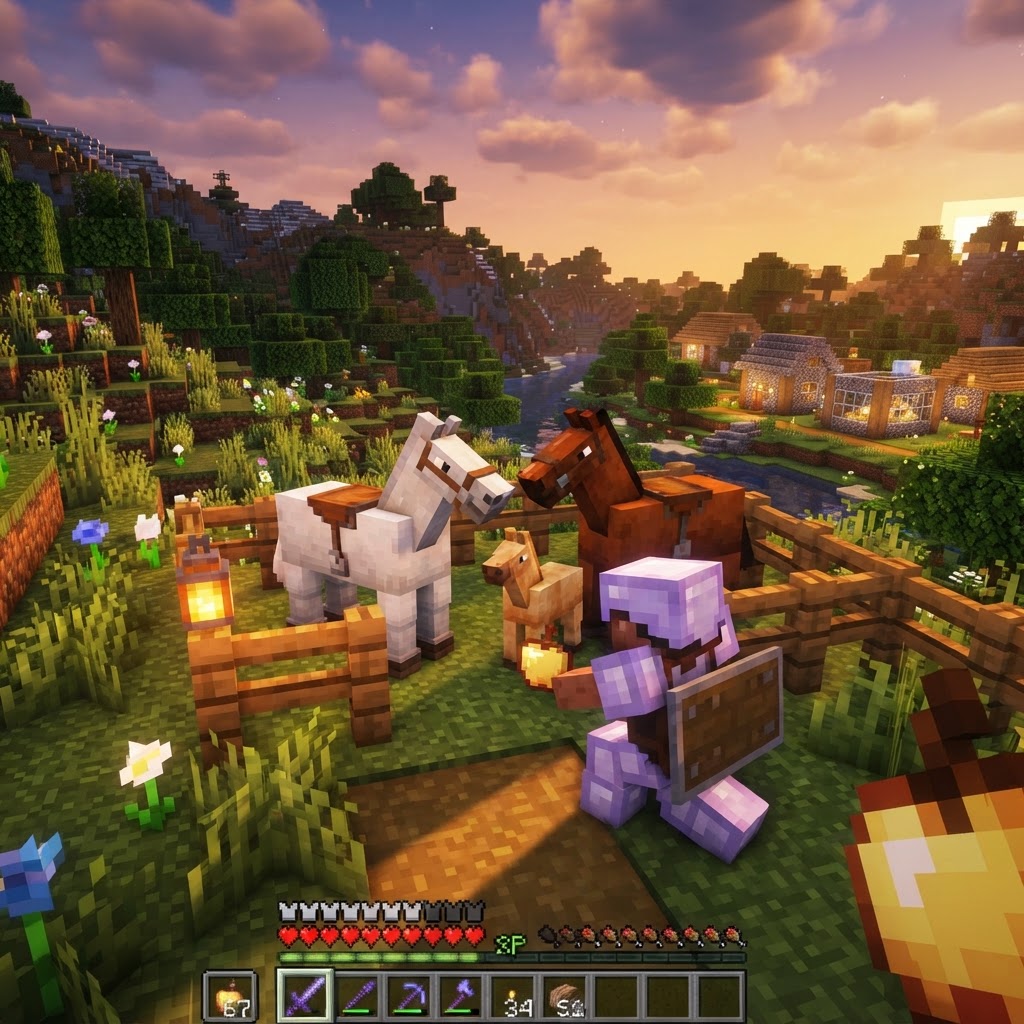
Breeding horses in Minecraft isn't just about making baby animals — it's your fastest path to owning a mount that can outrun everything in the overworld and clear five-block gaps with ease. Most players settle for whatever wild horse they tame first, never realizing a few strategic breeding sessions can produce a stat-capped stallion that makes exploration feel completely different. This guide goes beyond the basics to show you exactly how to get the best possible offspring, every time.
Why Breeding Horses Is Worth Your Time
The difference between a good horse and a great horse is enormous — and breeding is the only way to get there.
Wild horses spawn with randomized stats. Speed, jump height, and health are all rolled independently when a horse generates in the world, meaning the horse you tamed last night might be objectively mediocre and you'd never know it. Breeding gives you control over those stats, and more importantly, it gives you a path to improvement over generations.
Here's what's actually at stake:
- Speed ranges from roughly 4.74 blocks/second to 14.23 blocks/second. A max-speed horse is nearly three times faster than a minimum-speed one.
- Jump Height ranges from 1.2 to 5.2 blocks. A high-jump horse clears walls and terrain that stops a low-jump horse dead.
- Health ranges from 15 to 30 HP (7.5 to 15 hearts). Double the survivability between floor and ceiling.
No saddle upgrade, no enchantment, no potion changes these base stats. Only breeding — and selective breeding at that — pushes them higher. If you're planning a serious exploration run, a Nether highway build, or just want the best mount possible, breeding is non-negotiable.
What You Need Before You Start
Gather these materials first — skipping prep is the #1 reason breeding sessions go sideways.
You cannot breed horses with just any food. Horses are fed golden apples or golden carrots to enter love mode — regular apples and regular carrots do nothing for breeding purposes.
Required items:
- 2 tamed horses (both must be tamed by YOU — wild horses won't enter love mode)
- 2 Golden Apples OR 2 Golden Carrots (one per horse)
- An enclosed space large enough for a foal to spawn (at least 2x2, ideally larger)
- A lead or fence setup to keep both horses close together
- Tame both horses separately. Mount each horse repeatedly with empty hands until hearts appear and it accepts you. A horse that hasn't been tamed by you will not respond to breeding items.
- Bring the horses together. Use a lead or ride one while leading the other into your enclosure. Build a fence around them so they can't wander.
- Feed the first horse a Golden Apple or Golden Carrot. Right-click (Java) or use the interact button (Bedrock) while standing near it. You'll see red hearts float above the horse.
- Immediately feed the second horse. Both horses need to be in love mode simultaneously for breeding to trigger.
- Wait for the foal. The two horses will move toward each other and a baby horse will appear between them. This takes about 2–3 seconds.
- Wait for the foal to grow. Foals take 20 minutes (1 Minecraft day) to mature naturally.
- Speed up growth optionally. Feed the foal Golden Apples, Golden Carrots, Sugar, Wheat, or Hay Bales to accelerate growth. Each item reduces remaining growth time.
- Parent 1's stat
- Parent 2's stat
- One randomly generated stat (as if a "phantom" third horse contributed)
- Speed: Ride it across a measured distance and time it, or count chunks covered
- Jump: Find a flat area and hold the jump bar to max before releasing — observe the height cleared
- Health: Check the heart display while mounted in the hotbar
| Breeding Item | Crafting Cost | Taming Boost? | Healing Amount | Notes |
|---|---|---|---|---|
| Golden Carrot | 8 Gold Nuggets + 1 Carrot | Yes (+5% taming) | 4 HP | Cheaper, easier to farm |
| Golden Apple | 8 Gold Ingots + 1 Apple | Yes (+10% taming) | 10 HP | Expensive, stronger taming effect |
| Enchanted Golden Apple | Not craftable (found only) | Yes (+17% taming) | 10 HP | Does NOT trigger breeding |
Step-by-Step: How to Breed Horses Correctly
Follow this exact process to guarantee a successful breeding attempt.
Understanding Foal Stats: How Inheritance Actually Works
This is what separates players who get lucky from players who get good horses consistently.
Minecraft uses a specific algorithm to determine a foal's stats. Understanding it is the key to a real selective breeding program.
For each of the three stats (speed, jump, health), the game rolls three values and averages them:
This means a foal's stats are not simply the average of its two parents. There's always a random element pulling in a third direction. The practical implication: breeding two max-stat parents doesn't guarantee a max-stat foal, but it dramatically raises the floor and average outcome.
| Breeding Scenario | Expected Outcome |
|---|---|
| Two low-stat wild horses | Foal averages out low — unlikely to improve much |
| One high-stat + one low-stat | Moderate foal — slight improvement over the weak parent |
| Two high-stat horses | Foal floor is high — random element rarely pulls stats down significantly |
| High-stat horse + bred mid-tier | Good consistent results — best budget strategy |
| Two selectively bred horses (gen 3+) | Near-maximum stats become achievable |
How to identify a horse's stats without mods:
Common Mistakes That Ruin Your Breeding Program
These errors cost players hours of wasted time and resources.
1. Breeding untamed horses.
You cannot breed horses you don't own. Feeding a Golden Apple to a wild horse just wastes the item. Both horses must have hearts appear when you mount them.
2. Using the wrong food.
Regular apples, regular carrots, hay bales — none of these trigger love mode. Players confuse "horse food" (which heals and accelerates growth) with "breeding food" (Golden Apples and Golden Carrots specifically).
3. Keeping only the best-looking foal.
Horse color and markings are cosmetic and have zero effect on stats. Keeping a beautiful painted horse over a plain brown one because it "looks stronger" is a trap. Always evaluate based on performance.
4. Ignoring the random third-stat element.
Players sometimes breed two high-stat horses once, get a mediocre foal, and assume the system is broken. The random component means you may need 3–5 breeding attempts per generation to get a standout foal. Don't give up after one try.
5. Not testing foals before continuing the line.
Grow each foal to adulthood and actually test its speed and jump before deciding whether to breed it forward. Players who breed foals immediately (using growth items) without testing are flying blind.
6. Losing track of generations.
Without labeling horses (nametags help enormously here), players accidentally breed siblings or keep inferior horses. Use a naming convention like "G1-A," "G2-B," etc.
Pro Strategies for Serious Horse Breeders
These techniques separate casual tamers from players who build genuinely elite mounts.
Run a minimum 3-generation program.
The random third-stat pull means first-generation bred horses are rarely exceptional. Commit to at least three generations: tame several wild horses, breed the best pairs, keep only the top-performing offspring, then breed those. By generation three, you're consistently producing horses that approach stat ceilings.
Start with more wild horses than you think you need.
Tame 6–10 wild horses from the same savanna or plains biome. Test each one's speed and jump. Keep only the top 2–3 performers as your foundation stock. The wider your starting gene pool, the better your generation-one outcomes.
Use different biomes for genetic variety.
Horse stats are randomized, not biome-locked, but plains and savannas spawn the most horses. If you've exhausted a local spawn area, travel to find fresh horses — more options means more chances of finding a high-stat foundation animal.
Breed horses and donkeys for mules strategically.
Mules cannot breed further, but they have inventory (chest) capability that horses lack. If you want a pack animal, breed a high-health horse with a donkey for a mule that can carry supplies and survive punishment. Keep your best horses for your pure breeding line.
Use a spreadsheet or book-and-quill log.
Serious breeders track parent stats, foal stats, and generation numbers. In-game, a book-and-quill named "Stud Book" in your inventory or on a lectern works well. Record which horses produced which offspring and what stats the foal showed at maturity.
The "three best foals" rule.
From each breeding session, grow all foals and keep the three best performers. Breed those three against each other in the next generation. This tournament-style selection accelerates stat improvement faster than keeping just one "winner" per round.
Conclusion: Build Your Bloodline, Don't Leave It to Chance
Breeding horses in Minecraft rewards patience and method. The core takeaway is simple: wild horses are a starting point, not a destination. Use Golden Apples or Golden Carrots, breed only tamed horses, understand that foal stats are an average of both parents plus a random element, and commit to multiple generations if you want a truly elite mount.
The players who end up with horses that clear five-block jumps and sprint across biomes faster than any other land mount didn't get lucky — they ran a program. Start with the best wild horses you can find, test before you breed forward, keep your naming organized, and by your third generation you'll have a horse that makes every previous mount feel like a mule. The investment in gold and time is modest compared to the exploration advantage you gain permanently.
RELATED ARTICLES
How to Make a Book in Minecraft: Easy Recipe & Uses
You're probably here because you just hit a wall — enchanting, writing, or crafting something advanced — and realized you need books but aren't sure how to get them efficiently. Books are one of Minec...
How to Make a Blast Furnace in Minecraft: Recipe & Uses
If you've been manually smelting ores one by one in a regular furnace, you're wasting serious time — the Minecraft blast furnace doubles your smelting speed for metals and ores, making it one of the m...
How to Make a Smoker in Minecraft: Recipe & Uses
If you're tired of waiting forever for your food to cook in a standard furnace, the smoker is the upgrade you didn't know you needed. It cooks food items at exactly twice the speed of a regular furnac...
STAY UPDATED
New blog posts, guides, and community tips delivered to your inbox.
No spam. Unsubscribe anytime.
Comments (0)
No comments yet. Be the first to share your thoughts!

