TABLE OF CONTENTS
Enchant Items in Minecraft: Ultimate Guide & Best Enchants
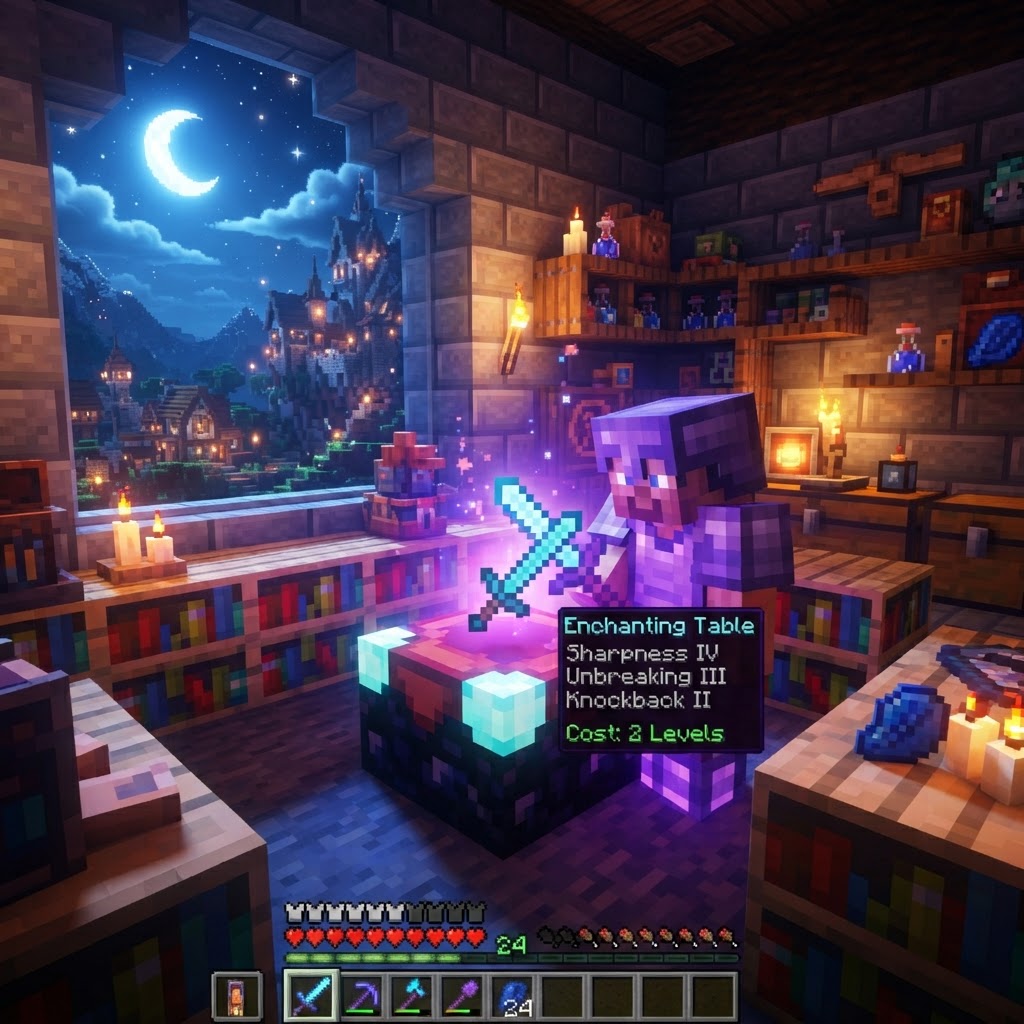
Enchanting is the difference between dying on your fifth trip to the Nether and dominating the End with gear that makes you nearly unstoppable. If you've been frustrated by weak enchantments, wasted lapis lazuli, or confusion about how the system actually works, this guide cuts through the noise and gives you everything you need to enchant items in Minecraft the right way.
Setting Up Your Enchanting Table Correctly
Most players skip this step entirely — and pay for it with garbage-tier enchantments.
An enchanting table alone won't get you powerful enchantments. The table has a maximum enchantment level cap determined by how many bookshelves surround it. Without bookshelves, you're capped at level 8 enchantments — practically useless for late-game gear. Here's how to build the full setup:
- Craft the enchanting table using 4 obsidian, 2 diamonds, and 1 book.
- Place the table in an open area where you can surround it with bookshelves.
- Place 15 bookshelves in a 5x5 ring, one block away from the table, leaving one gap for you to walk in. Leave the ring at two blocks tall if needed, but the table only reads bookshelves within a 5-block radius.
- Make sure no blocks sit between the table and the bookshelves — even a torch or chest placed in the gap will break the connection.
- Once all 15 bookshelves are correctly placed, your enchanting table will offer level 30 enchantments — the maximum.
Bookshelf Math:
Each bookshelf adds 2 levels to the maximum enchantment tier visible on the table. You need exactly 15 bookshelves to unlock level 30. More than 15 does nothing.
Understanding How the Enchanting Table Works
The enchanting table isn't random — it's semi-predictable if you know the rules.
The table always shows you three enchantment options at different experience costs (levels 1, 2, and 3 of each "slot"). The third option costs 3 lapis lazuli and requires you to be at or above a certain XP level, but it only spends a fixed amount of levels, not all of them.
| Enchantment Slot | Lapis Cost | XP Level Required | Levels Spent |
|---|---|---|---|
| Slot 1 (lowest) | 1 lapis | Varies (1–8) | 1 level |
| Slot 2 (middle) | 2 lapis | Varies (8–23) | 2 levels |
| Slot 3 (highest) | 3 lapis | Varies (23–30) | 3 levels |
The enchantment you see listed is a hint, not the full picture. You may receive additional enchantments on the item alongside the one displayed — this is completely normal and a core feature of the system.
Your enchanting seed also matters. Hovering over a slot shows a partial enchantment name. If you enchant a throwaway item in Slot 1 first, your seed changes — which shifts what Slot 3 will offer. This is how experienced players fish for specific enchantments.
Using an Anvil and Enchanted Books
The anvil method gives you control — use it when you need specific enchantments on specific gear.
Enchanting tables are great for rolling random results, but if you need Mending on your pickaxe or Silk Touch on your shovel, you need enchanted books combined with an anvil.
How to apply enchanted books:
- Gather an enchanted book (from fishing, trading with librarians, chests, or enchanting a book at the table).
- Open your anvil interface.
- Place your tool or armor in the left slot, the enchanted book in the right slot.
- Pay the XP cost shown. If it says "Too Expensive," see the Common Mistakes section below.
Combining Items vs. Combining Books:
| Method | Pros | Cons |
|---|---|---|
| Enchanting Table | Fast, cheap early on | Random results, can't target specifics |
| Anvil + Enchanted Book | Precise, repeatable | Costs more XP, "Too Expensive" risk |
| Combining Two Enchanted Items | Merges multiple enchants | Rapidly increases prior work penalty |
| Librarian Trading | Farm exact enchants repeatably | Requires villager setup and emeralds |
Best Enchantments by Gear Type
Not all enchantments are equal — these are the ones that actually change how the game feels.
Knowing what to enchant items with in Minecraft separates players who survive from players who thrive. Here are the highest-priority enchantments organized by gear type:
Sword:
- Sharpness V — Your bread and butter. +3 damage per hit at max level.
- Looting III — Critical for mob drops, especially blaze rods and wither skulls.
- Mending — Repairs the sword using XP orbs. Non-negotiable for your main sword.
- Unbreaking III — Makes Mending significantly more effective.
- Sweeping Edge III (Java only) — Dramatically improves crowd control.
Pickaxe:
- Efficiency V — Mining at this level feels like a different game.
- Fortune III — Essential for diamonds, coal, and ore multipliers. Never use Silk Touch on diamond ore.
- Mending + Unbreaking III — Keep this pickaxe forever.
- Silk Touch — Secondary pickaxe for grass blocks, beehives, and spawners.
Armor (Priority Order):
- Protection IV on all four pieces — General protection stacks multiplicatively across pieces.
- Mending on all four pieces — Sustains your armor indefinitely with XP.
- Feather Falling IV on boots — Prevents the most common player death.
- Thorns III on chest — Reflects damage to attackers.
- Respiration III + Aqua Affinity on helmet — Game-changing for ocean exploration.
Bow:
- Power V — Maximum damage output.
- Infinity — One arrow fires forever. (Cannot combine with Mending.)
- Flame I — Sets targets on fire for bonus damage over time.
- Punch II — Knocks back enemies, great for cliffs or Nether mob control.
Common Mistakes Players Make When Enchanting
These errors waste resources, cap your gear, and frustrate even experienced players.
Mistake 1: Using the anvil without a plan.
Applying enchantments in random order caps your item with the "Too Expensive" penalty before you've added what matters. Always map out your enchantment order before touching the anvil.
Mistake 2: Putting Fortune and Silk Touch on the same pickaxe.
These two enchantments are mutually exclusive. They cannot coexist on the same tool. Keep two pickaxes — one for each.
Mistake 3: Enchanting at low XP levels.
Enchanting at level 15 when you need level 30 gives you significantly weaker results. Always grind to at least level 30 before using your enchanting table for serious gear.
Mistake 4: Ignoring librarian villagers.
Librarians can be "reset" by breaking and replacing their lectern until they offer the enchanted book you want. This is the most reliable way to repeatedly get Mending books — arguably the most valuable enchantment in the game.
Mistake 5: Combining two highly-used items together.
If your sword already has 3 anvil uses and you try to combine it with another sword that also has 3 anvil uses, the resulting item will have a prior work penalty so high it becomes Too Expensive almost immediately. Start enchanting processes from fresh items when possible.
Mistake 6: Not using a grindstone strategically.
A grindstone removes enchantments and returns some XP — but also resets prior work penalty to zero. If an item you're experimenting on gets expensive, grindstone it and start fresh.
Pro Strategies for Advanced Enchanting
Once you understand the basics, these techniques separate good players from exceptional ones.
The Book Stacking Method:
Instead of applying individual books to your gear one at a time, combine books together first. Merge two Sharpness V books into one combined book before touching your sword. This costs fewer prior work penalties on the final item and keeps your gear under the "Too Expensive" threshold far longer.
The Librarian Farm:
Build a dedicated villager trading hall with multiple librarian villagers. Assign each one a specific enchanted book you need. Cure zombie villagers (using a weakness potion and golden apple) to get massive discounts — down to a single emerald per book in some cases. This is the most XP-efficient and reliable enchanting method in the game once your base is established.
Fishing for Enchanted Books:
A fishing rod with Luck of the Sea III and Lure III dramatically increases the rate at which you catch enchanted books. This is passive, semi-AFK, and can net you rare enchantments like Mending without any villager setup. Build an AFK fishing farm for truly passive enchantment collection.
Maximize Your XP Income:
- Build a mob spawner XP farm using a dungeon or blaze spawner.
- Smelt large quantities of items using furnaces — smelting gives XP when you collect the output.
- Use a Bottle o' Enchanting to quickly bank XP before a risky adventure.
- Enchant a book for Sharpness V at the enchanting table.
- Enchant a separate book for Looting III.
- Combine the two books on an anvil into one book.
- Apply combined book to fresh sword.
- Apply Unbreaking III book.
- Apply Mending book last (most expensive individual book).
- Result: fully enchanted sword with minimal prior work penalty.
Optimal Enchant Order for a Diamond Sword (Example):
Conclusion
Enchanting items in Minecraft rewards the players who understand the system — not the ones who just hope for good RNG.
The core takeaways: set up your bookshelf ring correctly for level 30 access, understand that the anvil method is for precision while the table is for volume, never ignore prior work penalties, and invest early in a librarian trading system if you want reliable access to top-tier enchantments like Mending. The players who feel unstoppable in Minecraft aren't luckier — they're using these systems deliberately. Apply what's in this guide, plan your enchantment order before opening your anvil, and your gear will reflect the effort.
RELATED ARTICLES
How to Make a Book in Minecraft: Easy Recipe & Uses
You're probably here because you just hit a wall — enchanting, writing, or crafting something advanced — and realized you need books but aren't sure how to get them efficiently. Books are one of Minec...
How to Make a Blast Furnace in Minecraft: Recipe & Uses
If you've been manually smelting ores one by one in a regular furnace, you're wasting serious time — the Minecraft blast furnace doubles your smelting speed for metals and ores, making it one of the m...
How to Make a Smoker in Minecraft: Recipe & Uses
If you're tired of waiting forever for your food to cook in a standard furnace, the smoker is the upgrade you didn't know you needed. It cooks food items at exactly twice the speed of a regular furnac...
STAY UPDATED
New blog posts, guides, and community tips delivered to your inbox.
No spam. Unsubscribe anytime.
Comments (0)
No comments yet. Be the first to share your thoughts!

