TABLE OF CONTENTS
How to Make a Composter in Minecraft: Recipe & Uses
If you've ever stared at mountains of seeds, rotting crops, and leftover food with no idea what to do with them, the composter is exactly what your Minecraft base needs. Beyond just cleaning up inventory clutter, a composter is your fastest route to a renewable bone meal supply — which directly accelerates your farms, dye production, and tree growth. Getting this block right from the start saves you hours of grinding.
What a Composter Actually Does (And Why You Need One)
Most players build one, use it once, and forget it — here's why that's a massive mistake.
A composter converts organic items — crops, seeds, plants, food — into bone meal through a composting process. Each time you add a valid item, there's a percentage chance the compost level rises. Once the internal level hits 7, the composter is full and produces a single bone meal you can collect by right-clicking.
But here's the real value: bone meal is one of the most versatile resources in the game. It grows crops instantly, accelerates tree saplings, spreads grass, fertilizes mushrooms, and is a core ingredient in white dye. Without a reliable bone meal source, your early-to-mid game farms are entirely dependent on skeleton drops — which are inconsistent and dangerous to farm.
A composter solves this permanently. Once you hook it into an automated system with hoppers, you essentially have a bone meal factory running in the background while you do everything else.
The Minecraft Composter Recipe: Step-by-Step
Seven fence-style slots, one straightforward craft — but you need the right wood.
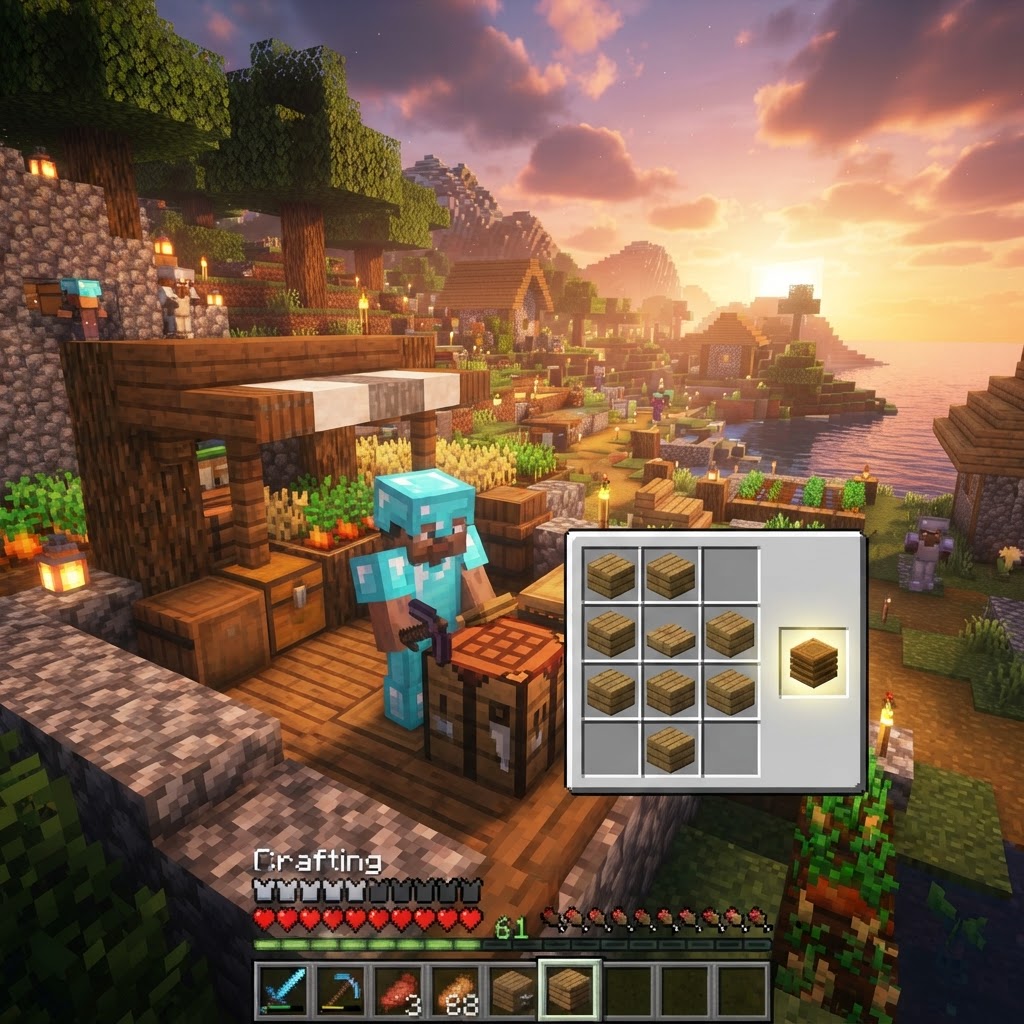
The composter recipe requires 7 wooden slabs of any type — and crucially, they don't need to match. You can mix oak, spruce, birch, jungle, acacia, dark oak, mangrove, bamboo, or cherry slabs freely in a single recipe.
Crafting Layout (3x3 Grid):
- Place one wooden slab in the left slot of the top row
- Leave the center slot empty
- Place one wooden slab in the right slot of the top row
- Fill the entire middle row with three wooden slabs (left, center, right)
- Place one wooden slab in the left slot of the bottom row
- Leave the center slot empty
- Place one wooden slab in the right slot of the bottom row
The result is a U-shaped pattern — essentially a bucket shape with an open top and open bottom center.
| Material | Amount Needed | Notes |
|---|---|---|
| Wooden Slabs (any type) | 7 | Mix and match freely |
| Crafting Table | 1 | Required (can't craft in 2x2) |
| Time to Craft | Instant | No smelting required |
What Items You Can Compost (And Their Efficiency Rates)
Not all organic items are created equal — dumping the wrong things wastes your time.
This is where most players lose efficiency. Every compostable item has a specific chance of raising the compost level. Items are grouped into tiers based on their raise probability.
| Chance Tier | % Chance to Raise Level | Example Items |
|---|---|---|
| Tier 1 (30%) | 30% | Grass, fern, dead bush, small flowers, saplings, seeds (wheat, melon, pumpkin) |
| Tier 2 (50%) | 50% | Dried kelp, sugar cane, vines, glow berries, melons, apples |
| Tier 3 (65%) | 65% | Bread, cookies, hay bales, carrots, potatoes, beetroot, mushrooms |
| Tier 4 (85%) | 85% | Cooked fish, cooked meat, pumpkin pie, cake slices, mushroom stew |
| Tier 5 (100%) | 100% | Cactus (via blocks), nether wart... wait — these do NOT compost |
Best items for fast bone meal production:
- Wheat from a large automated farm — consistent 65% inputs
- Pumpkin/melon slices — high volume, 50-65% rates
- Bread — 85% chance, excellent if you have wheat to spare
- Excess seeds — low rate but often available in massive quantities from grass farming
Using the Composter as a Villager Job Site Block
If you're ignoring this mechanic, you're leaving free trades on the table.
Composters aren't just bone meal machines — they're the designated job site block for the Farmer villager profession. A jobless villager (shown by their plain texture) placed near an unclaimed composter will path to it and become a Farmer.
Why does this matter? Farmer villagers offer some of the best early-game trades in Minecraft:
- Bread, pumpkins, melons, and apples for emeralds
- Golden carrots at high levels — one of the best food items in the game
- Suspicious stew at master level
To assign a Farmer villager:
- Place a composter in your villager trading area
- Ensure no other Farmer already "owns" that composter
- Make sure the villager has a valid path to the block
- Give the villager a bed and wait — they'll claim the job automatically
- Place your composter on the ground
- Place a hopper pointing into the top of the composter — this feeds items in automatically
- Place a hopper underneath the composter pointing into a chest — this collects bone meal automatically
- Connect a chest to the top hopper and dump your excess crops/seeds in
- Use a hopper minecart system to collect crops across wide farm areas and funnel them to a central composter bank
- Run multiple composters in parallel fed by the same chest to process higher volumes faster
- Use a hopper clock or observer to pulse items in at controlled rates if you're dealing with input overflow
- Craft with any 7 wooden slabs in a U-shape — no matching required
- Prioritize high-tier compost items (bread, hay bales) over low-tier seeds
- Always add an output hopper or the system stalls
- Use composters to assign and control Farmer villager professions
- Scale up with parallel composter banks fed by hopper systems
Automating Your Composter with Hoppers
Manual composting is fine early-game — but automation is where the real power is.
A composter works with hoppers on both the input and output sides, making full automation possible with minimal redstone knowledge.
Basic Automated Setup:
That's it. A four-block setup (chest, hopper, composter, hopper, chest) runs entirely hands-free.
For larger farms:
Common Mistakes Players Make with Composters
These are the errors that cost time, resources, and bone meal efficiency.
1. Not accounting for item tier when choosing what to compost
Players often dump whatever's closest — usually seeds — without realizing that seeds have only a 30% raise chance. You'll get far more bone meal per stack by composting bread or hay bales instead. Process seeds only when you have nothing better.
2. Placing the composter with no output hopper
If there's no hopper below the composter, bone meal sits inside and blocks any further composting. You'll check it days later and find it stalled on level 7 with nothing to show for it.
3. Accidentally blocking a Farmer villager's composter
If you build a second composter for automation right next to a trading area, a Farmer villager might "claim" your automation composter, causing path-finding chaos. Keep automation composters separated from trading halls or use glass/slabs to break line-of-sight paths.
4. Expecting composters to handle non-organic items
Manufactured items, metals, cobblestone, and most nether materials don't compost. New players regularly try to dump useless inventory items in — it simply doesn't work.
5. Forgetting that bone meal has a better source later
Once you have a skeleton farm, composters become supplemental rather than primary. Don't over-invest in composter infrastructure if you're close to automating a mob farm — reassess your priorities.
Pro Strategies: Getting Maximum Value from Composters
For players who want to optimize, not just survive.
Stack composters in a bone meal factory
Build a row of 8 composters, all fed by a single overflow chest from a large wheat or pumpkin farm. A single hopper chain feeds all of them, and all of them drain into a single output chest. This scales bone meal production linearly with almost zero additional complexity.
Use composters to control Farmer villager supply
If you're trading with multiple Farmer villagers, control how many composters are available. A single composter serves one Farmer. Want 4 Farmer traders? Place 4 composters with 4 beds. This lets you build a streamlined trading hall with predictable profession assignments.
Combine with a large-scale bamboo farm — carefully
Bamboo itself cannot be composted. However, bamboo farms produce scaffolding and other byproducts. More relevantly, if you use bamboo as fuel to smelt items, the bone meal from composting the food output of those smelted items creates an interesting closed loop. It's niche, but efficient in the right builds.
Composter + bone meal + flower farm = infinite dye
Plant a flower on grass, use bone meal from your composter to duplicate it, then craft dyes. A fully automated flower duplication farm fed by composter bone meal gives you a permanent renewable dye source for banners, beds, and concrete — no biome hunting required.
Use a dropper-based system for faster input
Hoppers are slow (2.5 items per second per hopper). For mass composting, use a dropper clock pulsing items directly into the composter top. This isn't usually necessary, but for players running continent-scale farms, it removes the hopper bottleneck entirely.
Conclusion: The Composter Is More Than a Trash Can
A composter built from 7 wooden slabs seems like a minor early-game craft — and in isolation, it is. But the players who get ahead in Minecraft are the ones who recognize infrastructure value early. A composter connected to an automated farm doesn't just make bone meal; it powers your crop acceleration, your dye supply, your villager trading hall, and your broader resource economy.
Key takeaways:
Build it early, automate it quickly, and let it run. Your future self — staring at a full chest of bone meal with zero effort — will thank you.
RELATED ARTICLES
How to Make a Book in Minecraft: Easy Recipe & Uses
You're probably here because you just hit a wall — enchanting, writing, or crafting something advanced — and realized you need books but aren't sure how to get them efficiently. Books are one of Minec...
How to Make a Blast Furnace in Minecraft: Recipe & Uses
If you've been manually smelting ores one by one in a regular furnace, you're wasting serious time — the Minecraft blast furnace doubles your smelting speed for metals and ores, making it one of the m...
How to Make a Smoker in Minecraft: Recipe & Uses
If you're tired of waiting forever for your food to cook in a standard furnace, the smoker is the upgrade you didn't know you needed. It cooks food items at exactly twice the speed of a regular furnac...
STAY UPDATED
New blog posts, guides, and community tips delivered to your inbox.
No spam. Unsubscribe anytime.
Comments (0)
No comments yet. Be the first to share your thoughts!

