TABLE OF CONTENTS
How to Make a Stonecutter in Minecraft: Recipe & Uses
If you've ever wasted a stack of stone slabs crafting the wrong shape, or sat at a crafting table doing painful math to figure out how many stairs you need — the stonecutter exists to fix exactly that. This block is one of the most underutilized efficiency tools in Minecraft, and most players either don't know how to make it or don't realize how much material and time it saves. This guide gives you the full picture: the recipe, where to find one for free, every block it works on, and the strategies that separate casual builders from serious ones.
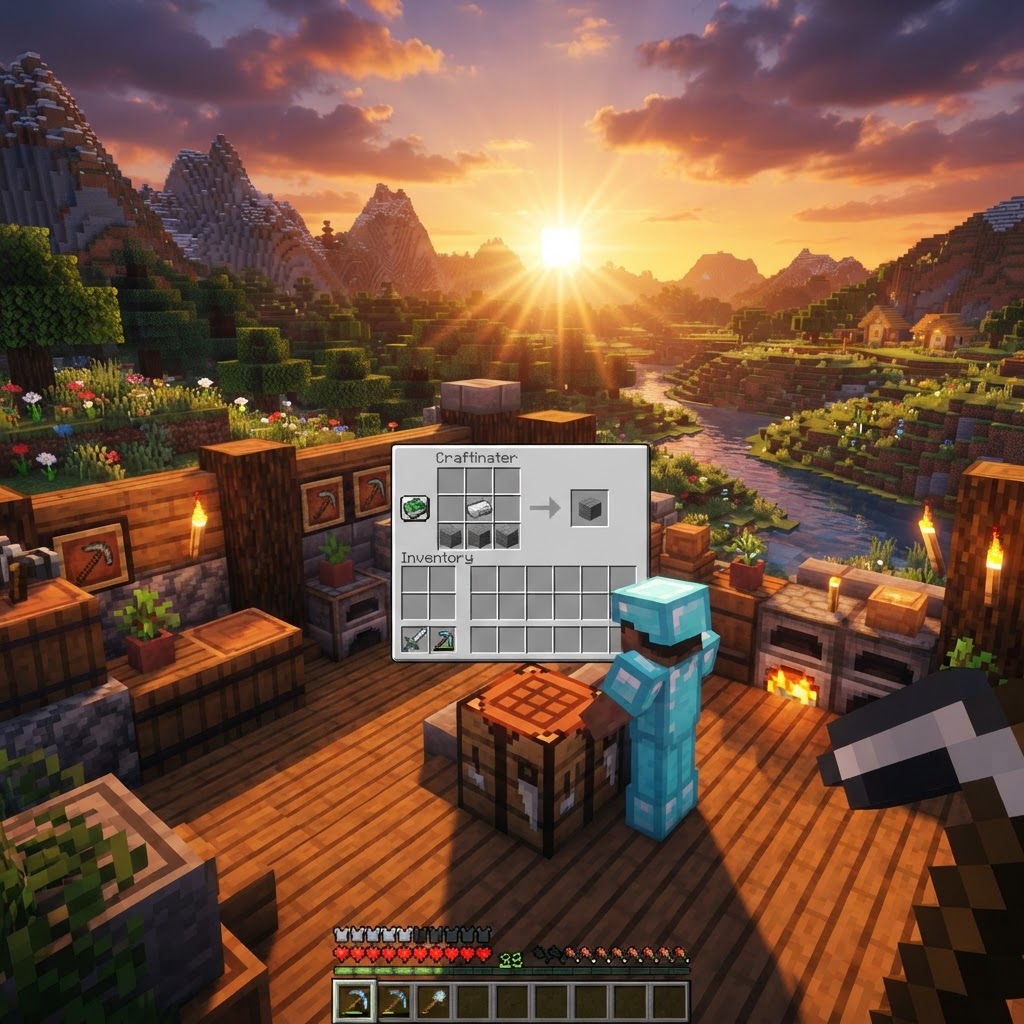
The Minecraft Stonecutter Recipe
Everything you need to craft one in under a minute.
The stonecutter recipe is refreshingly simple, and the materials are available in your first day of play if you know where to look.
You need:
- 3x Stone (not cobblestone — smelted stone)
- 1x Iron Ingot
Crafting layout (3x3 grid):
- Place the Iron Ingot in the center of the top row (middle slot, row 1)
- Place 3 Stone blocks across the entire bottom row (slots 7, 8, 9)
- That's it — the stonecutter appears in the output slot
- Plains villages
- Savanna villages
- Taiga villages
- Desert villages
- Snowy villages
The iron ingot requirement is the only real cost here. If you're early game and iron is tight, check villages first (more on that below). Stone itself is infinite — smelt any cobblestone you've mined and you're set.
Where to Find a Stonecutter Without Crafting One
Villages spawn stonecutters for free — here's where to look.
Before you burn your iron, check your world for a village. Stonecutters generate naturally in Mason houses inside villages. Every Mason villager profession is tied to a stonecutter job site block, which means wherever you find a Mason, there's a stonecutter nearby.
Biomes where Mason houses (and stonecutters) generate:
You can pick up the stonecutter with any pickaxe — no specific tier required. It drops as a placeable block and retains full functionality. If you're near a village early game, this saves your iron for tools and armor where it matters more.
Every Block the Stonecutter Can Process
This is where the real value is — know what it handles before you build.
The stonecutter doesn't work on every block in the game, but its coverage of stone-family materials is extensive. Here's a breakdown of the major material categories:
| Material Family | Stonecutter Outputs Available |
|---|---|
| Stone | Slabs, Stairs, Chiseled Stone, Stone Bricks, Stone Brick Stairs/Slabs/Walls |
| Cobblestone | Slabs, Stairs, Walls |
| Stone Bricks | Slabs, Stairs, Walls, Chiseled, Cracked (Java only) |
| Sandstone | Slabs, Stairs, Walls, Chiseled, Cut, Smooth variants |
| Quartz | Slabs, Stairs, Chiseled, Quartz Pillars, Quartz Bricks |
| Blackstone | Slabs, Stairs, Walls, Polished, Chiseled, Gilded |
|---|---|
| Deepslate | Slabs, Stairs, Walls, Cobbled, Polished, Chiseled variants |
| Prismarine | Slabs, Stairs, Walls, Dark Prismarine variants |
| Andesite / Diorite / Granite | Slabs, Stairs, Walls, Polished variants |
| Copper (Java 1.21+) | Slabs, Stairs, Grates, Chiseled (oxidized variants included) |
Stonecutter vs. Crafting Table: Why It Actually Matters
The material efficiency difference is bigger than most players realize.
This is the section that converts casual players into stonecutter converts. The crafting table technically lets you make most of the same shapes — but at a significant material cost for several recipes.
| Output Block | Crafting Table Cost | Stonecutter Cost | Material Saved |
|---|---|---|---|
| Stone Stairs | 6 stone → 4 stairs (1.5:1 ratio) | 1 stone → 1 stair (1:1 ratio) | 33% savings |
| Stone Slabs | 3 stone → 6 slabs (0.5:1 ratio) | 1 stone → 2 slabs (0.5:1 ratio) | Equal |
| Stone Bricks | 4 stone → 4 bricks | 1 stone → 1 brick | Equal |
| Chiseled Stone | 2 slabs → 1 chiseled (inefficient chain) | 1 stone → 1 chiseled (direct) | Saves crafting steps |
| Stone Brick Stairs | 6 bricks → 4 stairs | 1 stone → 1 stair (skips bricks entirely) | Massive — skips intermediate craft |
The stair calculation is where the stonecutter proves its worth most dramatically. Building a large structure with stone stairs? Using a crafting table, you need 6 blocks to make 4 stairs. Using a stonecutter, 1 block makes 1 stair. For a project requiring 200 stairs, that's 300 blocks with a crafting table versus 200 with a stonecutter — a full stack saved.
The stonecutter also lets you go directly from raw stone to stone brick stairs in a single step, skipping the intermediate stone brick craft entirely. This isn't just material efficiency — it's time efficiency on large builds.
Common Mistakes Players Make With the Stonecutter
Avoid these and you'll use this block at 100% of its potential immediately.
1. Using cobblestone instead of stone in the recipe
The single most common failure point. Players pull cobblestone from their inventory, place it in the crafting grid, and wonder why nothing appears. Smelt your cobblestone first. One furnace cycle per block.
2. Not checking villages before crafting
Spending 3 iron ingots across a session crafting multiple stonecutters when a single village trip would have given you one (or three) for free. Always scout villages first.
3. Ignoring the stonecutter for "non-decorative" builds
Some players only pull out the stonecutter when they're decorating. Wrong. Use it every time you're processing stone into stairs — even for functional builds like mine shafts, underground bases, and mob farms with stone staircases. The material savings compound over hundreds of hours.
4. Not knowing the stonecutter skips crafting steps
Many players still craft stone bricks first, then bring them to the stonecutter for stairs. You can go straight from raw stone to stone brick stairs in one stonecutter operation. Skip the middle step.
5. Forgetting it works on Nether materials
Blackstone, basalt (Java), and quartz are all stonecutter-compatible. Players who build Nether-themed structures and don't use the stonecutter are leaving efficiency on the table in one of the most resource-intensive biomes to build in.
6. Playing on Bedrock and expecting the same outputs as Java
There are minor differences between versions, particularly around cracked stone bricks (craftable via stonecutter on Java, not on Bedrock) and some copper variants. If a YouTube tutorial shows an output you can't find, version difference is the likely cause.
Pro Strategies: Getting More Out of Your Stonecutter
For builders who want to optimize at a level most guides don't cover.
Chain-process materials in bulk before building
Before starting a large project, estimate your full material needs and process everything at once. Standing at a stonecutter for 10 minutes upfront beats running back and forth during a build session. Pre-process all your stairs, slabs, and walls as raw materials before laying a single block.
Use the stonecutter to "downconvert" expensive blocks cheaply
Polished andesite can be cut into polished andesite slabs directly. If you have excess polished granite or diorite from terrain generation (most players do), the stonecutter turns "useless" byproduct stone into valuable decorative slabs and stairs without any extra crafting cost.
Keep a stonecutter in your Nether base
Nether fortresses and bastion remnants provide blackstone in bulk. Processing blackstone into polished blackstone bricks and their stair/slab variants on-site means you carry finished building materials back, not raw blocks — more efficient per inventory slot.
Exploit the stonecutter for XP-free conversion in automation
Unlike furnaces (which generate XP), the stonecutter converts blocks without any XP output. This matters in technical play — stonecutter-based item conversion won't interfere with XP farm designs the way furnace processing can.
Use the stonecutter to test a palette before committing
When you're deciding between stone brick walls, cobblestone walls, or andesite walls for a build, run a small sample of each through the stonecutter quickly to get one of each variant. Place them in-world and compare visually before mining 200 blocks of the wrong material.
Conclusion
The stonecutter is a small block with a big impact on how efficiently you build.
The Minecraft stonecutter recipe is simple — 3 stone and 1 iron ingot — but the real value isn't in making it, it's in using it consistently. The stair conversion ratio alone justifies always having one accessible, and the ability to skip intermediate crafting steps saves both materials and time on every serious build project. Find one in a village if you can, craft one if you can't, and make it a permanent fixture in your base or building station. Once you run the math on stair efficiency, you won't go back to the crafting table for stone shapes.
RELATED ARTICLES
How to Make a Book in Minecraft: Easy Recipe & Uses
You're probably here because you just hit a wall — enchanting, writing, or crafting something advanced — and realized you need books but aren't sure how to get them efficiently. Books are one of Minec...
How to Make a Blast Furnace in Minecraft: Recipe & Uses
If you've been manually smelting ores one by one in a regular furnace, you're wasting serious time — the Minecraft blast furnace doubles your smelting speed for metals and ores, making it one of the m...
How to Make a Smoker in Minecraft: Recipe & Uses
If you're tired of waiting forever for your food to cook in a standard furnace, the smoker is the upgrade you didn't know you needed. It cooks food items at exactly twice the speed of a regular furnac...
STAY UPDATED
New blog posts, guides, and community tips delivered to your inbox.
No spam. Unsubscribe anytime.
Comments (0)
No comments yet. Be the first to share your thoughts!

