TABLE OF CONTENTS
How to Make a Book in Minecraft: Easy Crafting Guide
If you've hit a wall trying to enchant gear, store knowledge, or set up a librarian trade, you already know the problem — books are the backbone of Minecraft's progression system, and not having them slows everything down. Whether you're chasing your first enchanting table or building an entire book farm, understanding every layer of book crafting will save you hours of frustration.
Why Books Are Central to Minecraft Progression
Books unlock some of the most powerful systems in the entire game — don't treat them as an afterthought.
Most players think of books as a simple early-game item. That's a mistake. Books gate access to enchanting, villager trading, written communication, and bookshelves — which themselves boost enchantment levels. Without a steady book supply, your enchanting table is capped at level 1 enchantments, your librarian villagers won't trade, and you can't craft a single bookshelf.
Here's what books directly enable:
- Enchanting Table Power: Each bookshelf surrounding an enchanting table adds enchantment levels, up to a maximum of 15 bookshelves for level 30 enchants. Each bookshelf requires 3 books.
- Librarian Trades: Librarian villagers trade enchanted books for emeralds — but first, their lectern (and your ability to craft it) depends on books being accessible.
- Book and Quill: For servers and roleplay, written books let you communicate, document seeds, leave coordinates, and create interactive libraries.
- Enchanted Books: Combining books with an enchanting table or anvil lets you store and transfer specific enchantments.
- Plant it on sand or dirt directly adjacent to water
- It grows up to 3 blocks tall — harvest at block 2 and leave the base to regrow
- A simple automatic sugar cane farm with observers and pistons can generate hundreds of paper per hour
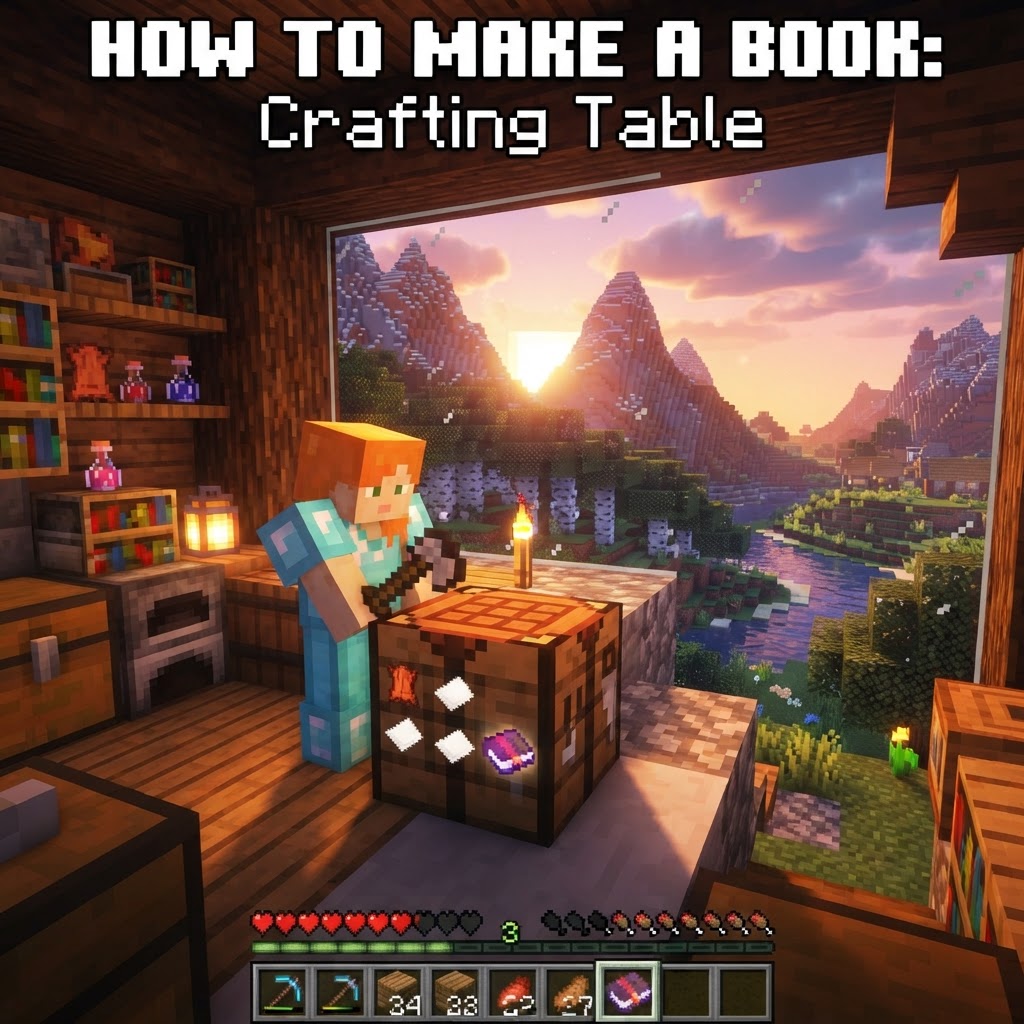
- Open your crafting table (3x3 grid)
- Place 3 paper in a vertical column on the left side (slots 1, 4, 7)
- Place 1 leather in slot 5 (center)
- Drag the book from the output slot to your inventory
- Auto sugar cane farm (observer + piston + hopper) feeding paper production
- Cow crusher/breeder for passive leather generation
- Auto-crafter (Java 1.21+) to combine both into books without manual crafting
- Build isolated stalls with lecterns
- Trap unemployed villagers and assign them to lecterns
- Reload trades by breaking/replacing the lectern until you get the enchantment you want
- Stock emeralds through iron farms or crop trading (wheat to farmers)
- Always use a crafting table, not your inventory grid
- Build sugar cane and cow farms early, not reactively
- Craft your full 15-bookshelf enchanting setup before spending books elsewhere
- Use librarian villagers for targeted enchanted books — don't gamble the table
- On Java 1.21+, automate the entire pipeline with auto-crafters
Gathering Your Materials: Leather and Paper
The two ingredients most players underestimate — until they're stuck without either.
A basic book requires 3 paper and 1 leather. That's it. But sourcing both efficiently is where players lose time.
Paper
Paper is crafted from sugar cane, which grows naturally near water in most biomes. Place 3 sugar cane in a horizontal row across a crafting table to produce 3 paper. One row of sugar cane = enough paper for one book.
Sugar Cane Tips:
Leather
Leather drops from cows, horses, donkeys, mules, llamas, and hoglins. Each mob drops 0–2 leather. The inconsistency is the real problem — cows are your most reliable source.
| Leather Source | Drops Per Kill | Reliability | Notes |
|---|---|---|---|
| Cow | 0–2 (avg 1) | High | Most common, breedable |
| Horse/Donkey | 0–2 | Medium | Less common spawn |
| Llama | 0–2 | Medium | Found in mountains/savanna |
| Hoglin | 0–1 | Low | Nether only, hostile |
| Fishing (Junk) | 1 | Low | Rare junk drop |
| Rabbit Hide (4x) | 1 via crafting | Low | Inefficient |
|---|
Crafting the Book: Step-by-Step
The recipe is simple, but the placement matters — and Java vs. Bedrock behaves differently.
Standard Book Recipe
Crafting Table Recipe Visual
```
```
P = Paper, L = Leather (any arrangement works)
Book Variants: Which One Do You Actually Need?
There are four distinct book types in Minecraft — each serves a completely different purpose.
Most guides stop at the basic book. But the item you actually need depends entirely on your goal. Here's the breakdown:
Bookshelf
| Book Type | Crafting Requirements | Primary Use |
|---|---|---|
| Book | 3 Paper + 1 Leather | Bookshelves, enchanting table setup |
| Book and Quill | 1 Book + 1 Feather + 1 Ink Sac | Writing, server communication, roleplay |
| Enchanted Book | Book + Enchanting Table or Anvil | Storing/transferring enchantments |
| Written Book | Signed Book and Quill | Permanent, shareable written books |
Crafted with 6 planks + 3 books, bookshelves are the primary reason players mass-produce books. They serve as décor but also power your enchanting setup.
Enchanted Book
You can create enchanted books by placing a regular book in the enchanting table. This stores an enchantment for later use on an anvil. Alternatively, combine books in an anvil to merge enchantments.
Common Mistakes Players Make
These are the errors that waste your resources and stall your progression.
1. Trying to craft in the 2x2 inventory grid
Books require a crafting table. New players frequently attempt this in their inventory and wonder why it isn't working.
2. Burning through leather on armor early
Leather armor is tempting at the start, but it's weak and quickly replaced. Prioritizing leather for books and bookshelves pays off far more in the mid-game.
3. Not scaling sugar cane production
A single sugar cane plant barely keeps up with book demand once you're building an enchanting room. Build a farm with at least 16 plants before you start crafting bookshelves in bulk.
4. Forgetting that bookshelves must be placed correctly
Bookshelves need to be within 2 blocks of the enchanting table, at the same height or one block above, with no blocks between them (including torches, carpets, or slabs). Many players place bookshelves and wonder why their enchantment level isn't rising.
5. Using books for decoration before securing the enchanting setup
Build your 15-bookshelf enchanting room first. Every book you spend on décor before that is a book that delays level 30 enchants.
6. Ignoring rabbit hide as a backup leather source
Four rabbit hides craft into one leather. If you're in a plains or forest biome with few cows, rabbits are actually a useful supplement most players skip entirely.
Pro Strategies for Advanced Players
If you're past the basics and want to optimize, these approaches change the math entirely.
Automated Book Farms
The most efficient large-scale approach combines:
On servers or long-term worlds, this setup can produce hundreds of books per hour passively.
Villager Trading Loops for Enchanted Books
Rather than spending books at an enchanting table randomly, set up a librarian trading hall:
This system gives you targeted enchantments — Mending, Silk Touch, Fortune III — without gambling on the enchanting table.
Book-to-Emerald Trading for Early Economy
Librarians will sometimes offer to buy books for emeralds (Java Edition). If you find a librarian with this trade, a functional sugar cane and cow farm suddenly becomes an emerald generator. Pair this with a Fletcher (sticks → emeralds) or Farmer (crops → emeralds) for a multi-stream emerald economy.
Looting III for Leather Efficiency
If you're killing cows manually, a sword enchanted with Looting III increases the maximum leather drop to 5 per kill. Combined with Fire Aspect, you also get cooked beef automatically. This triples your leather output without building any infrastructure.
The Mending Priority Rule
If you're setting up a librarian hall, prioritize finding a Mending trade above all others. Mending is not available from the enchanting table — it only comes from trades, fishing, or loot. A Mending librarian is worth locking in and protecting permanently.
Conclusion: Build Your Book Supply Before You Need It
Books aren't a mid-game luxury — they're a foundational resource you should be farming from day five onward.
The core recipe — 3 paper and 1 leather at a crafting table — takes seconds to execute. The real skill is recognizing how central books are to everything that follows: your enchanting room needs 45 of them, your librarian trades depend on them, and your long-term gear progression stalls without a reliable supply.
Key takeaways:
The players who dominate endgame enchanting aren't the ones who got lucky at the table — they're the ones who built the infrastructure first. Start your book supply now.
RELATED ARTICLES
How to Enchant in Minecraft: Best Methods, Books & Tips
Surviving Minecraft's mid-to-late game without enchantments isn't just harder — it's nearly impossible. Whether you're pushing into the Nether, raiding End Cities, or grinding for netherite, unenchant...
How to Make a Brewing Stand in Minecraft: Recipe & Uses
If you've hit a wall in Minecraft — mobs are one-shotting you, your armor feels useless, and the End seems impossible — a brewing stand is the tool that changes everything. Potions transform your surv...
How to Make Glass in Minecraft: A Complete Smelting Guide
Glass is one of those crafting staples that looks simple on the surface but hides a surprising number of ways to go wrong — and a lot of creative potential most players never tap. Whether you're build...
STAY UPDATED
New blog posts, guides, and community tips delivered to your inbox.
No spam. Unsubscribe anytime.
Comments (0)
No comments yet. Be the first to share your thoughts!

