TABLE OF CONTENTS
How to Make a Blast Furnace in Minecraft — Complete Guide
If you're smelting ore after ore in a regular furnace and watching your time disappear, a blast furnace is exactly what you've been missing. This block doubles your smelting speed for ores and metal items, making it one of the most efficient upgrades you can build in the early-to-mid game. Whether you're rushing to gear up or optimizing a large-scale mining operation, understanding the blast furnace fully — not just the recipe — is what separates efficient players from frustrated ones.
What Is a Blast Furnace and Why You Need One
Understanding the block's purpose saves you from building one at the wrong time — or never building one at all.
A blast furnace is a utility block in Minecraft that smelts ore blocks, raw metals, and metal armor or tools at twice the speed of a regular furnace. That speed comes at a cost — it consumes fuel at double the rate too — but the net efficiency is the same or better depending on how you play. The real win is time, not fuel economy.
Here's the thing most guides skip: the blast furnace is specialized. It only processes ore-related items. You can't cook food in it, smelt glass, or make charcoal. Players who build one expecting a universal upgrade get confused and disappointed. Build it knowing its lane, and it becomes one of the most valuable blocks in your base.
The blast furnace also serves a secondary purpose: assigning the Armorer job to villagers. If you're building a trading hall or trying to get discounted diamond armor, a blast furnace is the workstation you need. That alone makes it worth crafting even if you have a fully automated smelting setup elsewhere.
Crafting Recipe & Materials You'll Need
Get the ingredients wrong once and you'll waste iron — here's exactly what you need.
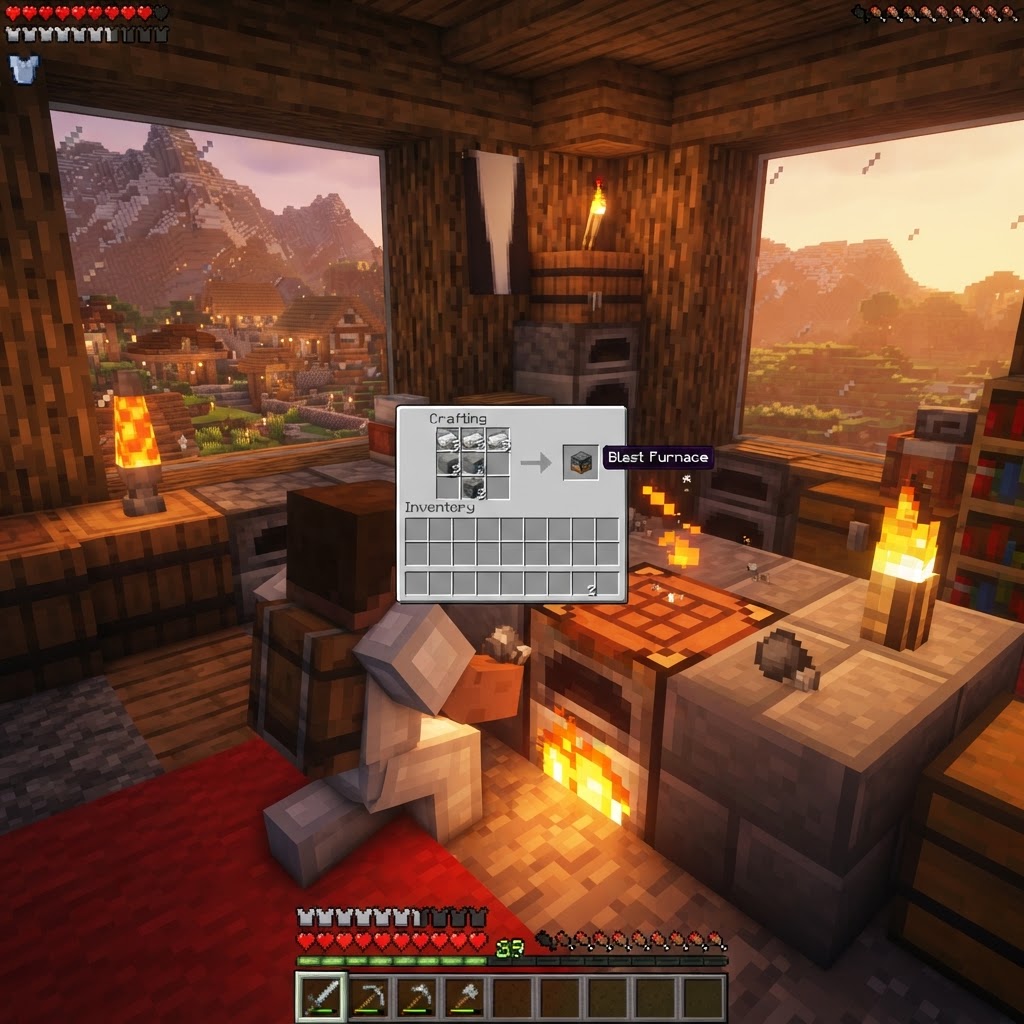
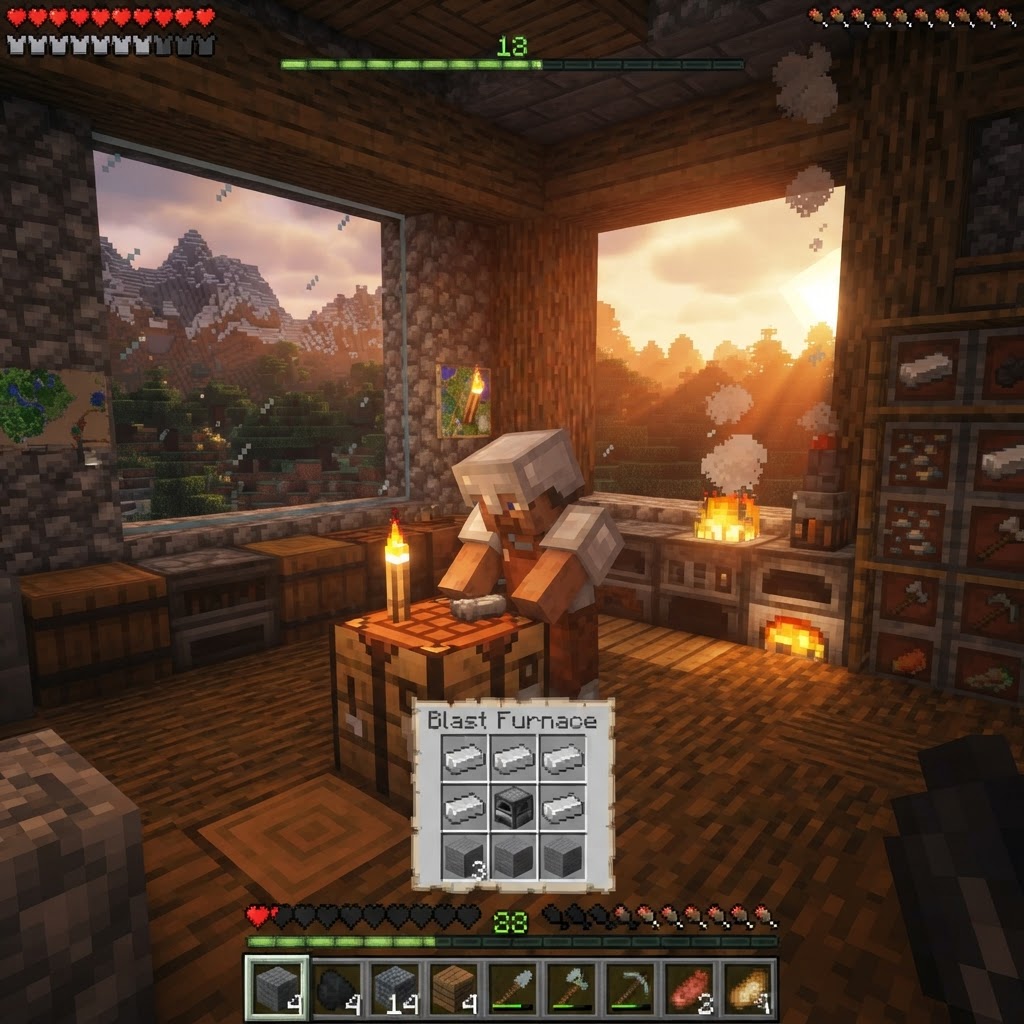
The blast furnace requires 5 iron ingots, 1 furnace, and 3 smooth stone. None of these are rare, but new players often stumble on the smooth stone step because it requires two smelting passes, not one.
Full materials breakdown:
- 5 Iron Ingots — Smelt 5 raw iron (iron ore drops raw iron in 1.17+; older versions drop the ore block itself)
- 1 Furnace — Craft with 8 cobblestone in a ring pattern on the crafting table
- 3 Smooth Stone — Smelt cobblestone → stone → smooth stone (two separate smeltings)
Crafting grid layout (3x3):
```
```
The furnace goes in the center. Iron ingots fill the top row and both middle-row sides. Smooth stone fills the entire bottom row.
Step-by-Step: Building Your First Blast Furnace From Scratch
Follow this sequence and you'll have a working blast furnace in under 10 minutes of playtime.
- Mine at least 13 iron ore — You need 5 ingots for the blast furnace itself, plus extra for tools if you're early-game. Mining 13 gives you buffer.
- Mine at least 12 cobblestone — 8 for the furnace, 3+ for smooth stone, and a few spare.
- Build a crafting table if you don't have one already (4 wood planks in a 2x2).
- Craft a furnace using 8 cobblestone in a ring on the crafting table.
- Smelt your iron ore in the furnace to get iron ingots. Use wood or coal as fuel.
- Smelt 3 cobblestone into stone, then smelt that stone into smooth stone — two separate batches.
- Open the crafting table, place your materials in the pattern above, and pull out your blast furnace.
- Place it in your base near your storage system for maximum workflow efficiency.
- All ore variants (iron, gold, copper, ancient debris)
- Raw metal items (raw iron, raw gold, raw copper)
- Iron, gold, and chainmail armor
- Iron and golden tools/weapons
- Horse armor (iron and gold)
- Craft it correctly: 5 iron ingots + 1 furnace + 3 smooth stone (double-smelt the cobblestone)
- Use it for ores and metals only: don't expect it to replace your regular furnace entirely
- Accept the XP tradeoff: faster smelting means less XP per item — know when each furnace type serves you better
- Automate it: hoppers on top (input), side (fuel), and bottom (output) unlock its full potential
- Leverage the Armorer mechanic: every trading hall needs blast furnaces, not just your smelting room
Blast Furnace vs Regular Furnace: What's Actually Different
Knowing exactly where the blast furnace beats the regular furnace prevents you from misusing both.
| Feature | Regular Furnace | Blast Furnace |
|---|---|---|
| Smelting Speed | 1x (10 seconds/item) | 2x (5 seconds/item) |
| Fuel Consumption Rate | Normal | Double |
| Smeltable Items | All smeltable items | Ores, raw metals, metal armor/tools only |
| XP per smelt | Standard rates | Half the XP per item |
| Villager workstation | Unemployed → Farmer? | Unemployed → Armorer |
| Crafting cost | 8 cobblestone | 5 iron + 1 furnace + 3 smooth stone |
|---|
The XP difference is significant for players who AFK-smelt to level up. A blast furnace gives you half the experience per item. If you're smelting 1,000 iron for XP farming, stick to regular furnaces. If you just want the ingots fast, blast furnace wins every time.
Smeltable item categories (Blast Furnace only):
Common Mistakes Players Make With Blast Furnaces
These are the errors that waste your materials, your time, and your fuel — avoid all of them.
Mistake 1: Using it for non-metal items
Players try to smelt sand into glass or logs into charcoal and wonder why the blast furnace won't accept the item. It simply won't. Keep a regular furnace nearby for everything non-metallic.
Mistake 2: Ignoring the XP loss
If you're building an XP farm around AFK smelting, the blast furnace is actively bad for that purpose. It gives 50% less XP per smelt. Players set up blast furnace arrays, AFK for an hour, and get half the levels they expected.
Mistake 3: Not automating fuel
The blast furnace burns fuel twice as fast. If you're hand-feeding it coal, you'll run out constantly. Hook up a hopper system below it for fuel input and above for item input. This is not optional for any serious operation.
Mistake 4: Forgetting the Armorer villager mechanic
Blast furnaces placed near unemployed villagers will convert them to Armorers. If you've placed one accidentally near your farming villagers, you may have converted workers you didn't want to change. Place blast furnaces deliberately and away from unassigned villagers unless you want Armorers.
Mistake 5: Crafting smooth stone wrong
Covered above, but worth repeating — stone ≠ smooth stone. Two smelting steps required. Check your inventory carefully before heading to the crafting table.
Pro Strategies: Getting Maximum Value From Your Blast Furnace
Once you've got the basics down, these are the plays that actually separate efficient miners from casual players.
Strategy 1: Build a dedicated ore-processing station
Set up 3-4 blast furnaces side by side, each fed by a separate hopper from a central chest. When you return from a big mining trip, dump all raw ore into the top chest and let the system process everything in parallel. With 4 blast furnaces running at double speed, you're effectively processing at 8x the rate of a single regular furnace.
Strategy 2: Use blast furnaces exclusively for ancient debris
Ancient debris is rare enough that every second of processing time matters. Each piece takes 10 seconds in a regular furnace vs. 5 seconds in a blast furnace. It's a small gap per piece, but if you're doing multiple Nether sessions, it adds up. Always reserve at least one blast furnace specifically for netherite conversion.
Strategy 3: Pair with Fortune III for raw ore efficiency
Fortune III on a pickaxe gives you more raw iron/gold/copper per ore block. Since blast furnaces smelt raw metals just as well as ore blocks, this combination maximizes your ingot yield per trip. Mine with Fortune III, smelt the raw drops in the blast furnace, and you're extracting significantly more metal from the same amount of mining time.
| Mining + Smelting Method | Ingots per Iron Ore Block (avg) | Smelting Speed |
|---|---|---|
| Regular pick + Regular furnace | 1 | 10 sec/item |
| Fortune III + Regular furnace | ~2.2 | 10 sec/item |
| Regular pick + Blast furnace | 1 | 5 sec/item |
| Fortune III + Blast furnace | ~2.2 | 5 sec/item |
Strategy 4: Build blast furnaces into your trading hall
Every Armorer villager needs a blast furnace as their workstation. If you're running a trading hall with 4-6 Armorers for enchanted armor trades, you need 4-6 blast furnaces in that room. Craft them in bulk — you'll need 5 iron ingots and 3 smooth stone per unit, so plan your resource gathering accordingly.
Strategy 5: Use hoppers on both top and bottom
Hopper on top feeds items in. Hopper on the bottom pulls smelted products out into a chest. This creates a fully automated pipeline. Add a second hopper feeding fuel from the side (into the fuel slot) and you have a zero-maintenance smelting station. This is how every efficient survival world runs its metalworking.
Conclusion: Build It Early, Use It Right
The blast furnace is a straightforward upgrade with a narrow but powerful purpose. Build it as soon as you have reliable iron access — usually within the first day or two of a survival world — and you'll immediately notice the difference in how fast your ore stockpiles convert to usable materials.
The key takeaways:
A blast furnace isn't the most complex block in Minecraft, but players who understand all of its mechanics — including its limits — get dramatically more value from it than players who just follow a recipe and move on.
RELATED ARTICLES
How to Make a Book in Minecraft: Easy Recipe & Uses
You're probably here because you just hit a wall — enchanting, writing, or crafting something advanced — and realized you need books but aren't sure how to get them efficiently. Books are one of Minec...
How to Make a Blast Furnace in Minecraft: Recipe & Uses
If you've been manually smelting ores one by one in a regular furnace, you're wasting serious time — the Minecraft blast furnace doubles your smelting speed for metals and ores, making it one of the m...
How to Make a Smoker in Minecraft: Recipe & Uses
If you're tired of waiting forever for your food to cook in a standard furnace, the smoker is the upgrade you didn't know you needed. It cooks food items at exactly twice the speed of a regular furnac...
STAY UPDATED
New blog posts, guides, and community tips delivered to your inbox.
No spam. Unsubscribe anytime.
Comments (0)
No comments yet. Be the first to share your thoughts!

