TABLE OF CONTENTS
Smoker in Minecraft: How to Make, Fuel & Use It
If you've ever sat through the agonizing wait of a standard furnace trying to cook a stack of chicken, you already understand exactly why the smoker exists. This block cuts food cooking time in half, and knowing how to craft one, fuel it efficiently, and integrate it into your base is the difference between a frustrating early game and a smooth, well-fed survival run.
What Is a Smoker in Minecraft and Why You Need One
The smoker isn't just a furnace reskin — it's a dedicated food processor that changes how you manage hunger.
Most players discover the smoker after spending too many early nights waiting on a furnace to finish cooking pork. The smoker solves a specific, real problem: cooking food takes time, and time in Minecraft equals resources and risk. The smoker cooks food items at 2x the speed of a regular furnace using the same amount of fuel. That means a full stack of raw beef goes from taking 200 seconds to 100 seconds. At scale, across dozens of play sessions, that's a genuinely significant difference.
There's a second reason to care about smokers that most guides skip: villager job assignments. A smoker is the job site block for the Butcher villager. If you place a smoker near an unemployed villager, they'll take the Butcher profession and begin offering food trades — raw and cooked meats, sweet berries, and emeralds. For players building trading halls or villages, this is just as important as the cooking speed benefit.
What the smoker can and cannot do:
| Category | Smoker | Regular Furnace |
|---|---|---|
| Raw Meat (all types) | ✅ Yes | ✅ Yes |
| Fish | ✅ Yes | ✅ Yes |
| Kelp | ✅ Yes | ✅ Yes |
| Potatoes (to baked) | ✅ Yes | ✅ Yes |
| Smelting Ores | ❌ No | ✅ Yes |
| Smelting Glass | ❌ No | ✅ Yes |
|---|---|---|
| Cooking Speed | 2x Faster | Standard |
| Fuel Efficiency | Same per item | Same per item |
How to Craft a Smoker in Minecraft
Four logs and a furnace — that's all that stands between you and faster food.
The crafting recipe is straightforward, but there are a few nuances that trip players up the first time.
You will need:
- 1 Furnace (crafted from 8 cobblestone, cobbled deepslate, or blackstone)
- 4 Logs OR 4 Wood blocks (any type — oak, spruce, birch, jungle, acacia, dark oak, mangrove, cherry, bamboo, or crimson/warped stems)
Crafting Steps:
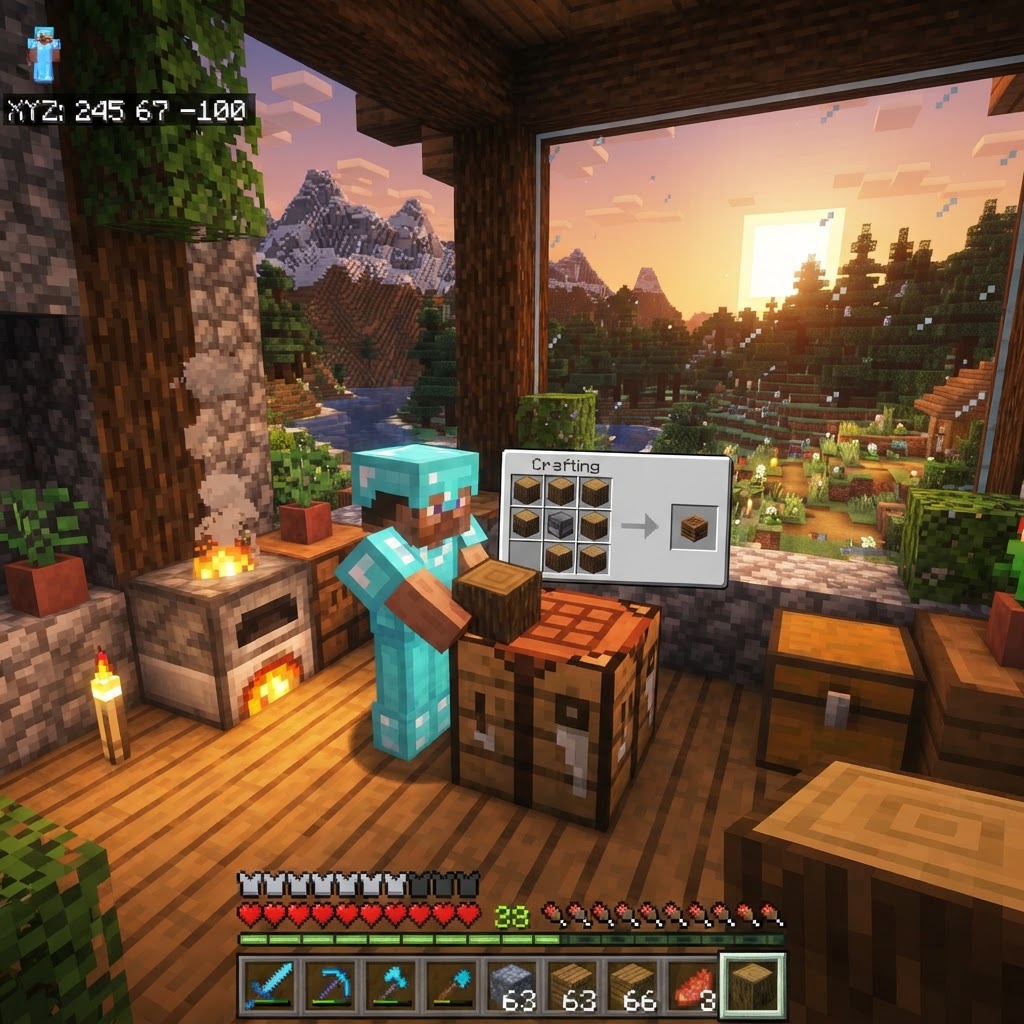
- Open your crafting table (3x3 grid)
- Place the furnace in the center slot
- Place one log in the top center slot
- Place one log in the left center slot
- Place one log in the right center slot
- Place one log in the bottom center slot
- The smoker will appear in the result slot — drag it to your inventory
The pattern forms a plus/cross shape around the central furnace. Every log slot must be filled, and the four corner slots remain empty.
Log type flexibility:
| Log Type | Works in Recipe? | Notes |
|---|---|---|
| Oak Log | ✅ Yes | Most common, easy to source |
| Spruce/Birch/Jungle | ✅ Yes | All interchangeable |
| Acacia/Dark Oak | ✅ Yes | Same recipe, no difference |
| Mangrove/Cherry | ✅ Yes | Newer wood types, still valid |
| Crimson/Warped Stem | ✅ Yes | Nether wood works — fireproof aesthetics |
| Stripped Logs | ✅ Yes | Stripped versions count as logs |
|---|---|---|
| Wood Blocks (bark) | ✅ Yes | The full bark block works too |
| Planks | ❌ No | Planks do NOT substitute for logs |
Fueling Your Smoker
The smoker accepts every fuel source a furnace does — but choosing the right fuel changes everything.
Fuel efficiency matters more with a smoker than a regular furnace because you're cooking food in bulk. The smoker burns fuel at the same rate as a furnace in terms of items cooked per fuel unit — the speed increase comes from the smelting time, not extra fuel consumption. This means the fuel economics are identical, just compressed in time.
Best fuel sources for a smoker, ranked:
- Lava Bucket — Cooks 100 items per bucket. Best single-item fuel. Bucket returns empty.
- Dried Kelp Block — Cooks 20 items per block. Best renewable bulk fuel. Farm kelp, dry it, craft into blocks.
- Blaze Rod — Cooks 12 items. Excellent mid-game option if you're raiding fortresses.
- Coal Block — Cooks 80 items. Space-efficient for storage and transport.
- Coal / Charcoal — Cooks 8 items each. Charcoal is the superior early-game option since it requires no mining.
- Planks / Wooden Tools — Cooks 1.5 items. Use as emergency fuel only, not for bulk cooking.
- Logs — Cooks 1.5 items. Less efficient than turning them into charcoal first.
- Place the smoker in your base
- Right-click to open the interface (same three-slot layout as a furnace)
- Add fuel to the bottom-left slot
- Add raw food to the top slot
- Collect cooked food from the result slot
- Run a hopper from a raw food chest into the top of the smoker (item input)
- Run a hopper from the bottom of the smoker into an output chest (result collection)
- Run a hopper from a fuel chest into the side of the smoker (fuel input)
- This creates a fully automatic cooking station — drop raw meat in, collect cooked meat later
Using Your Smoker Effectively
Placement, automation, and workflow — getting maximum value from a block most players underuse.
Placing a smoker isn't just dropping it anywhere. Think about workflow. Ideally your smoker sits adjacent to a chest for raw food input and another chest for cooked food output. This sets you up for hopper automation later.
Basic usage:
Automating your smoker with hoppers:
XP Note: Collecting food from a smoker gives the same XP as a regular furnace. If you're building an XP farm, let cooked items accumulate before collecting them — the XP from multiple batches pools and releases all at once when you grab the items.
Common Mistakes Players Make With Smokers
These errors waste your time, fuel, and materials — avoid them from day one.
1. Using planks instead of logs in the recipe
Already covered, but worth repeating: the crafting grid will flat-out reject planks. If your smoker won't craft, check this first.
2. Trying to smelt ores in a smoker
New players often set up a smoker as their primary smelting block and then wonder why iron ore won't process. The smoker is food-only. Label your blocks clearly to avoid confusion.
3. Not connecting hoppers for automation
Running to your smoker every few minutes to manually swap raw food is slow. Even a basic two-hopper setup (in and out) transforms the smoker from a manual appliance to a passive kitchen.
4. Using inefficient fuel
Feeding logs directly into a smoker is one of the most wasteful things you can do. One log cooks 1.5 items. That same log crafted into charcoal cooks 8 items. That's a 5x efficiency gap.
5. Forgetting the Butcher villager interaction
Players building villages or trading halls frequently miss that the smoker is a job site block. If you want a Butcher villager, place a smoker — don't leave one sitting unclaimed in your base while wondering why no one's trading food.
6. Building only one smoker
One smoker handles one stack at a time. Mid-to-late game players running large farms should build 2-4 smokers in parallel, all hopper-fed from the same input chest, to process food in parallel batches.
Pro Strategies: Beyond Basic Cooking
For players who want to build systems, not just cook dinner.
Stack multiple smokers with a single hopper input
Place 3-4 smokers side by side and run a single hopper line that feeds them all from a central raw food chest. Hoppers distribute items round-robin, meaning all smokers work simultaneously. Your cooking throughput quadruples with minimal extra resource cost.
Kelp farm + smoker loop
Build an automated kelp farm → feed harvested kelp into a smoker to dry it into dried kelp → craft dried kelp into blocks → use kelp blocks as smoker fuel. The farm fuels itself and produces excess dried kelp as a food source. This is one of the most efficient renewable systems in vanilla Minecraft.
XP pooling for enchanting sessions
Instead of collecting cooked food incrementally, let your automated smoker run for an extended period without collecting the output. The XP orbs are stored and released all at once when you finally collect the items. Use this before enchanting sessions to top up your experience levels cheaply.
Smoker as a village anchor
When establishing a new village or trading hall, place smokers strategically before any unemployed villagers spawn or wander nearby. Butchers are underrated traders — they'll exchange emeralds for raw meats and offer cooked meat at good rates, providing a sink for excess animal farm output.
Final Takeaways
The smoker in Minecraft is one of the highest-value utility blocks available in early survival for a reason: it solves a real bottleneck (food cooking speed), costs almost nothing to make (four logs and a furnace you already have), and scales into late-game automation with minimal extra work.
Craft it early. Fuel it with charcoal until you have a kelp farm. Automate it with hoppers as soon as you can spare the iron. Build multiples once your food production scales up. And don't overlook the Butcher villager job site mechanic — it turns a cooking block into a trading asset.
The players who master the smoker aren't just cooking faster. They're building systems that feed every other part of their game.
RELATED ARTICLES
How to Make a Book in Minecraft: Easy Recipe & Uses
You're probably here because you just hit a wall — enchanting, writing, or crafting something advanced — and realized you need books but aren't sure how to get them efficiently. Books are one of Minec...
How to Make a Blast Furnace in Minecraft: Recipe & Uses
If you've been manually smelting ores one by one in a regular furnace, you're wasting serious time — the Minecraft blast furnace doubles your smelting speed for metals and ores, making it one of the m...
How to Make a Smoker in Minecraft: Recipe & Uses
If you're tired of waiting forever for your food to cook in a standard furnace, the smoker is the upgrade you didn't know you needed. It cooks food items at exactly twice the speed of a regular furnac...
STAY UPDATED
New blog posts, guides, and community tips delivered to your inbox.
No spam. Unsubscribe anytime.
Comments (0)
No comments yet. Be the first to share your thoughts!

