TABLE OF CONTENTS
How to Breed Horses in Minecraft: Complete Guide
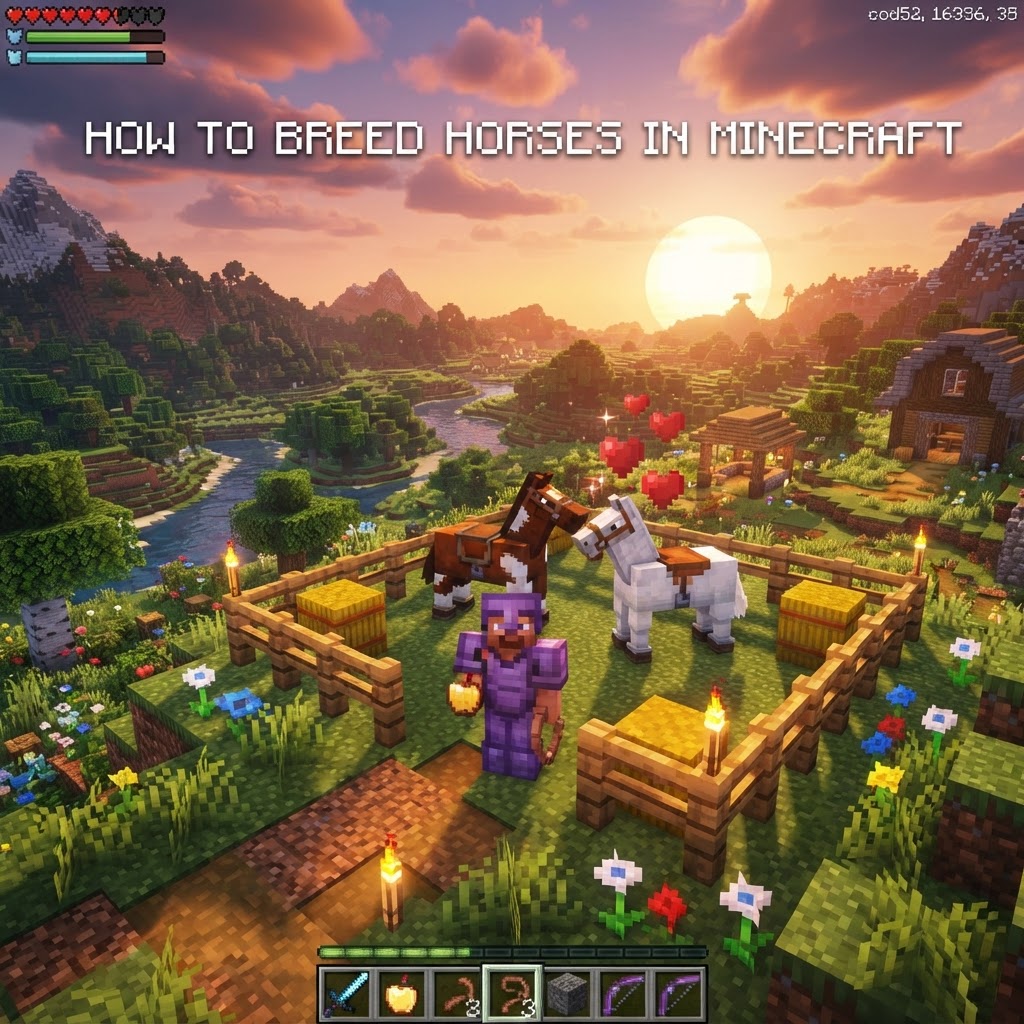
Getting a fast, strong horse in Minecraft isn't just about luck — it's about understanding the breeding system well enough to engineer the mount you actually want. Most players tame a random horse and call it done, but if you've ever watched another player zoom past you on a horse that clears five-block gaps effortlessly, you already know there's a better way. This guide covers everything from taming prep to stat inheritance so you can stop settling for average horses and start building a bloodline worth riding.
Taming Horses Before You Can Breed Them
You can't breed what you haven't tamed — here's how to do it fast and right.
Breeding requires two tamed horses. Skipping this step or rushing it is where most players lose time. Here's the process done correctly:
- Find horses — They spawn naturally in Plains and Savanna biomes, usually in herds of 2–6. Savanna biomes tend to have higher spawn rates.
- Approach empty-handed — Right-click the horse with nothing in your hand to mount it.
- Stay on through the bucks — The horse will throw you repeatedly. Each attempt raises its temper stat by 5 points. When temper exceeds the horse's threshold (random value 0–99), it's tamed. On average, expect 3–8 attempts.
- Watch for the hearts — Once tamed, hearts appear and the horse stops bucking. It now accepts a saddle.
- Repeat for your second horse — You need two tamed horses in close proximity to breed.
- 1 Golden Apple or Golden Carrot per horse (2 total)
- Both horses tamed and saddled or at least tamed
- A fenced area is strongly recommended — foals can wander
- Pen both horses — Build a fenced enclosure at least 5×5 blocks. This keeps both parents and the foal contained.
- Feed the first horse — Right-click it with a Golden Carrot or Golden Apple. You'll see red hearts appear around it, indicating love mode.
- Feed the second horse immediately — Right-click the second horse with the same or different food item before the first horse's love mode timer expires (approximately 30 seconds).
- Watch for the foal — Both horses will walk toward each other, and a foal will appear between them. It will have a random coat color based on its parents.
- Wait for the cooldown — After breeding, each horse enters a 5-minute cooldown before it can breed again.
- Feed the foal to accelerate growth — Foals take 20 real-time minutes to grow into adults naturally. You can speed this up by feeding them hay bales, apples, sugar, wheat, or golden food.
- Movement Speed — Ranges from ~0.1125 to 0.3375 (in game units). The fastest horses visually feel nearly 3× faster than the slowest.
- Jump Height — Ranges from 0.4 to 1.0 blocks of jump strength, translating to roughly 1.5 to 5.5 blocks of actual height.
- Max Health — Ranges from 15 to 30 HP (7.5 to 15 hearts).
- Breeding two fast horses gives you a good chance of a fast foal, but not a guarantee.
- The random wild card can drag stats down even from two elite parents.
- Over many generations, selective breeding (always keeping the best foal and breeding it with another high-stat horse) does push stats upward.
What You Need to Breed Horses in Minecraft
Two items trigger breeding — but which one you use actually matters.
You only need two items to breed horses: Golden Apples or Golden Carrots. Both work, but they are not equal in cost or accessibility.
| Item | Crafting Cost | Ease of Getting | Notes |
|---|---|---|---|
| Golden Carrot | 8 Gold Nuggets + 1 Carrot | Easier (nuggets from zombies) | Best budget option |
| Golden Apple | 8 Gold Ingots + 1 Apple | Expensive early-game | Faster temper boost if also taming |
| Enchanted Golden Apple | Cannot craft (found only) | Very rare, chests only | Does NOT trigger breeding |
What you need per breeding session:
Step-by-Step: How to Breed Horses in Minecraft
Follow this exact sequence and breeding works every time.
Understanding Foal Stats: Speed, Jump, and Health
This is where most guides stop — and where your actual progress begins.
Every horse in Minecraft has three hidden stats:
How stat inheritance works:
When two horses breed, the foal's stats are calculated by averaging the two parents' stats and then adding a third randomized "wild card" value from a new random horse. This means:
| Parent Combo | Expected Foal Quality | Notes |
|---|---|---|
| Two average horses | Average foal | No improvement likely |
| One elite + one average | Slightly above average | Marginal gains |
| Two elite horses | High chance of strong foal | Still has random element |
| Elite horse + same horse's offspring | Strong improvement trend | Multi-gen strategy |
Common Mistakes Players Make When Breeding Horses
If breeding feels frustrating or random, you're probably making one of these errors.
1. Not penning the horses first
Horses in love mode will wander toward each other, but if there's too much open space, they'll drift and the timer will expire before they meet. Always use a fence.
2. Using Enchanted Golden Apples
Already covered, but worth repeating — they don't work. Save them for combat buffs.
3. Breeding randomly without tracking stats
If you breed any two horses together without checking their speed and jump stats, you're just generating random horses. You won't improve your bloodline.
4. Expecting color control
Many players try to "breed for a specific color" thinking it works like dog collar colors. Horse color is semi-random. You have no reliable control over it through breeding alone.
5. Ignoring the foal growth mechanics
Leaving a foal to grow on its own for 20 minutes is fine in a safe base, but in survival it's a liability. Feed hay bales to cut growth time significantly and protect your investment.
6. Not having enough golden food stockpiled
If you want to breed multiple generations in one session to chase elite stats, you'll need 10–20 golden carrots minimum. Running out mid-session breaks your momentum.
Pro Strategies for Building Elite Horse Bloodlines
Beyond the basics — how serious players engineer the fastest mounts in their world.
Multi-Generation Selective Breeding
Don't just breed once. Breed a litter of 3–5 foals from your two best horses, then use the F3 screen (Java) or a horse stats mod/datapack to identify which foal has the best stats. Retire the weaker parents and breed the best foal with a new high-stat wild horse. Repeat over 5–6 generations. Players have documented reaching near-maximum stat caps this way.
Wild Horse Hunting for Stat Injection
Wild horses occasionally spawn with near-maximum stats. Before building your breeding program, capture and check multiple wild horses. A single wild horse with 0.30+ speed is more valuable as a breeding partner than your current "best" tamed horse.
Donkey and Mule Consideration
Breeding a horse with a donkey produces a mule. Mules cannot breed further, but they can carry a chest (inventory storage while mounted). This is a deliberate trade-off: mules for utility, horses for speed. Never waste your elite horse bloodline on mule production unless you specifically need pack animals.
Naming and Tracking Your Bloodline
Use name tags to label horses by generation and role (e.g., "G3-Fast," "G2-Jump"). This sounds like overkill until you accidentally breed the wrong pair and lose three generations of stat progress. One name tag costs one level at an anvil. It's worth it.
Golden Carrot Farming at Scale
To support aggressive breeding programs, set up a gold farm (nether piglin bartering or zombie/piglin mob farms) and a carrot farm. Golden Carrots are your most efficient breeding currency — they cost 8 gold nuggets (less than one ingot) versus 8 full ingots for a Golden Apple.
Quick Reference: Breeding at a Glance
| Task | What You Need | Time Required |
|---|---|---|
| Tame one horse | Nothing (or food to speed it) | 1–5 minutes |
| Breed two horses | 2× Golden Carrot or Golden Apple | Under 1 minute |
| Foal to adult (natural) | Nothing | 20 minutes |
| Foal to adult (accelerated) | Hay bales, apples, sugar | 5–10 minutes |
| Breeding cooldown | Wait | 5 minutes per horse |
Conclusion
Breeding horses in Minecraft is one of the few systems that rewards patience and planning with genuinely better results. The core loop is simple — tame two horses, feed them golden food, get a foal — but the real value comes from understanding stat inheritance and building a multi-generation bloodline deliberately. Stop breeding randomly, start checking stats, keep your best foals, and within a handful of generations you'll have a horse that makes the vanilla spawn rates feel embarrassingly slow. Stock up on golden carrots, build a proper pen, and treat your horses like the long-term investment they actually are.
RELATED ARTICLES
How to Make a Book in Minecraft: Easy Recipe & Uses
You're probably here because you just hit a wall — enchanting, writing, or crafting something advanced — and realized you need books but aren't sure how to get them efficiently. Books are one of Minec...
How to Make a Blast Furnace in Minecraft: Recipe & Uses
If you've been manually smelting ores one by one in a regular furnace, you're wasting serious time — the Minecraft blast furnace doubles your smelting speed for metals and ores, making it one of the m...
How to Make a Smoker in Minecraft: Recipe & Uses
If you're tired of waiting forever for your food to cook in a standard furnace, the smoker is the upgrade you didn't know you needed. It cooks food items at exactly twice the speed of a regular furnac...
STAY UPDATED
New blog posts, guides, and community tips delivered to your inbox.
No spam. Unsubscribe anytime.
Comments (0)
No comments yet. Be the first to share your thoughts!

