TABLE OF CONTENTS
How to Make a Campfire in Minecraft — Complete Guide
You're probably here because you've seen that warm, crackling fire in a village or taiga biome and want one for yourself — or because you're knee-deep in a survival run and need a reliable light source, smoke signal, or cooking station that doesn't blow up your house. Campfires in Minecraft do more than look good; they're one of the most versatile utility blocks in the game, and most players barely scratch the surface of what they can do.
What You Need to Craft a Campfire
Knowing the exact materials before you go gathering saves you two trips.
A campfire requires three specific ingredient types, and substitutions are limited. Here's exactly what to collect before you open your crafting table:
- 3 Sticks — Craft from any wood planks (2 planks = 4 sticks). You'll find these easily or craft them immediately.
- 3 Wood or Logs — Any wood type works: oak, birch, spruce, jungle, acacia, dark oak, mangrove, cherry, or bamboo. They don't need to match.
- 1 Coal OR 1 Charcoal — This is the one that trips people up. You need a fuel source in the center. Coal is mined from stone layers; charcoal is crafted by smelting any log in a furnace.
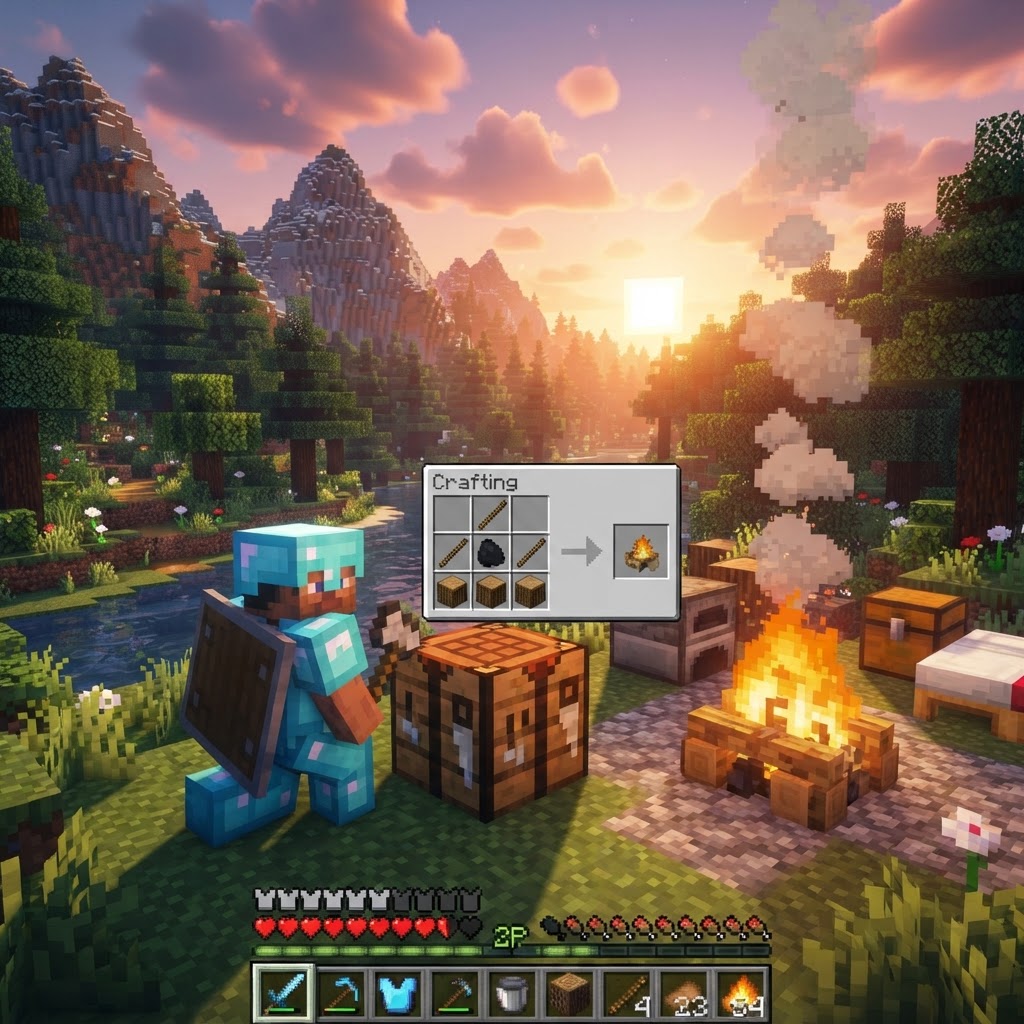
- Open your crafting table (3×3 grid required — your 2×2 inventory grid won't work).
- Place a stick in the top-center slot (Row 1, Column 2).
- Place a stick in the middle-left slot (Row 2, Column 1) and a coal or charcoal in the center (Row 2, Column 2), then another stick in the middle-right slot (Row 2, Column 3).
- Fill the entire bottom row (Row 3) with three logs or wood blocks.
- Drag the campfire into your inventory.
- Bees avoid campfire smoke. Place a campfire under a beehive and bees won't sting you during harvesting — this is a critical beekeeper mechanic.
- Mobs that walk across a lit campfire take fire damage (1 HP/second for regular, 2 HP/second for soul).
- Campfires do not light mobs on fire the way lava or flint-and-steel does — contact damage only, no burning trail.
Quick material comparison:
| Material | Where to Get It | Time Investment |
|---|---|---|
| Coal | Mine underground (Y: 95 or Y: -57 peaks) | Medium — requires pickaxe |
| Charcoal | Smelt any log in a furnace | Low — available Day 1 |
| Sticks | Craft from planks or find in bonus chests | Instant |
| Logs/Wood | Chop any tree | Instant |
How to Craft a Campfire (Step-by-Step)
The exact placement matters — this isn't a shapeless recipe.
The campfire recipe is shaped, meaning items must go in specific slots in the crafting grid. Getting this wrong is the #1 reason players think the recipe "isn't working."
Follow these exact steps:
Visual grid layout:
```
```
Soul Campfire vs. Regular Campfire
Two versions exist — most guides ignore the soul variant entirely.
Once you've mastered the basic campfire, it's worth knowing that a second, more powerful variant exists: the Soul Campfire. It functions nearly identically but has key differences that matter for specific builds and strategies.
To craft a Soul Campfire, simply replace the coal/charcoal in the center of the recipe with Soul Sand or Soul Soil. Both are found in the Nether — Soul Sand in Soul Sand Valleys and basalt deltas, Soul Soil also in Soul Sand Valleys.
| Feature | Regular Campfire | Soul Campfire |
|---|---|---|
| Light Level | 15 (maximum) | 10 |
| Flame Color | Orange/yellow | Blue |
| Deters Piglins? | No | Yes — passive Piglins avoid blue fire |
| Smoke Height | ~10 blocks | ~10 blocks |
| Cooking Speed | Same | Same |
| Damage to Players | 1 HP/second | 2 HP/second |
|---|---|---|
| Crafting Difference | Coal/Charcoal center | Soul Sand/Soul Soil center |
Everything a Campfire Actually Does
Players use 20% of what campfires are capable of — here's the full list.
Campfires aren't just decorative. Understanding their full function set transforms how you use them.
Cooking (No Fuel Cost)
Drop raw food directly onto a lit campfire and it cooks — no furnace, no fuel required. You can cook up to 4 food items simultaneously, one per side of the campfire block. Each item takes 30 seconds to cook (compared to 10 seconds in a furnace), but the zero-fuel cost makes it ideal for early survival.
Smoke Signals
An unobstructed campfire produces a smoke column that rises roughly 10 blocks. Place a hay bale underneath the campfire and that smoke column extends to approximately 24 blocks — visible from a massive distance. This is genuinely useful for marking base locations or navigation points in survival.
Mob Behavior
Light Source
At light level 15, a regular campfire matches glowstone and sea lanterns as a top-tier light source. Soul Campfires sit at level 10, comparable to a jack-o'-lantern.
Aesthetic and Atmosphere
Campfires placed under trapdoors (leave trapdoor open) create a contained fire visual without the smoke — popular for fireplaces in builds. Waterlogging a campfire extinguishes it while keeping the block in place.
Common Mistakes Players Make
These are the exact errors that send players back to Google.
1. Using the 2×2 Inventory Grid
The campfire is a shaped recipe requiring a 3×3 grid. Your personal inventory crafting area is 2×2. Always use a crafting table.
2. Substituting Planks for Logs
Planks don't work in the bottom row. The recipe is specific to logs, wood blocks (the rotatable log-like blocks), or stripped variants. If it's not cook-able in a furnace to make charcoal, double-check it counts as a "log."
3. Forgetting to Light It After Placement
Campfires placed from inventory are lit by default on placement — BUT if you've previously extinguished one (with a shovel or water), you must relight it with flint and steel or a fire charge. A campfire that isn't lit still exists as a block but does nothing.
4. Not Using Hay Bales for Long-Range Signals
Players build elaborate signal towers with torches when a single campfire + hay bale underneath makes a smoke column visible across most biomes.
5. Skipping the Soul Campfire for Nether Farms
Regular campfires do nothing special near Piglins. Soul Campfires passively deter non-zombified Piglins without requiring gold armor — a significant quality-of-life advantage most players miss.
6. Placing Campfires Near Flammable Builds
Campfires spread fire to wooden blocks within range in Java Edition particularly. Always use stone, cobblestone, or non-flammable materials within 3-4 blocks of a campfire in your base.
Pro Strategies for Getting More From Campfires
Beyond the basics — how experienced players actually use campfires.
Stack Cooking Stations Early
In early survival, build 4 campfires in a row. You can simultaneously cook 16 food items (4 per campfire) with zero fuel — far outpacing a single furnace during the first few days when coal is still being hoarded for torches and smelting.
Automated Bee Farm Setup
The most efficient honey/honeycomb setup: place a campfire directly under each beehive or bee nest, use a dispenser with shears aimed at the hive (for honeycomb) or a glass bottle (for honey bottles), and run a hopper below to collect drops. The campfire smoke keeps bees calm and the dispenser triggers from a redstone clock. Zero bee aggro, fully passive production.
Smoke Marker Network for Large Maps
If you play on large servers or exploration-heavy worlds, plant campfires on hilltops with hay bales beneath them at regular intervals. They function like a permanent waypoint network visible from elevation without any redstone or map markers.
Soul Campfire Perimeter for Piglin Farms
Surround the non-farm perimeter of a Piglin gold farm with Soul Campfires. Piglins naturally avoid blue fire, which can help funnel mob movement in specific farm designs without requiring additional structural walls.
Extinguishing for Decoration
Shovel-click a campfire to extinguish it. The block remains with all its visual detail but produces no smoke, light, or heat — perfect for decorative fireplaces inside builds where you want the look without the smoke column rising through your ceiling.
Campfire as a Mob Damage Floor
In manual mob farms or arenas, a floor lined with campfires deals consistent damage without knockback — unlike cacti or magma blocks. Mobs walk across, take damage, and don't get pushed into irregular positions that break collection funnels.
Conclusion
A campfire is simple to craft but rich with strategic depth.
The campfire recipe itself takes under two minutes once you have materials: sticks, logs, and coal or charcoal arranged in a specific shaped pattern on a crafting table. But what separates a player who just builds one from a player who builds them well is understanding the soul campfire variant, the smoke-signal mechanic with hay bales, the bee farming application, and the cooking efficiency advantages in early survival.
Get your crafting table open, grab a piece of charcoal if you haven't found coal yet, and don't forget — that soul campfire is only one Nether trip away and worth every block of Soul Sand it costs. Every base, farm, and exploration setup in Minecraft benefits from at least knowing what campfires can do. Now you know all of it.
RELATED ARTICLES
How to Make a Book in Minecraft: Easy Recipe & Uses
You're probably here because you just hit a wall — enchanting, writing, or crafting something advanced — and realized you need books but aren't sure how to get them efficiently. Books are one of Minec...
How to Make a Blast Furnace in Minecraft: Recipe & Uses
If you've been manually smelting ores one by one in a regular furnace, you're wasting serious time — the Minecraft blast furnace doubles your smelting speed for metals and ores, making it one of the m...
How to Make a Smoker in Minecraft: Recipe & Uses
If you're tired of waiting forever for your food to cook in a standard furnace, the smoker is the upgrade you didn't know you needed. It cooks food items at exactly twice the speed of a regular furnac...
STAY UPDATED
New blog posts, guides, and community tips delivered to your inbox.
No spam. Unsubscribe anytime.
Comments (0)
No comments yet. Be the first to share your thoughts!

