TABLE OF CONTENTS
Nautilus Shell in Minecraft: How to Get One Fast
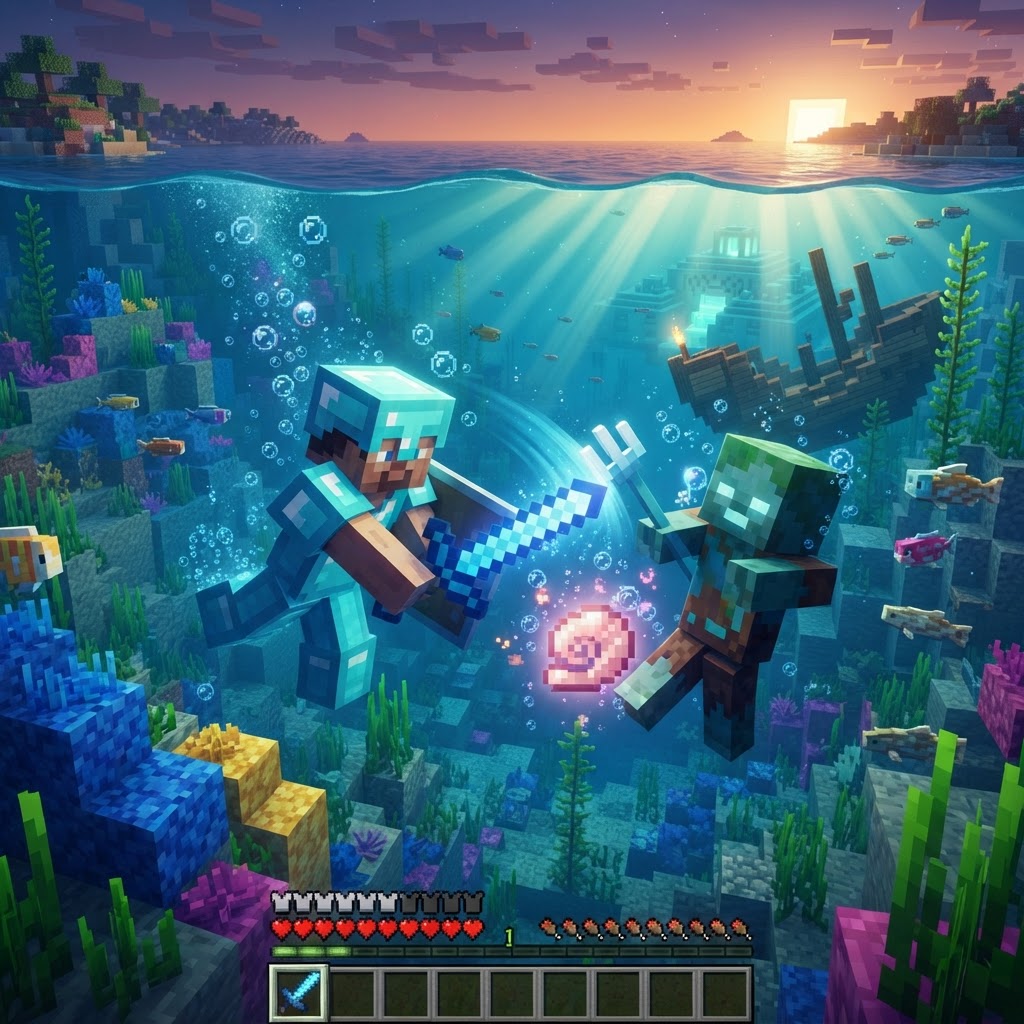
Getting a nautilus shell feels deceptively simple until you're three hours deep into fishing with nothing to show for it, or you've killed every Drowned in sight and still can't craft your Conduit. The nautilus shell is one of Minecraft's most annoying bottleneck items — you need eight of them for a single Conduit, and the drop rates are brutal if you don't know what you're doing. This guide cuts through the frustration and gives you the fastest, most reliable path to stacking nautilus shells — whatever your current situation.
What a Nautilus Shell Actually Does (And Why You Need So Many)
Understanding the endgame use case helps you plan how aggressively to farm.
Before you commit to grinding, it's worth knowing exactly what you're farming for. Nautilus shells have one primary purpose: crafting a Conduit. The Conduit is one of Minecraft's most powerful utility blocks, granting underwater players the "Conduit Power" status effect — which combines Water Breathing, Night Vision, and Haste into a single buff. It also attacks hostile mobs within range, making it invaluable for ocean monument raids and any underwater build.
The Conduit recipe requires:
- 8 Nautilus Shells (surrounding the center)
- 1 Heart of the Sea (center slot)
- Craft a Fishing Rod with Luck of the Sea III and Lure III enchantments
- Fish in open water (no blocks within 5x4x5 area around the bobber)
- Fish during rain for a slight speed boost on bite timing
- Use an AFK fishing farm if you want to completely automate this
- Only Drowned that spawn holding a shell will drop it — roughly 3–8% of Drowned spawn with one depending on version
- The drop chance with no looting is about 3%, increasing to 5.5% with Looting III
- Java Edition: Drowned that convert from Zombies do NOT spawn holding shells — only naturally spawned ocean/river Drowned do
- Bedrock Edition: All Drowned have a baseline chance to drop a shell, making this method slightly better on Bedrock
- Clearing a large area of ocean floor to remove mob spawn competition
- Building platforms at Y=40–50 to funnel Drowned into a central drop point
- Using water streams to push mobs into a kill chamber
- Killing with a Looting III sword at the bottom
- Crafting use: Conduit only (8 shells + 1 Heart of the Sea)
- Fishing drop rate: ~7.1% treasure category (Luck of the Sea III)
- Drowned drop rate: ~3% base, ~5.5% with Looting III (Java — shell-holders only)
- Wandering Trader price: 5 Emeralds each, 5 per trader
- Best Java method: Drowned farm + AFK fishing combo
- Best Bedrock method: Active Drowned hunting with Looting III
- Version note: Java Drowned converted from Zombies don't drop shells
Nautilus shells have no other crafting use. They can't be stacked creatively in builds or traded casually — their value is entirely tied to the Conduit. That means once you have your 8 shells, you're done. The grind has a finish line, which makes it manageable if you approach it efficiently.
The Three Ways to Get a Nautilus Shell
Each method works — but they're not equal in speed or accessibility.
There are exactly three ways to obtain nautilus shells in Minecraft: fishing, looting Drowned mobs, and trading with Wandering Traders. Here's a breakdown of each before we go deep on the best ones.
1. Fishing
| Method | Availability | Avg. Time Per Shell | Renewable? |
|---|---|---|---|
| Fishing (Luck of the Sea III) | Any biome, any time | ~20–40 min | Yes |
| Drowned (holding a shell) | Ocean/river biomes | ~15–30 min | Yes |
| Wandering Trader | Random spawn, limited | Instant (if available) | No (per trade) |
Fishing is the most accessible method since it requires no specific biome. However, nautilus shells are classified as "treasure" loot, meaning they only appear in the treasure category — which is significantly rarer than junk or fish catches.
To maximize efficiency:
Without Luck of the Sea III, your treasure catch rate is approximately 5%. With Luck of the Sea III, it climbs to roughly 7.1% — still low, but meaningfully better over hundreds of casts.
2. Looting Drowned
This is the fastest method for players who are already exploring ocean biomes. Drowned mobs have a chance to spawn holding a nautilus shell, and when they do, they drop it on death.
Key mechanics:
3. Wandering Trader
The Wandering Trader sells nautilus shells for 5 Emeralds each, with a maximum of 5 trades available per trader. This is the most expensive method and entirely dependent on a Wandering Trader spawning near you, but it's instant if one shows up.
Don't build your strategy around this method. Use it as a supplement — if a Wandering Trader appears and you have emeralds, buy all 5. But never wait for one instead of actively farming.
Method Deep Dive: Which Should YOU Use?
Your best method depends on your current gear, biome access, and time investment.
| Your Situation | Best Method | Why |
|---|---|---|
| Early game, no enchanted rod | Drowned hunting in rivers | No gear requirement, shells visible |
| Mid game, have enchants | AFK fishing farm | Fully passive, multi-item gains |
| Near ocean monument | Drowned + Looting III sword | Fast kill rate, correct biome |
| Time-limited session | Wandering Trader (if available) | Instant, no grinding required |
| Bedrock Edition player | Drowned hunting | Better drop rates than Java |
The sweet spot for most players is combining Drowned hunting with an AFK fishing setup. Hunt Drowned actively while your fishing farm runs passively — you'll hit 8 shells significantly faster than doing either alone.
Common Mistakes Players Make When Farming Nautilus Shells
These errors waste hours — most players make at least two of them.
Mistake 1: Fishing Without Luck of the Sea
Standard fishing rods have such a low treasure rate that you could fish for 5 hours and get nothing. Always enchant before committing to fishing as your primary method. If you don't have the enchantment, go hunt Drowned instead.
Mistake 2: Killing ALL Drowned Indiscriminately
If a Drowned isn't visibly holding a nautilus shell in its hand, killing it won't give you a shell. You can see the shell in their off-hand as a glowing item. Prioritize those Drowned and skip the ones without — this dramatically improves time efficiency.
Mistake 3: Farming in Rivers Instead of Oceans (Java)
Rivers do spawn Drowned, but at much lower densities than ocean floors. For Java Edition players, deep ocean biomes — especially Deep Cold Ocean and Deep Lukewarm Ocean — have the highest Drowned mob density. Always ocean-farm over river-farm when possible.
Mistake 4: Not Using Looting Enchantment
A Looting III sword increases your shell drop rate from Drowned by nearly double. Always have it on your sword before a Drowned farm session. This one change can cut your total grind time in half.
Mistake 5: Skipping the Heart of the Sea
Players sometimes grind all 8 shells only to realize they haven't found a Heart of the Sea. Find your buried treasure first. If you can't locate a Heart of the Sea, the shell grind is premature — you can't craft the Conduit without both components.
Pro Strategies for Getting Nautilus Shells Fast
These are techniques most casual guides don't mention — use them to cut your grind time significantly.
Build a Drowned Farm Over the Ocean
If you're serious about shell farming, build a mob farm that channels ocean mobs through a kill zone. A basic design involves:
A well-built Drowned farm can produce 1–3 shells per hour passively, which means your full stack of 8 is achievable in a single play session.
Use Dolphin's Grace to Hunt Faster
When actively Drowned-hunting in oceans, feed nearby dolphins raw fish to get the Dolphin's Grace buff. This increases your swim speed substantially, letting you close distance on shell-holding Drowned before they despawn or dive deeper.
Combine Fishing Rewards With Your Farm
A Luck of the Sea III / Lure III rod running in an AFK setup will produce nautilus shells at roughly 1 per 1–2 hours of fishing. It's slow alone, but running it while you sleep or while you're doing other in-game tasks makes it purely free progress. Stack it on top of active Drowned hunting.
Trade Spare Shells With Other Players (Multiplayer)
On multiplayer servers, nautilus shells often become a tradeable commodity. Players who've already crafted their Conduit have no use for extra shells. Check your server's trading channels — you might be able to buy the remaining shells you need for cheap, or trade emeralds for an immediate stack.
Nautilus Shell Quick Reference
Everything you need to remember, in one place.
Wrapping Up
The nautilus shell grind doesn't have to be a multi-session nightmare. The players who struggle most are the ones using only one method, using it unoptimized, and not checking whether the Drowned they're killing can even drop a shell. Fix those three things and you'll have your 8 shells far faster than average.
Your fastest path: get Looting III on your sword, head to a deep ocean biome, prioritize shell-holding Drowned, and run an AFK fishing farm in the background. Do that, and you'll have a complete Conduit recipe before you know it — and an ocean base that's genuinely worth living in.
RELATED ARTICLES
How to Make a Book in Minecraft: Easy Recipe & Uses
You're probably here because you just hit a wall — enchanting, writing, or crafting something advanced — and realized you need books but aren't sure how to get them efficiently. Books are one of Minec...
How to Make a Blast Furnace in Minecraft: Recipe & Uses
If you've been manually smelting ores one by one in a regular furnace, you're wasting serious time — the Minecraft blast furnace doubles your smelting speed for metals and ores, making it one of the m...
How to Make a Smoker in Minecraft: Recipe & Uses
If you're tired of waiting forever for your food to cook in a standard furnace, the smoker is the upgrade you didn't know you needed. It cooks food items at exactly twice the speed of a regular furnac...
STAY UPDATED
New blog posts, guides, and community tips delivered to your inbox.
No spam. Unsubscribe anytime.
Comments (0)
No comments yet. Be the first to share your thoughts!

