TABLE OF CONTENTS
Automatic Villager Trading + AFK XP Farm — Advanced Guide
Mastering automatic villager trading in Minecraft turns one of the game's most tedious mechanics into a fully passive income stream. This guide walks you through building a complete system that automatically resets trades, collects items, and generates XP while you're AFK. By the end, you'll have a working farm that handles emeralds, gear enchanting, and experience grinding simultaneously.
Understanding the Automatic Villager Trading System
What you're actually building and why it outperforms manual trading
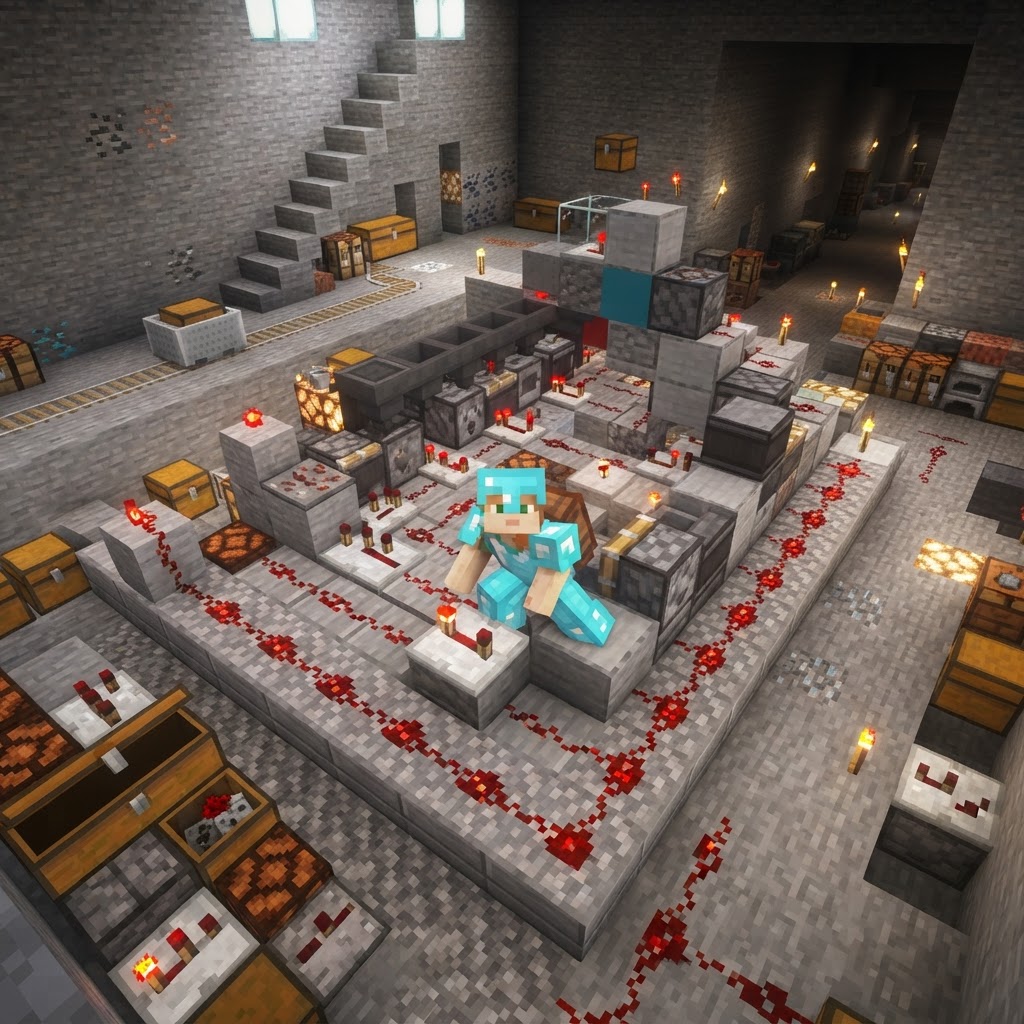
This isn't a simple villager breeder — it's a multi-layered machine. The core loop works like this: villagers trade until their stock depletes, a curing or job-site cycling mechanism resets their inventory, and a hopper-minecart or dropper network handles item routing without your input.
What this farm produces passively:
- Enchanted books (Mending, Efficiency V, Fortune III)
- Emeralds from bulk crop trading
- XP orbs from repeated high-value trades
- Raw materials like Bottles o' Enchanting (from cleric villagers)
Key villager professions to target:
| Profession | Best Trade | Job Site Block | XP per Trade Cycle |
| Librarian | Mending books | Lectern | 3–5 orbs |
| Cleric | Bottles o' Enchanting | Brewing Stand | 6–11 orbs |
| Farmer | Emeralds for crops | Composter | 3–5 orbs |
| Armorer | Diamond armor | Blast Furnace | 10–15 orbs |
Setting Up the Automatic Villager Trading Hall
Physical layout, villager containment, and trade station design
The trading hall is the backbone of the whole system. Poor placement here creates pathing bugs, villager escapes, and broken job-site assignments that waste hours of fixing.
Step-by-step hall construction:
- Dig a 3-block-deep pit (1×1 per villager) — this prevents them from wandering while keeping them accessible.
- Place a trapdoor on top of each pit, flush with the floor. Open trapdoors stop villagers from climbing out without blocking your trading GUI.
- Set job site blocks directly adjacent to each pit — within a 48-block horizontal radius and same Y-level is ideal.
- Install a naming system — use name tags (Mending_01, Cleric_02, etc.) before locking trades so you never lose a valuable villager.
- Wire each station to a daylight sensor or manual lever that activates beds within the farm — villagers need to "sleep" to reset trades on the next in-game day.
- Add a central hopper line running under each station. Use Hopper Minecarts beneath a rail loop if throughput is a concern — they're significantly faster than standard hoppers at item collection.
- Place a sticky piston facing toward the job site block
- Connect it to a comparator clock timed to 12,000-tick cycles (roughly one Minecraft day)
- When the piston retracts, the villager pathfinds to the block, restocks, and the piston extends again to block access until the next cycle
- Infect a villager with a zombie villager (splash Potion of Weakness + golden apple)
- Cure them in a pit with a bed nearby
- Each cure cycle drops trade costs — sometimes to 1 emerald per Mending book
- Repeat 2–3 times to hit the minimum trade cost floor
- 8–12 sticky pistons (per row of 5 villagers)
- 1 comparator clock (5-clock or 7-clock design both work)
- Redstone dust, repeaters set to 4 ticks
- 1 observer (optional, for daylight-triggered activation)
- Build a 3×3 platform centered on the highest-value trader (Cleric or Armorer)
- Place water source blocks flowing toward a Soul Sand bubble column at the center
- The bubble column pulls XP orbs upward into a collection chamber
- AFK in the chamber — orbs auto-collect with a standard pickup radius
Recommended hall dimensions: 5 villagers per row, rows spaced 4 blocks apart, with a central walkway. A 20-villager hall fits cleanly in a 25×20 footprint.
Automatic Trade Cycling with Redstone
How to reset villager trades without touching a single block manually
Villagers restock twice per in-game day — at sunrise and noon — as long as they can reach their job site block. The automatic cycling system exploits this by controlling when villagers access their job sites using piston gates.
The Piston Gate Method:
This controlled access prevents over-restocking and gives your hopper network time to clear items before the next trade wave.
Alternative: The Curing Loop (high-output builds)
For maximum throughput, some farms use the zombie-curing discount loop:
Redstone components you'll need:
Building the AFK XP Collection Layer
Converting passive trades into a continuous experience point stream
The XP layer is what separates a trading hall from an actual farm. Villagers emit XP orbs on every completed trade — the goal is to funnel those orbs to one collection point where you AFK.
AFK spot design:
Boosting XP output per session:
| Fletcher | Arrows / bows | Fletching Table | 3–6 orbs |
| Method | XP Boost | Setup Complexity | Notes |
| Bottle o' Enchanting spam (Cleric) | High | Low | Bottles give 3–11 XP each on break |
| Cured villager discount trades | Very High | Medium | More trades per emerald stack |
| Automated crop feeder (Farmer) | Medium | High | Needs auto-harvester input |
Auto-trading with Macro/mod tools (single-player only):
- Litematica (Fabric) — paste pre-built schematics for precise hall layouts
- Carpet Mod — enables fake player bots (`/player
spawn`) that trade autonomously in single-player - MiniHUD — overlay tool for verifying villager pathfinding ranges without guessing
Carpet Mod's fake player feature is the cleanest solution for true automation in single-player. A single `/player TradingBot action attack` command on a 4-tick loop handles continuous trading without any external software.
Optimization, Scaling, and Common Fixes
Squeezing maximum output and solving the bugs that kill hours of progress
Performance optimization for large halls:
- Keep villager count under 20 per loaded chunk cluster — beyond this, pathfinding lag compounds rapidly
- Use Entity Cramming limits (set via `/gamerule maxEntityCramming 24`) to prevent unintended deaths
- Chunk-load the farm with a chunk loader (Nether portal design or carpet fake player standing nearby)
Scaling beyond 20 villagers:
Stack trading halls vertically. Each floor handles 20 villagers, connected by a central item elevator (bubble column + hopper system). A 3-floor build processes 60 villagers and generates roughly 800–1,200 XP per full trade cycle depending on professions.
Common problems and fixes:
| Multi-villager simultaneous trading | Very High | High | Requires auto-clicker or macro |
| Problem | Cause | Fix |
| Villager won't restock | Can't pathfind to job site | Move job site within 16 blocks, clear obstructions |
| Trade locked at wrong item | Wrong profession assigned | Break job site block, wait for villager to de-assign, replace |
| XP orbs not collecting | Bubble column blocked | Ensure soul sand is underwater, no blocks above column |
| Piston gate not cycling | Comparator clock desync | Use an observer-based pulse reset on reload |
Conclusion: Your Complete Passive Trading Engine
A fully realized automatic villager trading system is one of the highest-value builds in all of Minecraft survival. Done correctly, it eliminates the grind for enchanted books, generates sustainable emerald income, and keeps your XP bar full without active effort. Start with a 5-villager hall using Librarian and Cleric professions, implement the piston gate cycling system, and layer in the AFK XP collection chamber once trades are locked in. Scale from there. The architecture described here supports up to 60 villagers before hitting meaningful performance limits — more than enough for any survival or server context. Build it once, and the farm pays for itself within the first week of play.
| Curing discount not stacking | Bedrock version | Use Java or accept single-cure discounts only |
RELATED ARTICLES
How to Make a Book in Minecraft: Easy Recipe & Uses
You're probably here because you just hit a wall — enchanting, writing, or crafting something advanced — and realized you need books but aren't sure how to get them efficiently. Books are one of Minec...
How to Make a Blast Furnace in Minecraft: Recipe & Uses
If you've been manually smelting ores one by one in a regular furnace, you're wasting serious time — the Minecraft blast furnace doubles your smelting speed for metals and ores, making it one of the m...
How to Make a Smoker in Minecraft: Recipe & Uses
If you're tired of waiting forever for your food to cook in a standard furnace, the smoker is the upgrade you didn't know you needed. It cooks food items at exactly twice the speed of a regular furnac...
STAY UPDATED
New blog posts, guides, and community tips delivered to your inbox.
No spam. Unsubscribe anytime.
Comments (0)
No comments yet. Be the first to share your thoughts!

