TABLE OF CONTENTS
Minecraft Enchanting Guide: How to Enchant Items Effectively
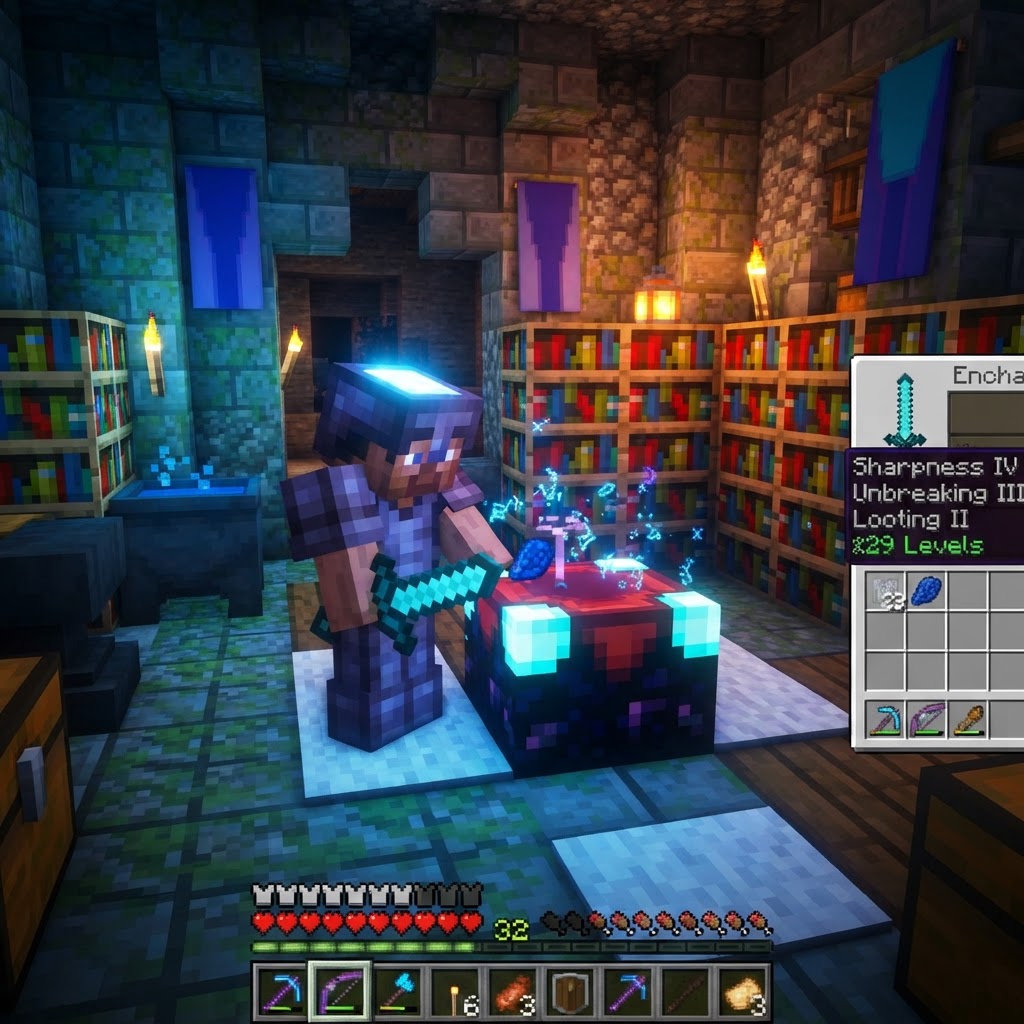
Enchanting transforms your Minecraft gear from functional to formidable — but most players waste dozens of levels chasing bad enchantments because they don't understand how the system actually works. Whether you're dying in the Nether with unenchanted armor or struggling to find Fortune III on your pickaxe, this guide fixes the knowledge gaps that keep you grinding inefficiently.
Setting Up Your Enchanting Room the Right Way
The difference between random low-level enchantments and powerful Tier 3 options is almost entirely about your setup.
Most new players place an Enchanting Table and wonder why they're only seeing level 1 enchantments. The answer is bookshelves — but placement matters just as much as quantity.
To unlock the maximum enchantment level (Level 30), you need 15 bookshelves arranged in a specific pattern around your Enchanting Table. Here's exactly how to do it:
- Place your Enchanting Table in the center of an open area.
- Leave a one-block air gap on all sides directly adjacent to the table.
- Build a ring of bookshelves at a distance of exactly 2 blocks from the table (no diagonal gaps in the corners).
- The bookshelves must be at the same level as the table or one block higher — bookshelves placed too high or low don't count.
- Keep the air gap clear — placing torches, carpets, or other blocks between a bookshelf and the table cancels that bookshelf's effect.
Bookshelf Layout: 15 Bookshelves = Max Level
The standard arrangement is a 5×5 ring of bookshelves with the center open (minus the four corners), giving you exactly 15 slots. You can also stack a second layer to fill bookshelves more efficiently in tight spaces, as long as placement rules are respected.
| Bookshelves Placed | Max Enchantment Level Unlocked |
|---|---|
| 0 | Level 1–8 |
| 5 | Level 1–17 |
| 10 | Level 1–24 |
| 15 | Level 1–30 |
The Enchanting Process Step-by-Step
Knowing the exact mechanics prevents you from wasting lapis and levels on enchantments you don't want.
Here's how each enchanting session actually works:
- Open the Enchanting Table — right-click it to open the interface.
- Place your item in the left slot (any enchantable item: tools, weapons, armor, books).
- Add Lapis Lazuli in the right slot — you need up to 3 lapis per enchantment.
- Review your three options — the table shows three enchantment slots with level costs (1, 2, or 3 levels of lapis + XP required). Hover over each to see a hint at one enchantment inside, but not all of them.
- Select your enchantment — click the one you want. The item receives ALL randomized enchantments in that package, not just the one shown.
- Collect your item and check what you received.
- Acquire enchanted books — from fishing (fastest with Luck of the Sea III), librarian villagers (most reliable), dungeon/temple loot chests, or by enchanting blank books at your table.
- Open the anvil interface.
- Place your target item (e.g., your diamond sword) in the left slot.
- Place the enchanted book in the right slot.
- Confirm the cost in levels — and retrieve your newly enchanted item from the output slot.
What Each Tier Generally Offers:
| Enchantment Tier | XP Levels Cost | Lapis Cost | Typical Enchantment Quality |
|---|---|---|---|
| Tier 1 (bottom slot) | 1–8 levels | 1 lapis | Low-level, single enchantment |
| Tier 2 (middle slot) | 10–19 levels | 2 lapis | Mid-level, sometimes dual enchants |
| Tier 3 (top slot) | 20–30 levels | 3 lapis | High-level, often multiple enchants |
Understanding Enchantment Levels and the RNG System
Enchanting isn't pure luck — the seed system means you can manipulate outcomes if you know how.
Every time you enchant an item, the game uses a seed to generate the three enchantment options. That seed changes every time you enchant something. This is why enchanting a cheap book (using 1 level and 1 lapis) before enchanting your real item can "reroll" the options you see.
Enchantability is a hidden stat that affects how many enchantments you can receive and at what level. Higher enchantability means better odds of higher-power enchantments. Here's how materials stack up:
| Material | Enchantability Score | Notes |
|---|---|---|
| Gold | 25 | Highest enchantability — great for books |
| Netherite | 15 | High quality, durable enchants |
| Diamond | 10 | Standard for most endgame gear |
| Iron | 9 | Decent mid-game option |
| Stone/Leather | 5–7 | Low — avoid for important enchanting |
| Wood/Chain | 5–12 | Inconsistent results |
|---|
Anvils, Books, and Combining Enchantments
The anvil is where real enchanting power comes from — it's not just for renaming tools.
The Enchanting Table gives you randomized results. The anvil gives you precision. Using enchanted books, you can apply exactly the enchantment you want to any compatible item.
How to use books and anvils effectively:
Combining two items with enchantments also works on an anvil, merging the enchantments of both. The item in the left slot is preserved; the item in the right slot is consumed. All compatible enchantments from the right item transfer to the left.
Prior Work Penalty: Every time an item is used on an anvil, its "prior work" count increases. The more times it's been through an anvil, the more expensive future operations become. After roughly 6 anvil uses, the cost may exceed 39 levels — at which point the game says "Too Expensive" and you cannot modify it further.
Common Mistakes That Waste Your Levels
These are the habits killing your XP bar without giving you anything useful in return.
1. Enchanting without max bookshelves
Players regularly enchant at Level 30 cost without having all 15 bookshelves in place, burning levels for Tier 1 quality outcomes. Always verify your setup.
2. Ignoring the "cheap book reroll" trick
Not using a cheap throwaway enchant (1 lapis, 1 level on a book) to reroll bad options means you're gambling with your best gear. Reroll until you see a Tier 3 option you actually want.
3. Applying incompatible enchantments
Silk Touch and Fortune cannot go on the same item. Protection variants (Fire, Blast, Projectile, regular) cannot stack on one piece of armor. Wasting an anvil operation to discover incompatibility is a frustrating and avoidable mistake.
4. Using the anvil in the wrong order
Applying enchantments to your diamond sword one at a time racks up prior work penalties fast. Combining books together first and applying them in bulk dramatically extends how many operations your item can survive.
5. Forgetting that enchanting a book always costs the same
A Level 3 enchantment on a book costs the same lapis/XP as on a tool, but the result is tradeable and transferable. Enchanting books intentionally is almost always better than enchanting gear directly when targeting specific enchantments.
6. Leaving villager trades untapped
Librarian villagers with lecterns sell specific enchanted books — and you can reset their trades by breaking and replacing the lectern until you get exactly what you need. Ignoring villagers means hours of RNG grinding when you could have Fortune III in minutes.
Pro Strategies for Advanced Enchanting
Once you understand the basics, these techniques separate efficient players from everyone else.
Build a dedicated XP farm first.
The entire enchanting system is gated behind experience levels. Before investing serious time in enchanting, set up a mob grinder or kelp/cactus smelting farm. Entering your enchanting room at Level 30+ consistently makes everything smoother.
Use the Librarian trading exploit to guarantee enchants.
Find an unemployed villager, place a lectern nearby to assign the Librarian profession, check their first trade. If it's not what you want, break the lectern, replace it, and check again — this rerolls their trade inventory. Lock in the trade by buying once at Level 1, then trade up to unlock higher-tier offerings. This gives you guaranteed access to any enchantment in the game with enough emeralds.
The "sacrifice" enchanting method for efficiency:
Enchant cheap iron tools at Level 30 and break them down for the enchantments you want on books. Then transfer only the best results to your netherite gear. You burn iron, not netherite, during the RNG phase.
Mending + Infinity cannot coexist on a bow — and Mending + Unbreaking on the same item is widely considered the "core combo" for any piece of gear you plan to use long-term. Always prioritize these two on any item before adding damage/utility enchantments.
Grindstones remove enchantments and return some XP — use a Grindstone to strip a badly enchanted item and try again rather than letting a curse-laden piece of armor sit in your inventory.
Quick Reference and Key Takeaways
Minecraft enchanting rewards players who understand the system rather than just throwing levels at it blindly. The core principles are simple: build your room correctly with 15 bookshelves, use throwaway enchants to reroll bad options, plan anvil operations to minimize prior work penalties, and exploit librarian villagers for guaranteed enchantment access.
The players who consistently have Fortune III pickaxes and Sharpness V swords aren't luckier — they've optimized their setup, they trade with villagers, and they think about enchantment order before touching an anvil. Apply these strategies and you'll spend less time grinding levels and more time actually playing with powerful gear.
RELATED ARTICLES
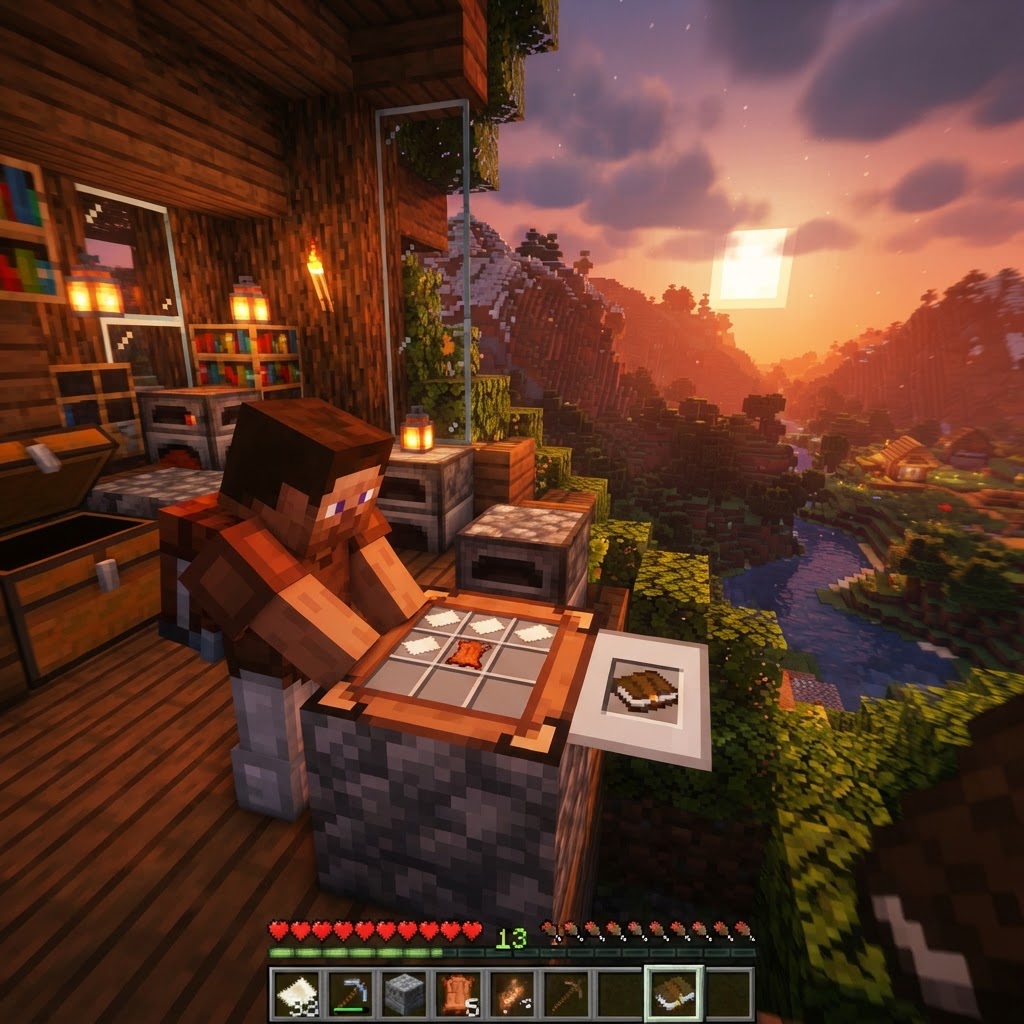
How to Make a Book in Minecraft: Easy Recipe & Uses
You're probably here because you just hit a wall — enchanting, writing, or crafting something advanced — and realized you need books but aren't sure how to get them efficiently. Books are one of Minec...
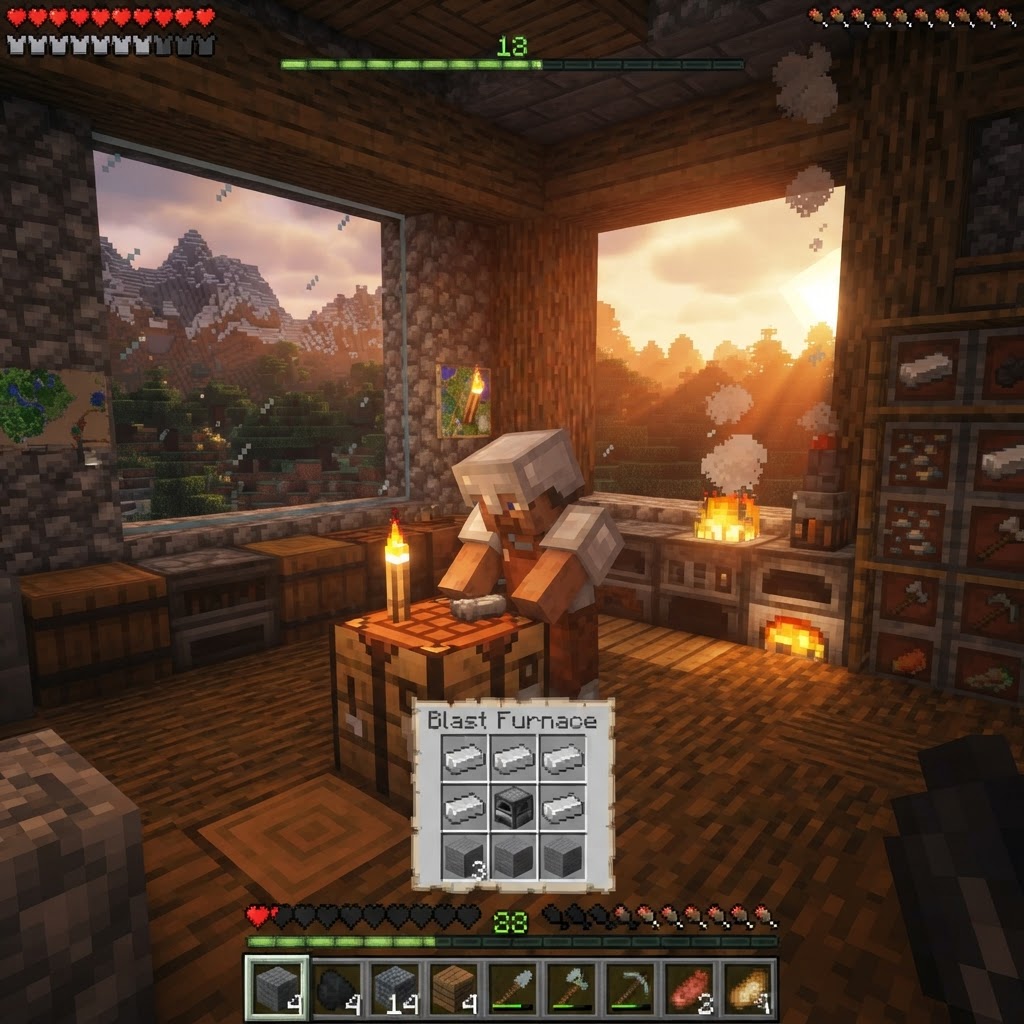
How to Make a Blast Furnace in Minecraft: Recipe & Uses
If you've been manually smelting ores one by one in a regular furnace, you're wasting serious time — the Minecraft blast furnace doubles your smelting speed for metals and ores, making it one of the m...
How to Make a Smoker in Minecraft: Recipe & Uses
If you're tired of waiting forever for your food to cook in a standard furnace, the smoker is the upgrade you didn't know you needed. It cooks food items at exactly twice the speed of a regular furnac...
STAY UPDATED
New blog posts, guides, and community tips delivered to your inbox.
No spam. Unsubscribe anytime.
Comments (0)
No comments yet. Be the first to share your thoughts!

