TABLE OF CONTENTS
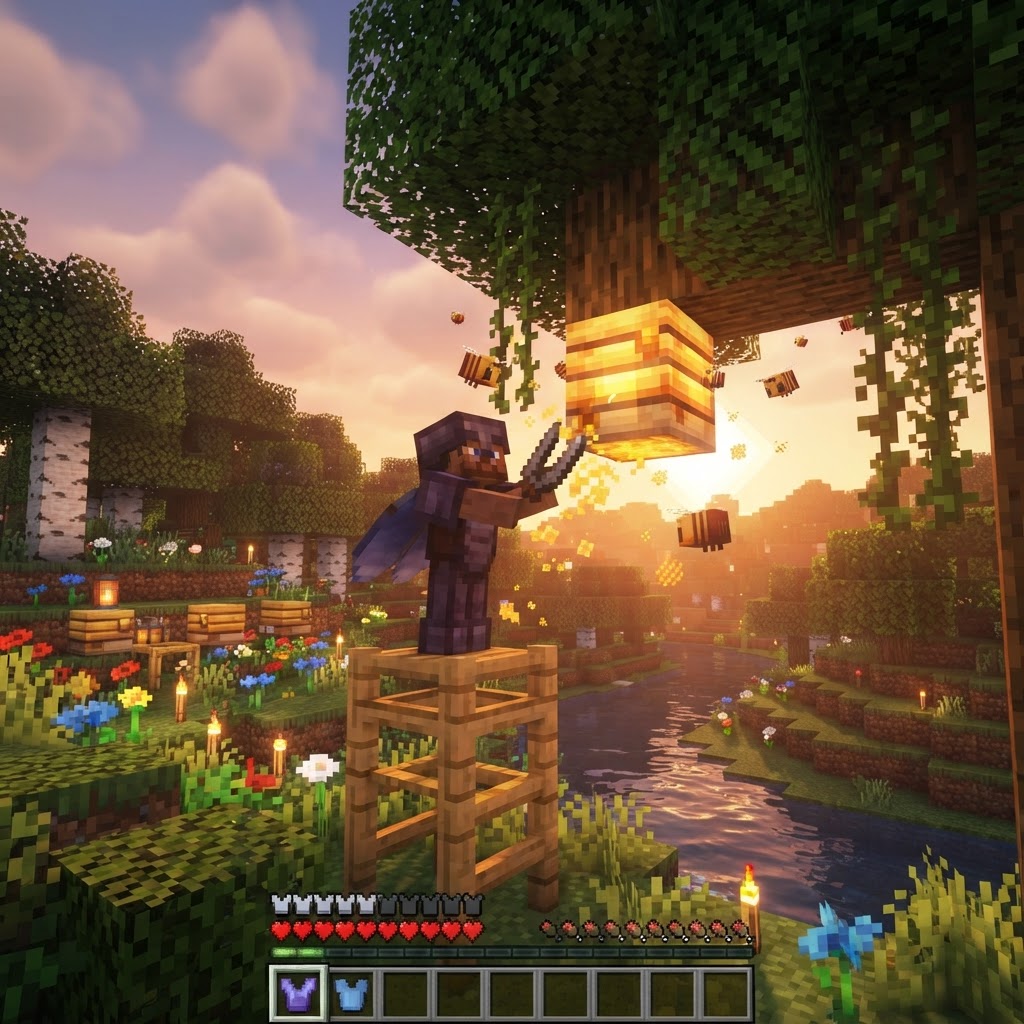
Get Honeycomb Fast in Minecraft — Ultimate Guide
Honeycomb is one of those resources that seems simple to collect until your first attempt ends with you running from an angry bee swarm while your inventory stays empty. Whether you're trying to craft wax for copper builds, set up a beehive farm, or unlock candles and honeycombs blocks, this guide covers every method, every mistake, and every shortcut so you walk away with a full stack every time.
What Honeycomb Is Actually Used For
Before you grind for it, know exactly why you need it — and how much.
Players often search for honeycomb without a clear picture of how much they actually need. That uncertainty leads to either under-collecting (and having to go back twice) or over-building infrastructure for a one-time craft. Here's the full breakdown of every honeycomb use case in the game.
| Crafted Item | Honeycomb Required | Why You Need It |
|---|---|---|
| Beehive (1x) | 3 honeycombs | Portable bee housing for farms |
| Candle (1x) | 1 honeycomb + 1 string | Light source, decoration |
| Honeycomb Block (1x) | 4 honeycombs | Decoration, sound-dampening builds |
| Waxed Copper (any stage) | 1 honeycomb per block | Preserve copper oxidation state permanently |
Candles also double as birthday cake decorations and come in all 16 dye colors, making them popular in creative and survival builds alike. If you're planning a copper mega-build, do that math before you head out. A 200-block copper roof means 200 honeycombs — that's a full-scale farm job, not a casual trip to one bee nest.
Finding Bee Nests in the Wild
You can't harvest what you can't locate — here's where bees actually spawn.
Bee nests generate naturally in the world attached to specific trees in specific biomes. They are not rare, but they are biome-dependent, and new players often waste time searching in the wrong areas entirely.
Biomes where bee nests spawn:
- Meadow — Highest density; nearly every oak and birch tree has a nest. Start here.
- Plains — Common; roughly 5% of oak trees carry a nest
- Sunflower Plains — Same rate as plains, slightly easier to spot in open terrain
- Flower Forest — Moderate frequency on birch and oak trees
- Cherry Grove — Added in 1.20; cherry trees frequently spawn with nests attached
- Forest / Birch Forest — Lower frequency but large biome size means many total nests
- Campfire Method (Recommended)
- Place a campfire directly beneath the bee nest or beehive
- The smoke pacifies bees and prevents aggression
- Use shears on the full nest to collect 3 honeycombs
- The campfire must be lit — a campfire with a carpet on top produces no smoke effect for bees
- Silk Touch Bottle Method (Alternative)
- Use a glass bottle on a level-5 nest to collect a honey bottle instead
- This resets the honey level without aggroing bees IF smoke is present
- Honey bottles are separate from honeycombs — don't confuse your goals
- Trap a bee nest or place a crafted beehive in a controlled area
- Place a campfire 1 block directly beneath the hive (or use a soul campfire — it also works and produces less light pollution)
- Plant flowers within 6 blocks of the hive — bees need nearby flowers to collect pollen efficiently
- Optionally add a hopper below a dispenser loaded with shears to automate collection
- Fill a dispenser with shears and connect it to a comparator signal
- A comparator reading a beehive outputs signal strength 5 when honey is full
- Wire that comparator to the dispenser to trigger automatic shearing
- Place a hopper and chest beneath the hive to catch the honeycombs as they drop
- Best biome to find nests: Meadow
- Tool to harvest honeycomb: Shears only
- Safety requirement: Lit campfire directly below the nest
- Honey level needed: 5 (visible dripping honey)
- Honeycomb per harvest: 3 (up to 6 with Fortune III on Bedrock)
- Beehive crafting cost: 3 honeycombs + 6 wooden planks
- Fastest farm setup time: ~20 minutes with one wild nest
Bee nests always attach to the side of the tree trunk during world generation. They will not appear on leaves or floating. If you find a tree with a nest, check nearby trees — bees from the same nest do not travel far, and cluster generation means multiple nests are often in the same patch of forest.
Using commands to locate (Java Edition):
`/locate biome minecraft:meadow` — Gives you coordinates to the nearest meadow instantly.
Harvesting Honeycomb Without Getting Attacked
The difference between a clean harvest and a chaotic retreat is one item and one block.
This is where most players fail. A bee nest or beehive only produces honeycomb when it reaches honey level 5 — you can visually confirm this when the nest looks darker and has honey dripping from it. Attempting to harvest at any earlier stage yields nothing.
The two safe harvesting methods:
What tool do you need?
Shears are the only tool that yield honeycomb. Using your fist, a sword, or any other tool destroys the nest and drops nothing useful (unless you have Silk Touch, which captures the nest itself as an item).
| Action | Tool | Result |
|---|---|---|
| Shear a level-5 nest (no campfire) | Shears | 3 honeycombs + bee aggro |
| Shear a level-5 nest (campfire below) | Shears | 3 honeycombs, no aggro |
| Break nest with Silk Touch | Any Silk Touch tool | Nest item drops, 0 honeycombs |
| Break nest without Silk Touch | Any tool | Nest destroyed, bees homeless and angry |
| Use bottle on level-5 nest | Glass bottle | 1 honey bottle, no honeycomb |
Building a Repeatable Honeycomb Farm
One bee nest gives you 3 honeycombs every few minutes — scale this up properly.
Once you understand the mechanics, building a sustainable honeycomb farm takes about 20 minutes and pays off indefinitely. The core concept: bees leave the nest during the day to collect pollen, return to the nest, and gradually raise the honey level from 0 to 5. Each cycle takes roughly 2–5 minutes of active bee behavior in good weather.
Minimum viable farm setup:
Automated collection with a dispenser:
Scaling up: Each hive holds exactly 3 bees at maximum capacity. To breed more bees, use flowers on two adults — baby bees grow in about 20 minutes. Populate multiple hives by breeding from one original nest and using Silk Touch to relocate populated hives.
Common Mistakes Players Make
These errors cost time, resources, and sometimes your life.
1. Harvesting before honey level 5
The nest looks the same from a distance at level 3 or 4. Only level 5 shows visible honey dripping and a darker texture. Shearing early gives you nothing and potentially triggers aggression.
2. Forgetting the campfire is lit
A campfire extinguished by rain or player error stops producing smoke. Bees are immediately un-pacified. Always double-check the campfire is active before shearing.
3. Using a carpet on the campfire
Carpets on campfires block smoke visually but also eliminate the bee-pacifying effect. This is a common trick used to prevent campfires from cooking items in some farms — but it breaks the bee mechanic entirely.
4. Breaking nests without Silk Touch
Wild bee nests are permanent structures that can't be replaced. If you break one without Silk Touch, those bees become hostile and permanently homeless (they despawn eventually). Bring a Silk Touch tool anytime you approach a nest you want to keep.
5. Not replanting flowers near the hive
Bees traveling too far to find pollen extends your honey level cycle significantly. Keep flowers within 6 blocks on all sides to maximize cycle speed.
6. Harvesting at night and expecting full yield
Bees return to nests at night and honey production pauses. Shearing is still possible at night, but the nest won't reach level 5 if bees haven't been active during the day.
Pro Strategies for Efficient Honeycomb Collection
These techniques separate casual players from builders who never run out.
Breed your own bee population from one nest
You only need a single wild bee nest to establish a complete farm. Silk Touch the nest, relocate it to your base, breed the bees with flowers until you have 6, split them into two hives, and expand from there. You never need to return to a wild biome again.
Use Looting enchantment? No — but Fortune helps on Bedrock
On Java Edition, shears are not affected by Fortune enchantments. On Bedrock Edition, Fortune III shears can yield up to 6 honeycombs per harvest instead of 3. If you're on Bedrock and building a large copper build, Fortune III shears are genuinely worth crafting.
| Feature | Java Edition | Bedrock Edition |
|---|---|---|
| Fortune effect on shears | No effect | Yes — up to 6 honeycombs |
| Campfire range for pacifying | 5 blocks below | 5 blocks below |
| Comparator detection of honey | Supported | Supported |
| Bee behavior in rain | Stay in nest | Stay in nest |
| Bees per hive (max) | 3 | 3 |
Link multiple hives to one automated dispenser
With a bit of redstone, you can chain comparators from several hives into one OR-gate circuit that fires a dispenser array simultaneously. This isn't complex redstone, but it multiplies your output significantly without extra player effort.
Trade with wandering traders
Wandering traders occasionally sell bee-related items, but not honeycomb directly. However, if you're in a world with low bee nest spawns, focus on the Meadow biome seed strategy — it's faster than any trading route.
Quick Reference
Everything you need at a glance.
Honeycomb rewards the player who prepares. Know which biome to target, bring shears and campfire materials, confirm the honey level before you shear, and you'll never run short again. If you're scaling up for a copper megabuild or full automation, the dispenser-comparator setup is the correct answer — set it once and let your bees do the work indefinitely. The mechanics are consistent, the farm is low-maintenance, and with the right biome knowledge, even your first playthrough collection session can yield a full chest of honeycomb before the sun sets.
RELATED ARTICLES
How to Make a Book in Minecraft: Easy Recipe & Uses
You're probably here because you just hit a wall — enchanting, writing, or crafting something advanced — and realized you need books but aren't sure how to get them efficiently. Books are one of Minec...
How to Make a Blast Furnace in Minecraft: Recipe & Uses
If you've been manually smelting ores one by one in a regular furnace, you're wasting serious time — the Minecraft blast furnace doubles your smelting speed for metals and ores, making it one of the m...
How to Make a Smoker in Minecraft: Recipe & Uses
If you're tired of waiting forever for your food to cook in a standard furnace, the smoker is the upgrade you didn't know you needed. It cooks food items at exactly twice the speed of a regular furnac...
STAY UPDATED
New blog posts, guides, and community tips delivered to your inbox.
No spam. Unsubscribe anytime.
Comments (0)
No comments yet. Be the first to share your thoughts!

