TABLE OF CONTENTS
How to Make a Cauldron in Minecraft (Java & Bedrock Guide)
If you've ever tried to dye leather armor, brew potions without a brewing stand, or deal with the Wandering Trader's llamas, you already know why a cauldron matters. The problem most players run into isn't just how to craft one — it's not understanding what cauldrons actually do across different game versions, which leads to wasted resources and missed mechanics. This guide covers everything: the exact recipe, version differences, practical uses, and the pro-level strategies that turn a cauldron from a decoration into a core survival tool.
Crafting a Cauldron in Minecraft
Seven iron ingots, one recipe — here's exactly how to do it right.
Crafting a cauldron is straightforward once you have the materials, but players frequently waste time hunting iron without a plan. Here's the full process from zero to finished cauldron.
What You Need:
- 7 Iron Ingots (no substitutions — iron blocks and nuggets don't work)
- A Crafting Table (3×3 grid required)
Step-by-Step Crafting:
- Mine at least 7 iron ore blocks. Iron spawns reliably between Y-levels -64 and 64, with the highest concentration around Y=16. Bring a stone pickaxe minimum — wood won't work on iron.
- Smelt the raw iron in a furnace using any fuel source. Each raw iron = one iron ingot.
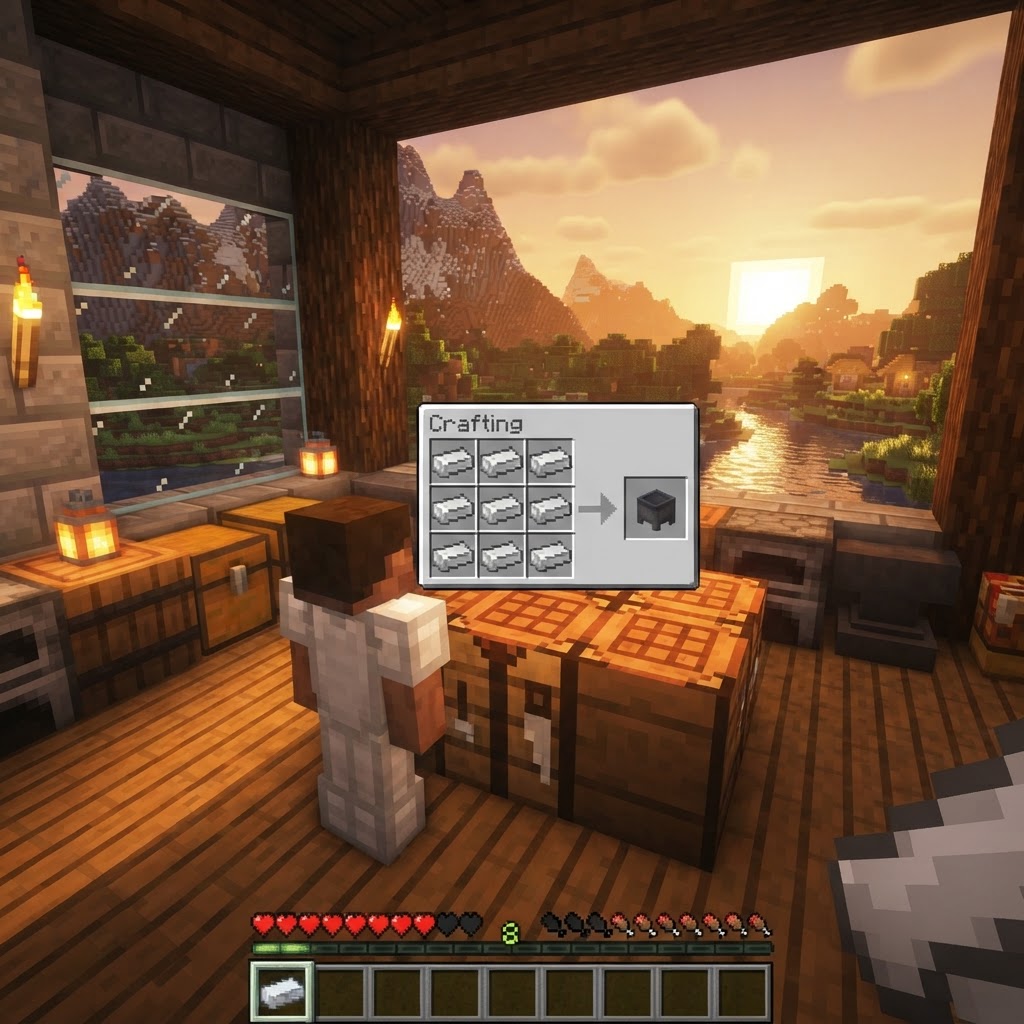
- Open your Crafting Table and arrange 7 iron ingots in a U-shape: fill the left column (3 ingots), right column (3 ingots), and bottom-center cell (1 ingot). Leave the top-center and middle-center cells empty.
- Drag the cauldron into your inventory.
- Witch Huts (swamp biomes) — always contains a cauldron, sometimes with a potion inside
- Igloos (snowy biomes) — the basement contains a cauldron with a splash potion of weakness
- Village houses — specifically tannery buildings in certain village types
- Woodland Mansions — rare but reliable
- Store water — holds up to 3 "levels" of water, filled with a water bucket or during rain
- Clean dyed leather armor — dip dyed leather armor into a water-filled cauldron to remove the dye (costs one water level per piece)
- Remove banner patterns — same mechanic, one water level consumed per use
- Extinguish fire — step into a water cauldron to put yourself out (uses one level)
- Store potions (including splash and lingering variants)
- Store lava
- Dye leather armor directly inside the cauldron
- Fill glass bottles with stored potions
- Apply/remove dye from leather horse armor, beds, and shulker boxes
- If you're using a cauldron for armor dyeing in a batch, fill it completely (full bucket) before starting
- Place cauldrons outdoors under open sky during rainstorms for a free, passive top-up — no bucket needed
- In Bedrock, keep separate cauldrons for water and potions rather than switching between liquids constantly
- Use a glass bottle rather than a bucket when you only need to remove a single dye layer — it costs one level either way, but bottles are cheaper to produce
- Craft it with 7 iron ingots in a U-shape — or find one free in a witch hut or igloo
- Check your version — Java cauldrons store water only; Bedrock cauldrons store water, potions, and lava
- Use rain-filling — passive outdoor refilling is free and consistently underused
Alternative: Finding Cauldrons in the World
You don't always have to craft one. Cauldrons generate naturally in:
What Cauldrons Actually Do
Most players use 10% of a cauldron's functionality — here's the other 90%.
A cauldron is far more than a decorative pot. Its functions vary significantly between Java and Bedrock, but both versions offer utility that players regularly overlook.
Universal Functions (Both Versions):
Bedrock-Exclusive Functions:
Java vs. Bedrock: Key Differences Explained
Same block, very different toolset — know your version before you plan.
The cauldron is one of the most version-divergent blocks in Minecraft. Treating them as identical will cost you time and resources.
| Feature | Java Edition | Bedrock Edition |
|---|---|---|
| Store Water | ✅ Yes (3 levels) | ✅ Yes (3 levels) |
| Store Potions | ❌ No | ✅ Yes |
| Store Lava | ❌ No | ✅ Yes |
| Dye Leather Armor | ✅ (via crafting grid) | ✅ (directly in cauldron) |
| Fill During Rain/Snowfall | ✅ Yes | ✅ Yes |
| Remove Dye from Armor | ✅ Yes | ✅ Yes |
|---|---|---|
| Dye Beds/Shulker Boxes | ❌ No | ✅ Yes |
| Used in Brewing Without Stand | ❌ No | ✅ Yes (partial) |
Cauldron Filling Methods and Efficiency
Not all filling methods are equal — here's how to manage your cauldron levels strategically.
A cauldron holds three levels of liquid. How you fill it changes depending on your situation and version.
| Filling Method | Levels Added | Notes |
|---|---|---|
| Water Bucket | 3 (full) | Fastest single-fill method |
| Glass Bottle | 1 level | Useful for controlled fills |
| Rain (Outdoor, no roof) | Fills slowly over time | Free and passive — very useful in bases |
| Snowfall (Bedrock) | Fills with powder snow | Unique Bedrock mechanic |
| Lava Bucket (Bedrock only) | 3 (full) | For lava cauldrons specifically |
Managing Cauldron Levels Efficiently:
Common Mistakes Players Make With Cauldrons
These are the errors that send players back to Google every time.
1. Wrong Crafting Placement
The most common crafting error is placing the bottom ingot in the wrong cell. The U-shape requires the bottom-center cell filled and the middle-center empty. Placing iron in the center produces nothing.
2. Expecting Java to Behave Like Bedrock
Playing on Java and wondering why you can't store that potion you brewed? You can't. Java cauldrons are water-only. This catches switchers every single time.
3. Wasting Potion Levels (Bedrock)
On Bedrock, adding a potion to a cauldron with remaining water removes the water and replaces it with potion — you don't "mix" them. Toss water that's still in there before adding potions or you'll lose the potion.
4. Not Using Rain to Refill
Placing your cauldron indoors under a solid ceiling means it will never self-fill. Players build elaborate bucket systems when simply leaving one cauldron outdoors (or under a transparent block like glass) would auto-fill during weather.
5. Ignoring Cauldrons in Witch Huts
Early-game players break witch huts apart and loot them without taking the cauldron. It's a free cauldron — saving you 7 iron ingots — and sometimes comes pre-filled with a useful potion on Bedrock.
6. Thinking Cauldrons Replace Brewing Stands
They don't. Even on Bedrock, cauldrons store potions but don't brew them. You still need a brewing stand to create potions from scratch. A cauldron is storage and a delivery mechanism, not a crafting station for potions.
Pro Strategies: Getting Maximum Value From Cauldrons
If you already know the basics, these techniques are what separates efficient players from the rest.
Mass Armor Dyeing Operations (Bedrock)
When outfitting a large multiplayer server or preparing dyed gear in bulk, set up a cauldron station with one cauldron per dye color. Pre-fill each cauldron with the same base color, then dip multiple armor pieces in sequence. You get perfectly consistent color matching without the random variation that comes from individual crafting-grid dye jobs.
Lava Cauldron Mob Farms (Bedrock)
Lava cauldrons deal fire damage to mobs that walk into them, but unlike lava source blocks, they don't spread. This makes them safe, contained damage sources in mob processing rooms. Use them in combination with hoppers below to collect drops without burning items.
Passive Water Generation for Remote Bases
If you're building far from a water source, place cauldrons in exposed outdoor positions and let rain fill them. On servers with frequent weather cycles, you can sustain small operations — cleaning armor, filling bottles, extinguishing burns — entirely off rain-collected water without running back to a river or ocean.
Potion Bottle Multiplication (Bedrock)
A single lingering potion creates a potion cloud on the ground. But pouring one lingering potion into a cauldron gives you a full cauldron of that potion type (3 levels), each level fillable into a glass bottle. Strategically, you can turn 1 lingering potion into 3 splash potions, dramatically multiplying your potion supply.
Cauldrons as Visual Redstone Indicators
Cauldrons with comparators can output a redstone signal based on fill level (0, 1, 2, or 3 levels). Use this to build water-level indicators for automated farms, alerting systems when a storage container is running low, or purely aesthetic pressure-based puzzles in adventure maps.
Conclusion
A cauldron in Minecraft is deceptively simple to craft but deeply useful when you understand the full picture. Seven iron ingots in a U-shape gets you the block — but knowing that Java and Bedrock handle cauldrons completely differently, that rain passively fills outdoor cauldrons, and that Bedrock players can multiply potions through cauldron mechanics is what separates a player who builds one and forgets it from one who integrates it into every major system.
The three things to remember:
Whether you're dyeing armor for a server faction, building redstone contraptions, or just wanting a clean way to store potions, the cauldron earns its iron cost many times over.
RELATED ARTICLES

How to Make a Book in Minecraft: Easy Recipe & Uses
You're probably here because you just hit a wall — enchanting, writing, or crafting something advanced — and realized you need books but aren't sure how to get them efficiently. Books are one of Minec...

Featured Minecraft Modpack: Create a World of Industry
If you're ready to transform Minecraft into a fully mechanized industrial playground, this Create modpack guide covers everything you need. You'll learn what makes Create-based modpacks stand out, whi...

How to Make a Blast Furnace in Minecraft: Recipe & Uses
If you've been manually smelting ores one by one in a regular furnace, you're wasting serious time — the Minecraft blast furnace doubles your smelting speed for metals and ores, making it one of the m...
STAY UPDATED
New blog posts, guides, and community tips delivered to your inbox.
No spam. Unsubscribe anytime.
Comments (0)
No comments yet. Be the first to share your thoughts!

