TABLE OF CONTENTS
Minecraft Composter Guide: Make & Use One Fast
If you're drowning in excess crops, seeds, and plant materials with nowhere to put them, the Minecraft composter solves two problems at once: it clears your inventory clutter and produces bone meal — one of the most versatile resources in the game. Whether you're running a villager trading hall, a massive farm, or just trying to stop wasting food, understanding the composter fully will save you time and materials every single session.
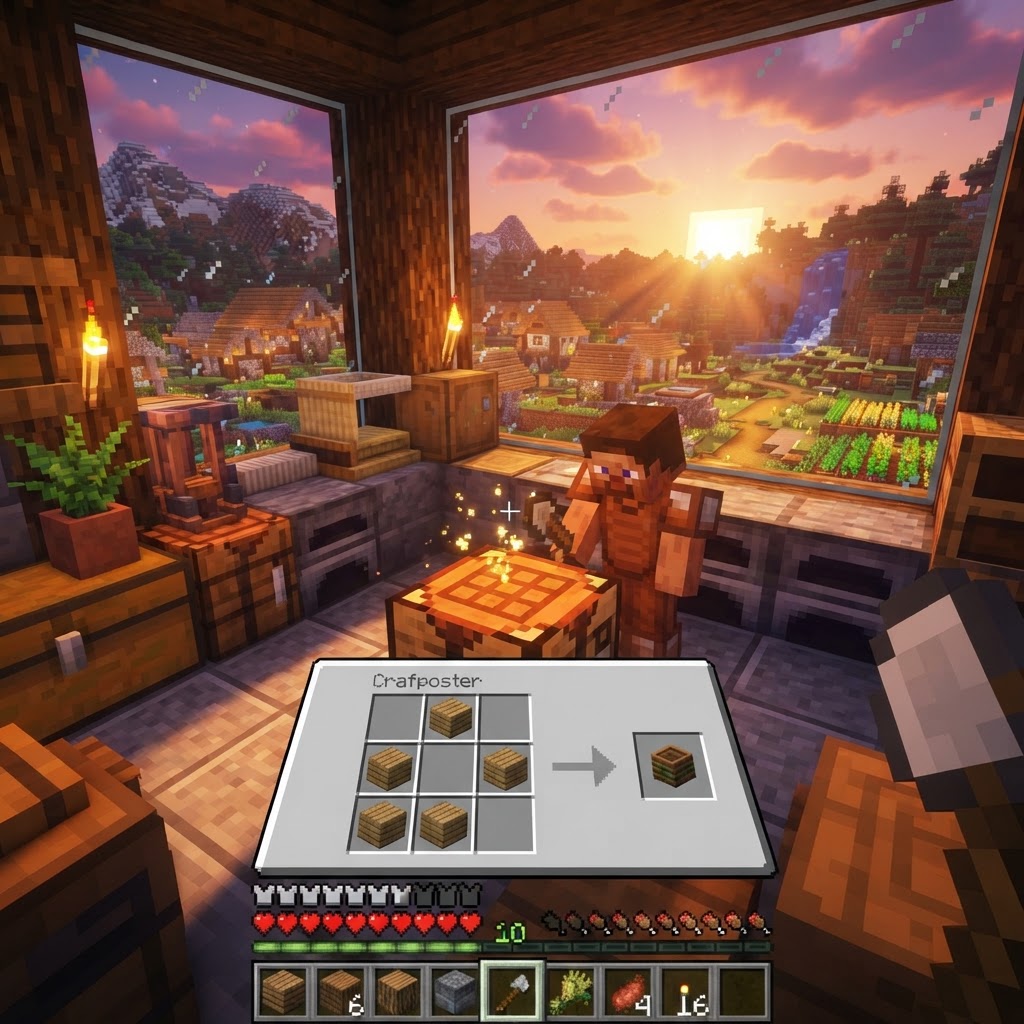
Crafting the Minecraft Composter
You only need seven planks and about thirty seconds — but the placement matters more than most players realize.
The composter is one of the cheapest utility blocks in Minecraft, which is exactly why so many players overlook optimizing it. Don't make that mistake.
What you need:
- 7 wooden slabs (any wood type, mixed types work fine)
- A crafting table
Crafting steps:
- Open your crafting table (3×3 grid)
- Place 1 wooden slab in the far-left of Row 1
- Place 1 wooden slab in the far-right of Row 1
- Fill all 3 slots of Row 2 with wooden slabs (left, middle, right)
- Place 1 wooden slab in the far-left of Row 3
- Place 1 wooden slab in the far-right of Row 3
- Leave the center of Row 1 and Row 3 empty — this creates the open-top barrel shape
- Drag the composter into your inventory
- Each item that qualifies has a fixed percentage chance of raising the internal layer count by 1
- The layer visually changes (you can see the pile rising) as layers accumulate
- Layers go from 0 to 7; at 7, the composter is "ready"
- Right-clicking a ready composter collects 1 bone meal and resets to 0
- The composter does NOT automatically output — you must collect manually unless you use a hopper system
- A hopper placed underneath the composter will automatically collect bone meal when the composter is ready
- A hopper placed on top feeding into the composter will automatically insert compostable items
- This means you can build a fully automated input/output system with just two hoppers, a composter, and a chest
- Place an unemployed villager (one with no job) near a composter
- The villager must be able to pathfind to the composter
- Within a few in-game days, the villager will claim the composter and become a Farmer
- Farmer villagers trade crops, bread, apples, and — at higher tiers — golden carrots and suspicious stew
- Craft it early — 7 wooden slabs is nothing, and the sooner it's running, the more waste you convert
- Automate it — top hopper in, bottom hopper out, chest below. Set it once.
- Use it for villagers — a Farmer villager at Master level is a long-term asset that pays for itself in golden carrots and emeralds alone
Alternative: Find one in the world
Composters generate naturally in villages inside farmer houses. If you find a village before you find a crafting table's worth of wood, you can simply steal the composter and carry it to your base.
What You Can Put in a Composter
Not everything green goes in — knowing the exact compostable list saves you from wasting materials or missing opportunities.
This is where most players get stuck. They assume anything plant-related compostes, then get frustrated when items don't register. Here's the reality: items have different composting probabilities, meaning not every item added guarantees a layer increase.
Composter Fill Probability Table:
| Probability of Adding a Layer | Items |
|---|---|
| 30% chance | Wheat Seeds, Beetroot Seeds, Dried Kelp, Melon Seeds, Pumpkin Seeds, Sweet Berries, Glow Berries |
| 50% chance | Grass, Fern, Vines, Oak/Birch/Spruce/Jungle/Acacia Leaves, Dandelion, Poppy, Saplings |
| 65% chance | Dried Kelp Block, Melon Slice, Apple, Beetroot, Carrot, Cocoa Beans, Kelp, Potato, Sea Grass, Sugar Cane |
| 85% chance | Baked Potato, Bread, Cookie, Hay Bale, Mushroom Stew, Pumpkin, Red Mushroom Block, Sea Pickle, Wheat |
| 100% chance | Cake, Pumpkin Pie |
The composter needs 7 layers to fill completely. Once full, the top turns bone-meal-white and you right-click to collect 1 bone meal. The composter then resets to empty.
How the Composter Actually Works (Mechanics Deep Dive)
Understanding the internal logic helps you calculate efficiency and build better automated systems.
Here's what the game is actually doing when you throw an item into a composter:
Hopper Automation:
Using the Composter as a Villager Job Block
This is the second major reason to care about composters — and most players never use it intentionally.
The composter is the job site block for Farmer villagers. This has massive implications for anyone running a trading hall or trying to get specific trades.
How to use this:
Farmer Villager Trade Tiers:
| Trade Level | Notable Trades |
|---|---|
| Novice | Wheat, Potato, Carrot, Beetroot for Emeralds |
| Apprentice | Pumpkin, Melon for Emeralds |
| Journeyman | Bread, Apple for Emeralds |
| Expert | Cookie, Cake for Emeralds |
| Master | Golden Carrot, Suspicious Stew for Emeralds |
If you want to reassign a villager to Farmer, simply break their current job block and place a composter nearby. The villager will unclaim the old job and eventually claim the composter — but only if they haven't been traded with yet. Once you trade with a villager, their profession is locked permanently.
Common Mistakes Players Make With Composters
These are the exact errors that waste your time, your materials, and your bone meal supply.
Mistake 1: Using 100% efficiency items exclusively
Cake and Pumpkin Pie have a 100% chance per use — but they're expensive to make. Players sometimes craft these specifically to feed the composter, spending more resources than they gain in bone meal. Use your waste materials, not your valuable ones.
Mistake 2: Not automating the output
Hand-collecting bone meal from composters is fine early game. But if you have a large farm, you're leaving a ton of bone meal on the table by not running a hopper below the composter into a chest. Set it up once and forget it.
Mistake 3: Composting seeds when you need them
New players often compost wheat seeds because they have "too many" — then realize they needed them to breed chickens or trade with villagers. Always check your seed needs before bulk-composting them.
Mistake 4: Building one composter for a massive farm
A single composter produces roughly 1 bone meal per 7 successful item interactions. If you have a large-scale automatic crop farm, one composter is a bottleneck. Scale your composters to your farm output.
Mistake 5: Forgetting that leaves compost
Players who clear forests for wood discard thousands of leaves that could be composted. Leaves have a 30–65% chance depending on type. If you're chopping trees anyway, pick up the leaves with shears and run them through a composter system.
Pro Strategies: Getting the Most Out of Every Composter
These are the techniques that separate players who have bone meal to spare from those who are always short.
Strategy 1: The Kelp Farm → Composter Pipeline
Dried kelp blocks have an 85% composting chance and kelp grows infinitely without replanting. Build an automatic kelp farm, funnel harvested kelp into a furnace array (or smoker array) to create dried kelp blocks, then route those into a hopper-fed composter chain. This is one of the most resource-efficient passive bone meal generators in the game.
Strategy 2: Composter Chains for High-Output Farms
Instead of one composter, line up 5–10 composters in a row, all fed by a single hopper chain from your farm's output chest and all outputting into a collection chest via bottom hoppers. This prevents backup and processes large item volumes without clogging.
Strategy 3: Bone Meal Flower Farms
Use the bone meal your composters generate to grow flowers, then use those flowers to make dye — which you can trade to Shepherd or Leatherworker villagers for emeralds. This creates a closed-loop economy: crops → bone meal → flowers → dye → emeralds.
Strategy 4: Use Composters to Convert Villagers Mid-Hall
If you've built a trading hall and need to convert a specific villager to Farmer, bring composters to the hall. Place one, let the target villager pathfind to it, wait for conversion. Remove the composter when done if you want to keep the space clean. This is cleaner and faster than rebuilding villager housing.
Strategy 5: Haybale Composting for Rapid Bone Meal
If you have a wheat surplus and need bone meal fast, craft wheat into hay bales (9 wheat = 1 hay bale) before composting. Hay bales have an 85% composting chance and take up 1/9th the inventory space per unit of wheat used. This isn't more efficient per wheat stalk, but it's dramatically faster when you're manually feeding a composter.
Conclusion: The Composter Is a Force Multiplier
One block. Two major uses. Zero reason not to have one running.
The Minecraft composter earns its place in almost every base because it addresses a fundamental problem: resource conversion. Farm waste becomes bone meal. Bone meal accelerates crops and spawns flowers. Flowers become dye. Composters anchor Farmer villagers who unlock golden carrots and other high-tier trades. The chain of value from a single composter is longer than it first appears.
The three things to remember:
Don't let excess seeds, leaves, and crops sit in a chest gathering space. Put them to work.
RELATED ARTICLES
How to Make a Book in Minecraft: Easy Recipe & Uses
You're probably here because you just hit a wall — enchanting, writing, or crafting something advanced — and realized you need books but aren't sure how to get them efficiently. Books are one of Minec...
How to Make a Blast Furnace in Minecraft: Recipe & Uses
If you've been manually smelting ores one by one in a regular furnace, you're wasting serious time — the Minecraft blast furnace doubles your smelting speed for metals and ores, making it one of the m...
How to Make a Smoker in Minecraft: Recipe & Uses
If you're tired of waiting forever for your food to cook in a standard furnace, the smoker is the upgrade you didn't know you needed. It cooks food items at exactly twice the speed of a regular furnac...
STAY UPDATED
New blog posts, guides, and community tips delivered to your inbox.
No spam. Unsubscribe anytime.
Comments (0)
No comments yet. Be the first to share your thoughts!

