TABLE OF CONTENTS
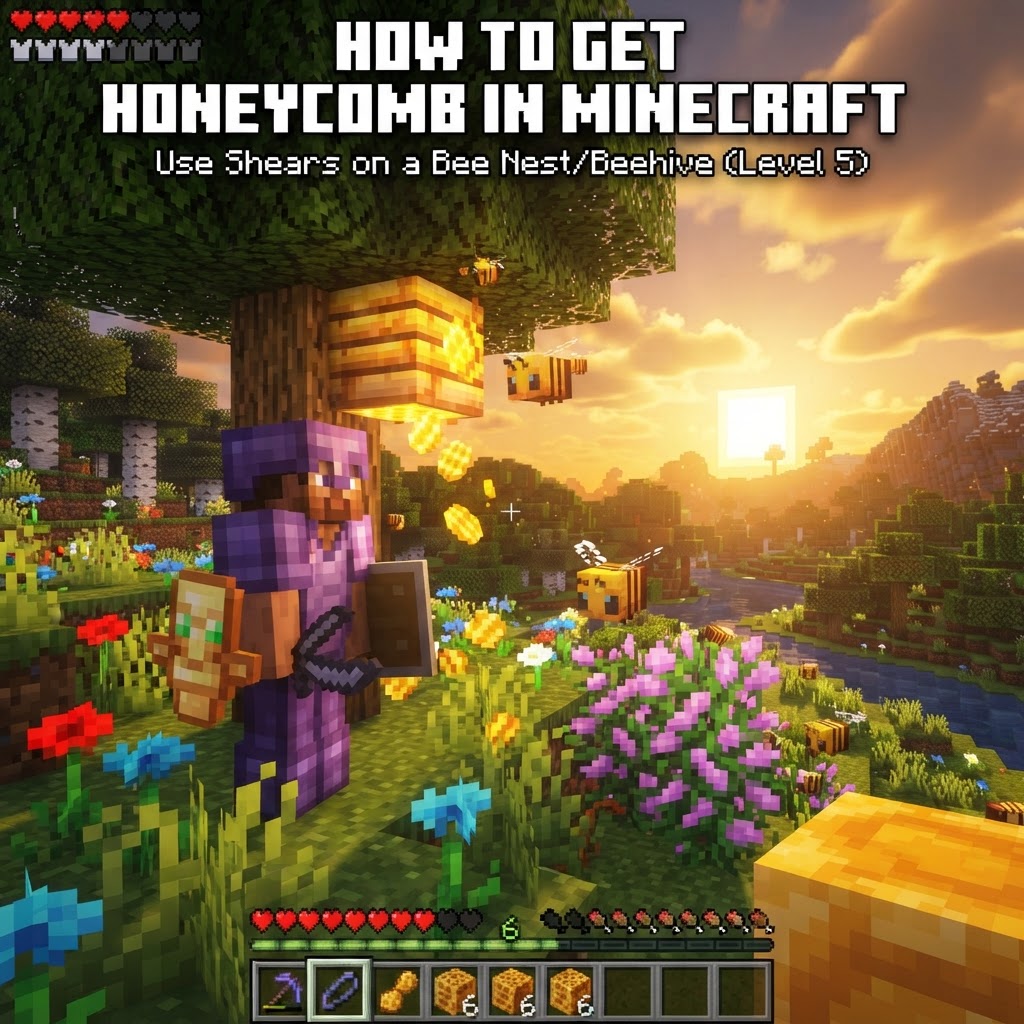
How to Get Honeycomb in Minecraft — Fast & Safe Methods
Honeycomb is one of those resources that seems simple to get until a swarm of angry bees ends your run and you lose everything. Whether you're crafting beehives to build a honey farm, making candles for atmosphere, or waxing copper blocks to lock in that perfect oxidation color, you need a reliable, repeatable way to collect honeycomb without the chaos. This guide covers every method, every mistake, and every shortcut so you never waste another harvest.
What Is Honeycomb Actually Used For?
Before you farm it, know exactly why you need it — the use case changes the quantity you need.
Most players search for honeycomb after hitting a crafting recipe that requires it. But the amount you need varies wildly depending on your goal, so let's break it down clearly:
Crafting Recipes That Require Honeycomb:
- Beehive — 3 honeycomb + 6 wooden planks (any type). This is the most common reason players need large quantities, especially when building a honey farm from scratch.
- Candle — 1 honeycomb + 1 string. Great for atmospheric builds and decoration. Candles can be dyed 16 colors.
- Honeycomb Block — 4 honeycomb per block. A decorative block with a surprisingly warm texture, popular in cottage-core and nature builds.
- Waxed Copper Variants — 1 honeycomb + 1 copper block (or stair/slab). This is a massive use case for technical players who want to preserve copper's oxidation stage permanently.
- Harvesting without a campfire or smoking activates aggro instantly
- Destroying the nest block aggros bees permanently (they won't forgive you even if you die and respawn nearby)
- Bees that are already inside the nest when you harvest do NOT come out aggroed if you use a campfire
- Rain does NOT prevent bee aggression — only smoke does
- Place a campfire directly under the bee nest or within 5 blocks directly below it
- Wait for the smoke particles to visually rise and reach the nest
- Right-click the nest with shears (not your hand, not a sword)
- Collect 3 honeycomb items that pop out
- The nest resets to honey level 0 and bees continue their routine
- Load shears into a dispenser aimed at the nest
- Power the dispenser with a redstone signal when the nest reaches level 5
- Place a campfire under the nest permanently
- Honeycomb drops to the ground (use a hopper and chest below to collect)
- 1 beehive = ~1 honeycomb per in-game day (roughly)
- 5 beehives = enough honeycomb for ongoing copper waxing projects
- 10+ beehives = enough to supply candle crafting, decorative blocks, and new hive construction simultaneously
Finding Bee Nests in the Wild
You can't harvest what you can't find — here's where bees actually spawn.
Bee nests generate naturally in specific biomes attached to certain tree types. They don't spawn everywhere, and players waste enormous time searching in the wrong areas.
Biomes Where Bee Nests Spawn Naturally:
| Biome | Tree Type | Nest Spawn Chance |
|---|---|---|
| Meadow | Oak | Very High (~100% of oak trees) |
| Flower Forest | Oak, Birch | ~5% of trees |
| Forest | Oak, Birch | ~5% of trees |
| Birch Forest | Birch | ~5% of trees |
| Plains | Oak | ~5% of trees near flowers |
| Sunflower Plains | Oak | ~5% of trees near flowers |
|---|---|---|
| Cherry Grove | Cherry | ~5% of cherry trees |
| Mangrove Swamp | Does not generate | N/A |
The fastest biome for nest hunting is the Meadow. In Java Edition, nearly every oak tree in a Meadow has a bee nest attached. If you spawn near a mountain biome or see a meadow on your map, go there first.
What to Look For:
Bee nests are tan, honeycomb-patterned blocks hanging from the underside or side of tree branches. They often have bees hovering nearby. At honey level 5 (when dripping honey particles appear), they're ready to harvest.
How to Harvest Honeycomb Without Getting Killed
Bee aggression is the #1 reason players fail this — here's the exact mechanic.
Bees become hostile when you harvest a nest without calming them first. A single angry bee alerts the entire nest, and all bees within range will attack. In the early game, this can kill you fast, especially if you have no armor.
Understanding Bee Aggression:
The Two Safe Harvesting Methods:
Method 1: Campfire Smoke (Most Reliable)
Method 2: Dispenser + Shears (Automated)
Harvesting Methods Compared
Not all methods are equal — pick the right one for your playstyle.
| Method | Tools Required | Honeycomb Yield | Risk Level | Best For |
|---|---|---|---|---|
| Campfire + Shears | Shears, Campfire | 3 per harvest | Very Low | Early-mid game manual harvesting |
| Dispenser + Shears | Shears, Dispenser, Redstone | 3 per harvest | None | Automated farms |
| Silk Touch + Relocate | Silk Touch Pickaxe | Indirect (move nest) | Low | Relocating nests to your base |
| No campfire (risky) | Shears only | 3 per harvest | Very High | Not recommended |
| Breeding + New Nests | Flowers | Indirect growth | None | Long-term scaling |
The campfire method is the right call for 90% of players. It's cheap, requires no redstone knowledge, and works immediately. Save the dispenser method for when you're building a dedicated honey farm with 5+ hives.
Setting Up a Scalable Honey Farm
One nest gives you trickles — a proper farm gives you stacks.
Once you understand how bees work, you can build a farm that produces honeycomb passively. Here's how to scale from one nest to a real operation:
Step 1: Relocate Nests or Breed Bees
Use Silk Touch to mine bee nests from the wild (wait until night or until all bees are inside the nest). Transport them to your base. Alternatively, breed bees using flowers — two bees fed flowers produce a baby bee, and as your population grows, you can craft new beehives (3 honeycomb + 6 planks) to house them.
Step 2: Build the Housing Row
Place beehives in a straight row with at least 2 blocks of clearance on each side for bee flight paths. Bees need to fly out, collect pollen from nearby flowers, and return. Place flower patches within 22 blocks of the hive for maximum efficiency.
Step 3: Install Permanent Campfires
Place a campfire under every hive. You can use a Soul Campfire for aesthetics (it produces blue smoke but works identically for calming bees). Cover campfires with carpet to prevent mobs from taking fire damage if they walk over them — the smoke still passes through.
Step 4: Automate the Harvest
Point dispensers loaded with shears at each hive. Wire them all to a single button or observer/comparator circuit that detects honey level 5 automatically. Run hoppers underneath each hive into a central chest.
Scaling Reference:
Common Mistakes Players Make
These errors cost resources, time, and lives — avoid all of them.
Mistake 1: Harvesting at the Wrong Honey Level
The nest must be at level 5 (honey level maxed, dripping particles visible) before shears work. Using shears on a level 1-4 nest does nothing. Players waste shear durability right-clicking early.
Mistake 2: Placing the Campfire Too Far Away
The campfire must be directly beneath the nest, not beside it or at an angle. Only upward-rising smoke calms bees. A campfire 3 blocks to the side does nothing.
Mistake 3: Destroying the Nest Instead of Harvesting It
Using a pickaxe (even accidentally) on a full honey nest destroys it without any drops and causes permanent aggro. If you need to move a nest, Silk Touch — no exceptions.
Mistake 4: Harvesting During Rain
Rain doesn't affect bee aggro, but it does extinguish campfires. Players set up campfires and then come back on a rainy day confused why bees are attacking. Check that your campfire is still lit before every harvest.
Mistake 5: Not Having Flowers Near Hives
Bees can't produce honey if there are no flowers nearby to pollinate. A hive with no flowers in range will never progress past level 0. Always plant flowers within 22 blocks.
Pro Strategies for Efficient Honeycomb Collection
For players who want to optimize beyond the basics.
Stack Multiple Nests Vertically
You can stack beehives 2-3 high in a column with a single campfire at the base. The smoke rises through all levels. This lets you harvest 3 hives from the same ground footprint, perfect for space-constrained bases.
Use Looting Enchantment? No — Use Fortune Instead
Fortune does NOT increase honeycomb drops from shears — honeycomb yield is fixed at 3 per harvest. However, Fortune DOES affect honey bottle farms if you're also collecting honey. Don't waste an enchantment slot expecting more honeycomb.
Night Harvesting Without Campfires
Bees return to their hive at night and don't come out. If your nest is at level 5 and it's nighttime, you can harvest with shears without a campfire and face zero aggression since all bees are already inside. This is the campfire-free method that actually works — time it right.
Trade for Honeycomb Indirectly
Journeyman-level Wandering Traders occasionally sell bee nests. It's not cost-effective for bulk honeycomb, but if you need a bee nest in a biome without meadows, this is a valid backup option.
Build Your Farm Near a Flower Forest
If you're in early game and can choose where to settle, building near a Flower Forest gives you wild bee nests nearby and a natural flower supply. You'll spend significantly less time hunting resources before your farm becomes self-sustaining.
The Bottom Line
Getting honeycomb consistently comes down to three things: finding the right biome (meadow first, always), using shears with a campfire below the nest, and scaling up to a proper hive farm once you've established your base. The campfire mechanic is the single most important detail most players miss — skip it and you'll fight bees every single harvest. Master it and honeycomb becomes one of the easiest resources in the game to stockpile.
For waxing copper at scale, target 10+ hives. For candles and decoration, 3-5 hives is plenty. Either way, start by relocating a meadow nest with Silk Touch, set up your campfire, breed your bee population up, and let the automation do the rest. Once that system is running, you'll never think about honeycomb scarcity again.
RELATED ARTICLES
How to Make a Book in Minecraft: Easy Recipe & Uses
You're probably here because you just hit a wall — enchanting, writing, or crafting something advanced — and realized you need books but aren't sure how to get them efficiently. Books are one of Minec...
How to Make a Blast Furnace in Minecraft: Recipe & Uses
If you've been manually smelting ores one by one in a regular furnace, you're wasting serious time — the Minecraft blast furnace doubles your smelting speed for metals and ores, making it one of the m...
How to Make a Smoker in Minecraft: Recipe & Uses
If you're tired of waiting forever for your food to cook in a standard furnace, the smoker is the upgrade you didn't know you needed. It cooks food items at exactly twice the speed of a regular furnac...
STAY UPDATED
New blog posts, guides, and community tips delivered to your inbox.
No spam. Unsubscribe anytime.
Comments (0)
No comments yet. Be the first to share your thoughts!

