TABLE OF CONTENTS
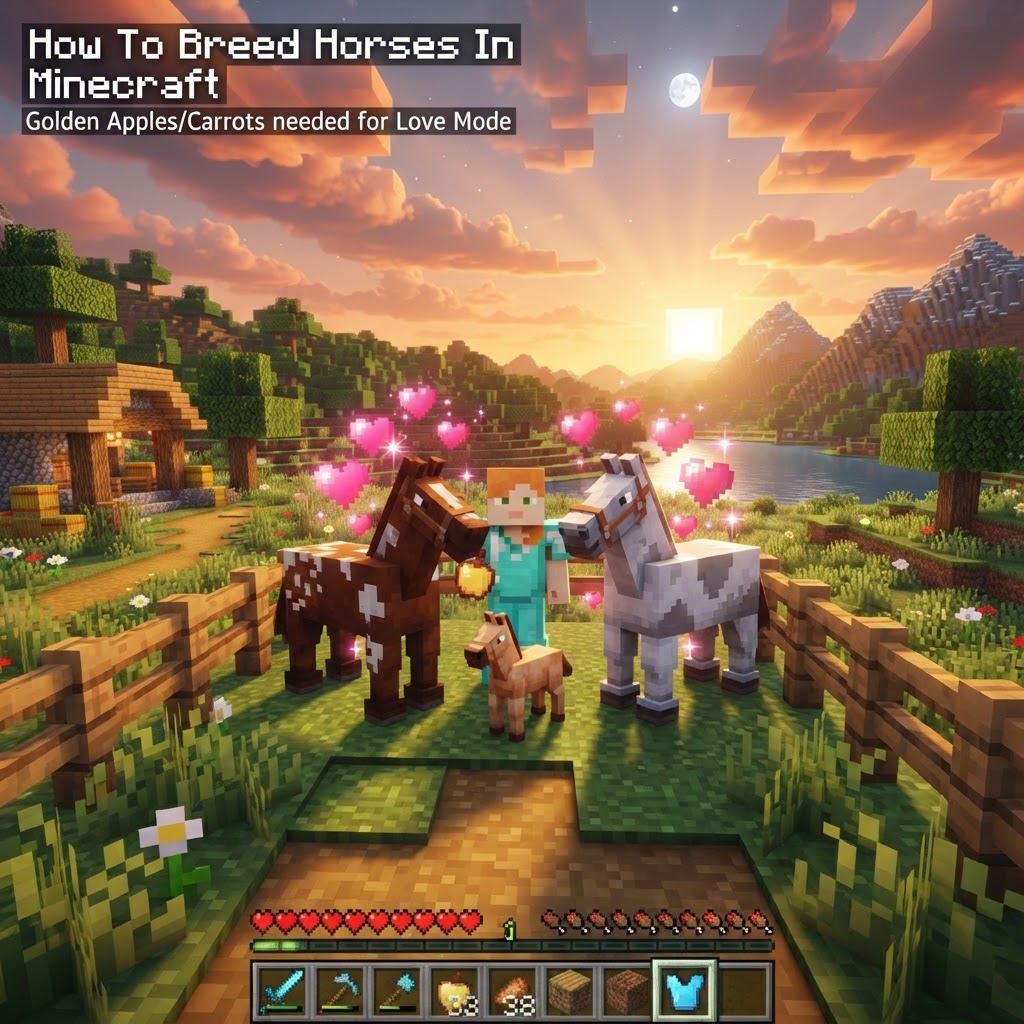
How to Breed Horses in Minecraft: Get Fast, Strong Foals
Breeding horses in Minecraft isn't just about making baby animals — it's about building a stable of fast, high-health mounts that can actually carry you across your world without dying to the first skeleton you encounter. Most players settle for whatever wild horse they tamed first, not realizing that selective breeding can produce foals dramatically superior to anything spawning naturally. If you want a horse that outruns phantoms, survives combat, and jumps over walls, this guide is built for you.
What You Need to Breed Horses
Get these items ready before you waste time chasing horses across plains biomes.
Breeding horses requires Golden Apples or Golden Carrots — and nothing else will work. Wheat, hay bales, regular apples? Those help with taming speed and healing, but they will not trigger love mode. This is the single most common reason players think breeding is "broken."
Breeding Item Comparison:
| Item | Triggers Breeding | Speeds Taming | Restores Health | Crafting Cost |
|---|---|---|---|---|
| Golden Apple | ✅ Yes | ✅ Yes | 10 HP | 8 Gold Ingots + Apple |
| Enchanted Golden Apple | ❌ No | ✅ Yes | 10 HP | Not craftable (loot only) |
| Golden Carrot | ✅ Yes | ✅ Yes | 4 HP | 8 Gold Nuggets + Carrot |
| Regular Carrot | ❌ No | ✅ Yes | 3 HP | N/A |
| Wheat | ❌ No | ✅ Yes | 2 HP | N/A |
| Sugar | ❌ No | ✅ Yes | 1 HP | N/A |
|---|
Golden Carrots are almost always the better choice. Eight gold nuggets cost far less than eight gold ingots, and since one ingot breaks into nine nuggets, you're spending roughly one ingot per carrot versus eight ingots per apple. When you're doing selective breeding across dozens of generations, that cost difference is enormous.
Taming Horses First
You can't breed what you haven't tamed — here's how to do it fast.
Both horses must be tamed before breeding works. Untamed horses will simply run away when you try to feed them. Taming is based on a hidden "temper" stat (0–100), and each time you mount and get bucked off, the horse's temper increases by 5. Once it reaches the threshold (usually around 95–100), the horse accepts you.
Steps to tame a horse efficiently:
- Approach the horse with empty hands or hold food.
- Right-click to mount — no saddle needed for taming.
- Get bucked off repeatedly. Don't run away; immediately remount.
- Feed the horse Golden Carrots between attempts to raise temper faster and cut taming time roughly in half.
- Hearts will appear once tamed. You'll stay on without being bucked.
- Equip a saddle to control movement (horses can't be steered without one).
- Pen both horses together. Use a fenced enclosure at least 5×5 blocks. Horses that wander too far apart won't interact.
- Feed the first horse a Golden Carrot or Golden Apple by right-clicking while holding the item.
- Feed the second horse immediately after. Both must be in love mode simultaneously.
- Watch for hearts floating from both horses — this confirms love mode is active.
- A foal will appear within 2–3 seconds, standing between the parents.
- Wait out the cooldown. Parents enter a 5-minute breeding cooldown before you can breed them again.
- Health: 15–30 HP (7.5 to 15 hearts)
- Speed: 0.1125 to 0.3375 blocks/tick (roughly 4.7 to 14.2 blocks/second)
- Jump Height: 0.4 to 1.0 blocks per jump (approximately 1.1 to 5.3 blocks high)
- Each stat takes the average of both parents' stats
- Then adds a third value pulled randomly from the full stat range
- Divides by 3
The Breeding Process Step by Step
Do this exactly and you'll have a foal within seconds.
Once you have two tamed horses and your Golden Carrots or Golden Apples ready, the process is straightforward — but the setup matters.
The foal will initially be too small to ride. It matures into a full adult after 20 in-game minutes (about 1 real-world minute with no acceleration). You can speed this up by feeding it: each Golden Carrot reduces growth time by 1 minute, Sugar by 30 seconds, and Wheat by 20 seconds.
Understanding Horse Stats and Genetics
This is what separates players who breed randomly from players who build champion horses.
Every horse has three hidden stats that determine its quality:
When two horses breed, the foal's stats are calculated through an averaging mechanic with a random bonus:
This means two high-stat parents significantly improve your odds of a high-stat foal, but there's always variance. It also means breeding two mediocre horses almost never produces exceptional offspring.
Horse Stat Comparison: Wild vs. Selectively Bred
| Stat | Average Wild Horse | Top Wild Horse | Selectively Bred (Gen 3+) |
|---|---|---|---|
| Health | ~22 HP | 30 HP | 26–30 HP consistently |
| Speed | ~0.22 b/t | 0.3375 b/t | 0.28–0.34 b/t |
| Jump Height | ~0.6 blocks | 1.0 blocks | 0.75–1.0 blocks |
The practical takeaway: start with the two best wild horses you can find, then breed them. Use the foal that shows the best stats and breed it back with another high-stat horse. By generation three or four, you can reliably produce horses that outclass anything spawning naturally.
To check a horse's stats without mods, mount it and observe: top-speed horses visually feel much faster, and you can measure jump height against known block structures. Mods like Horse Stats Vanilla display exact numbers, which is invaluable for serious selective breeding.
Common Mistakes Players Make
Stop sabotaging your own breeding program.
Using the wrong food. As covered above, non-golden food simply doesn't work for breeding. Players waste wheat and regular carrots constantly.
Breeding random horses without checking stats. Grabbing the first two horses you see and breeding them produces average foals. Always tame multiple candidates and identify the fastest, highest-jumping individuals before committing to a breeding pair.
Ignoring the 5-minute cooldown. Players think breeding failed and waste a second item on a horse still in cooldown. Watch for the grey particles that indicate a horse can't breed yet.
Not penning horses properly. Love mode expires after 30 seconds. If your horses are wandering a large field, they may not reach each other in time and the attempt fails silently.
Neglecting health stat. Speed gets all the attention, but a horse with 15 HP dies embarrassingly fast. Balance your breeding goals — a fast, fragile horse is a liability in hostile territory.
Releasing foals before they mature. Players sometimes open pens while foals are present and lose them. Always wait for full growth before moving horses.
Pro Strategies for Elite Horse Breeding
Advanced techniques for players who want the best mount in their server.
Run a generational breeding log. Keep a book and quill or a simple chest-naming system to track which horses came from which parents. It sounds excessive until you accidentally breed two siblings and waste five generations of progress.
Use a dedicated breeding stable. Build separate stalls for your breeding stock, active mounts, and foals. Mixing them leads to confusion about which horses have been evaluated and which are still maturing.
The "third horse" technique. When selecting your best foal to advance to the next breeding generation, always keep the second-best foal alive. If your champion horse dies or gets lost, you don't have to start over.
Prioritize speed above other stats for open-world travel, jump height for obstacle-heavy terrain. A horse that clears 5-block jumps is often more practically useful than pure speed when navigating mountains or fortress walls. Decide your use case before you start breeding toward a stat.
Breed during downtime. The 5-minute cooldown is real time, not game time. Queue up multiple pairs if you have the breeding stock — four pairs breeding simultaneously means four foals to evaluate instead of one.
Consider mule breeding for storage builds. A Donkey + Horse = Mule, which inherits some horse speed stats but can carry a chest. Breed a fast horse with your best donkey for a mule that actually moves at a reasonable pace. Mules themselves cannot breed, so keep the parents.
Conclusion: Build Your Breeding Program with Intent
Random breeding gets average results. Selective breeding gets champions.
The core takeaways: use Golden Carrots (not apples, not wheat), tame both horses before attempting to breed, understand that foal stats average the parents plus random variance, and always start with the best wild horses you can find. The players who end up with genuinely elite mounts aren't lucky — they're running intentional generational programs starting from high-stat wild candidates.
Your immediate action plan: head to a plains or savanna biome, tame six to eight horses, identify the two fastest and highest-jumping among them using visual and practical tests, pen those two together, breed them, evaluate the foal, and repeat with the best offspring. Three to four generations in, you'll have a horse that makes your original mount feel like a slow cow.
The world is big. Get a horse that's actually worth riding.
RELATED ARTICLES
How to Make a Book in Minecraft: Easy Recipe & Uses
You're probably here because you just hit a wall — enchanting, writing, or crafting something advanced — and realized you need books but aren't sure how to get them efficiently. Books are one of Minec...

Featured Minecraft Modpack: Create a World of Industry
If you're ready to transform Minecraft into a fully mechanized industrial playground, this Create modpack guide covers everything you need. You'll learn what makes Create-based modpacks stand out, whi...
How to Make a Blast Furnace in Minecraft: Recipe & Uses
If you've been manually smelting ores one by one in a regular furnace, you're wasting serious time — the Minecraft blast furnace doubles your smelting speed for metals and ores, making it one of the m...
STAY UPDATED
New blog posts, guides, and community tips delivered to your inbox.
No spam. Unsubscribe anytime.
Comments (0)
No comments yet. Be the first to share your thoughts!

